
The fastest way to find cool Twitter pages to follow is to stop scrolling hashtags and start searching by bio keywords, then rank the results by follower count, verification, location, language, and quality. A static "top 50 accounts" list is someone else's taste. Your niche has its own best voices, and you can find them in minutes instead of guessing.
How do you find the best Twitter accounts to follow in any niche?
Search X by the keywords people put in their bios, then filter the results down to the accounts that actually match your niche. Circleboom finds the cool Twitter pages to follow by scanning account bios and historical tweets on X through official, sanctioned APIs, then ranking them so the strongest voices rise to the top.
→ find cool Twitter pages to follow
Why "Best Accounts" Lists Don't Work for Your Niche
Most "cool Twitter pages to follow" articles hand you a fixed list of big names, then move on. That list might be great for general business or general humor, but it rarely matches the exact corner of X you care about, whether that's indie game dev, regional real estate, plant pathology, or B2B fintech.
The deeper problem is discovery itself. X's own search returns tweets first, not accounts, so finding people means digging through a wall of posts. As X explains in its guide on how to find people on X, the People tab favors accounts with complete profiles. It still leans toward big, active names. The quiet domain expert who posts twice a month gets buried.
That is exactly where a lot of strong accounts hide. The best voice in a niche is often not the loudest one. You need a way to search the part of a profile that actually declares a niche: the bio.
A tool like Circleboom's Twitter account lookup reads bio keywords and historical tweets. The accounts that have genuinely built presence around your topic show up, not just the ones trending this week.
Search Bio Keywords, Not Hashtags
Here is the shift that changes everything: bio keywords describe who someone is, while hashtags describe what is happening right now.
When you search a hashtag, you get a feed of moments. When you search bio keywords, you get a roster of people. Someone who writes "climate scientist" or "Web3 founder" or "vintage camera collector" in their bio is telling you their whole identity, not a single post. That signal is far more durable than a hashtag they used once.
Circleboom matches your keyword against both account bios and past tweets across a large historical dataset, which is why it reveals accounts that a live, activity-based search would miss entirely. The result is a list of real people in your niche, not a stream of disconnected posts.
This matters for one practical reason most guides skip: the accounts worth following are frequently the selective posters. A researcher who tweets a sharp thread once a month carries more authority than a content account posting forty times a day, yet only the high-volume account shows up in a recency-ranked feed. Searching bios pulls both into the same view.
How to Find Cool Twitter Pages to Follow in Any Niche
The process, step by step. You log in, run a bio-keyword search, narrow the list with filters, then follow the accounts that pass review.
Connect your X account to Circleboom
- Log in to Circleboom Twitter and connect your X account with official OAuth.

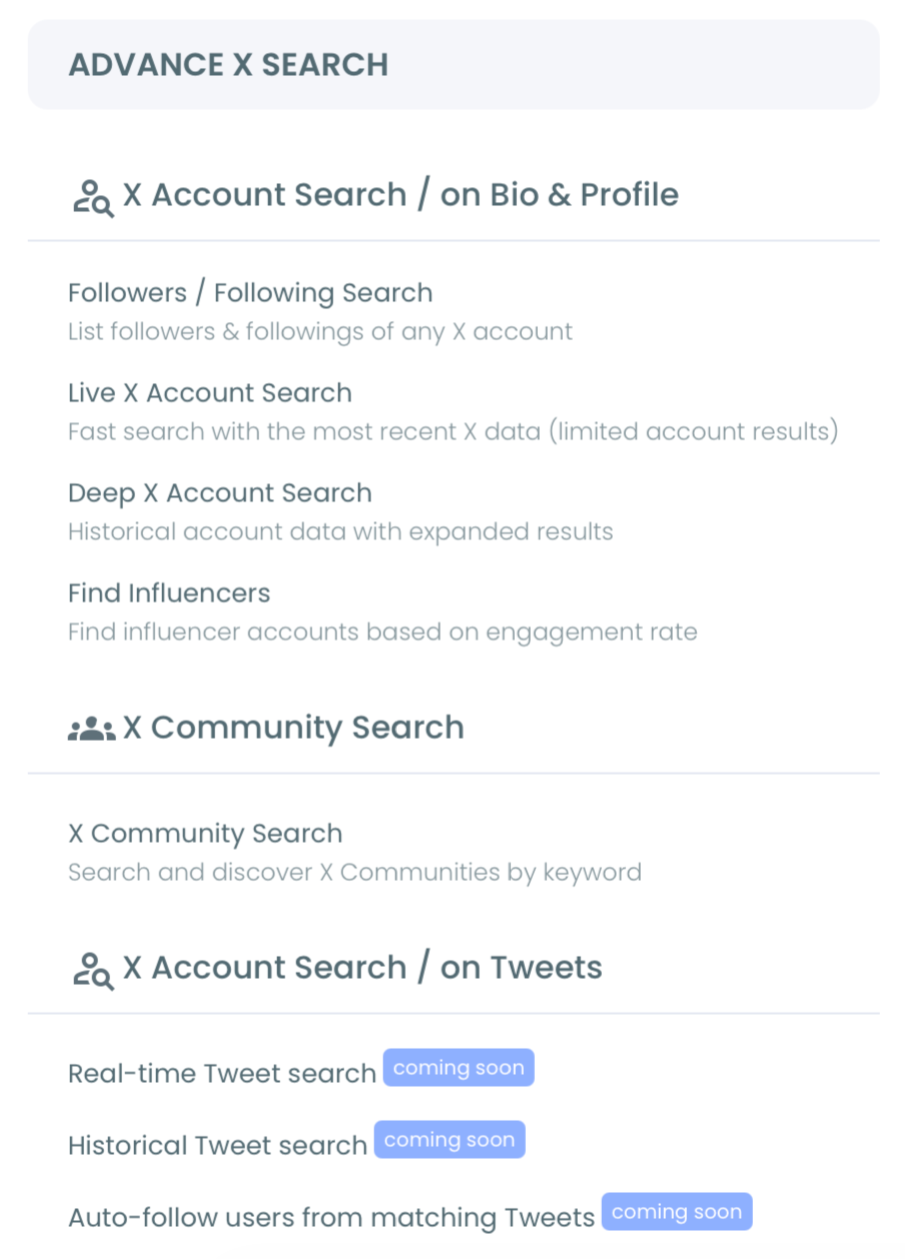
- Open the Advanced X Search menu from the dashboard, where the account-discovery tools live.
Run a bio-keyword search for your niche
- Enter the keyword that defines your niche into Deep X Account Search, using the word people would actually put in a bio, like "UX designer," "sourdough," or "SaaS marketing."
- Let Circleboom scan account bios and historical tweets, which returns a wide pool of relevant accounts ranked in a structured table with follower counts, account age, and activity level.
Filter and rank down to the best accounts
- Apply filters to narrow the pool, since the raw result can be large and you only want the strongest fits. The filters worth using first are:
- Follower count range, to set the size of account you want.
- Verification status, to show verified voices only.
- Location, to find accounts in a specific city or country.
- Language, to keep results in the language you read.
- Quality signals, to strip out fake, spam, inactive, and egghead accounts.
- Sort the filtered list by follower count or activity, then open the profiles that look promising and follow the ones that genuinely fit your feed.
That sequence works because each stage removes noise the previous one left behind. The login earns official-API access, the bio search casts a wide net, and the filters turn that net into a short, ranked shortlist. Skip the filters and you are back to scrolling.
See it live: searching X bios and profiles by keyword to reveal the targeted accounts behind a niche.
What You Gain From Searching Instead of Scrolling
Searching your way to cool Twitter pages to follow gives you a feed built on intent, not luck. Instead of a generic "follow these 50 people" list, you get accounts chosen by your own criteria: your niche, your preferred account size, your language, your region.
The quality lift is the real payoff. When you filter out spam, inactive, and bot-like profiles before you follow, your timeline fills with signal. A creator who removes low-quality accounts from a discovery pool ends up with a feed that actually teaches them something, which is the entire point of following anyone.
A repeatable method beats a one-time list
There is a compounding benefit too. The bio-keyword method is repeatable. Run it for "AI ethics" today, "design systems" next month, "local journalism" after that, and each search builds a fresh, ranked roster on demand.
You can also search Twitter bios and profiles for a specific phrase when you want to match exact wording. And when you want the high-reach accounts in a space, the dedicated path to find Twitter influencers does that job directly.
Circleboom runs all of this as an official X Enterprise Developer company. The data comes through sanctioned APIs, not scraping, so your account stays compliant and safe while you discover. That distinction matters when you are about to follow dozens of new accounts in a session.
For more reading, our roundup of interesting Twitter accounts to follow pairs well with the search method here. So does the guide to the best Twitter accounts to follow for knowledge.
New to account discovery? The walkthrough on how to find the right Twitter profiles to follow covers the basics. And when you only know a name or a topic, the guide on how to find people on Twitter without usernames shows the way in.
Wrapping Up
Finding cool Twitter pages to follow is not about copying someone else's list. It is about searching the bios that declare a niche, then filtering down to the accounts that fit yours. The method takes minutes, it works for any topic, and it reveals the quiet experts the big lists always miss. Run a bio-keyword search, narrow it with the filters, and follow the voices that earn a place in your feed.
→ Start your search for cool Twitter pages to follow
Questions Readers Ask
How do I find Twitter accounts by topic instead of by name?
Search by the keywords people write in their bios. Circleboom's account search scans bios and historical tweets for your topic, so you get a ranked list of accounts in that niche rather than a feed of individual posts.
Can I filter out fake or inactive accounts before I follow?
Yes. The quality filters let you strip out fake, spam, inactive, overactive, and no-photo accounts, so your results only include real, active profiles worth following.
Is it safe to use a third-party tool to search X?
It is safe when the tool uses official access. Circleboom pulls X data through sanctioned, official APIs rather than scraping, so your account stays compliant and you avoid the suspension risk that comes with workaround tools.
What keyword should I search to find the best accounts in my niche?
Use the exact word someone in that niche would put in their bio, like "product manager," "marine biology," or "indie game dev." The more specific the bio term, the tighter and more relevant the ranked results.