
Most advice on competitor top tweets says to sort a rival's posts by likes and study the winner. That gives one answer to a question that has four, because an account's most engaged, most seen, most replied to and most saved posts are often four different tweets.
Which of a competitor's tweets performed best on X?
It depends on the measure. Circleboom lists each compared account's Top 5 tweets on X by engagements, impressions, replies and bookmarks, using data retrieved through official X Enterprise APIs. The four lists often name different posts, and each list answers a different question.
→ competitor top tweets
A single ranking hides the reason a post won. One tweet is displayed to a large crowd and draws almost no response. Another is seen by far fewer people and gets saved by a large share of them. Sorting by likes files both under the same heading, or misses them entirely.
Circleboom's benchmark report ranks a rival account's tweets on X four separate ways, so you can read a rival's best-performing tweets by what each post did.

Four leaderboards, four questions about a competitor's top tweets on X
Each leaderboard answers one question about the audience you share with a rival. The four lists sit together in the report's Content Leaderboards section, one column per compared account.
| Leaderboard | Question it answers | What the ranking counts |
|---|---|---|
| Top 5 by engagements | What earns interaction? | Likes, reposts, replies, quotes and bookmarks combined |
| Top 5 by impressions | What travels? | Times the tweet was displayed |
| Top 5 by replies | What starts conversation? | Replies to the tweet |
| Top 5 by bookmarks | What gets kept? | Saves of the tweet |
The rule: a tweet that appears on only one list answers only that list's question.
A tweet that leads on impressions alone tells you about distribution and nothing about response. One that leads on bookmarks alone tells you about reference value and nothing about reach. A tweet that shows up on three or four lists is the rare all-round winner, and it deserves the closest read.
Here is an illustrative case. A rival's product announcement sits only on the impressions list. Their step-by-step thread sits on both engagements and bookmarks. A tweet that ends on a question sits only on replies.
Those are three lessons, and a likes-only sort would have blended them into one: announcements travel, walkthroughs earn action and saves, questions earn talk.
Why five tweets per list and not one
Five tweets per list turn a competitor's top tweets from a single anecdote into a small sample. One winner cannot show a pattern. Five can, because you can count how many of them share a topic or a format.
The report keeps the same count for every account in the comparison, yours included when you add it. That makes the lists comparable: five of theirs against five of yours, ranked on the same measure and pulled on the same date.
Top 5 by engagements: what earns interaction
The engagements leaderboard shows each account's 5 highest-engagement tweets in the analyzed window. Engagement is a combined count, so two tweets with the same total can have won in different ways.
Look at the mix behind the total. A leader carried by reposts was shared. A leader carried by replies was argued with or answered. If several of a rival's five engagement leaders share a theme, such as behind-the-scenes posts about how their product is built, that theme is what the shared audience rewards.
Top 5 by impressions: what travels
The impressions leaderboard shows each account's 5 most-seen tweets. These are visibility leaders. Among a competitor's top tweets, they are the ones that tell you which topics move beyond the account's usual circle.
A rival whose widest-reaching tweets all cover industry news has shown you that timely takes travel in your niche. That is a statement about reach. Whether those tweets also drew a response is a separate check against the engagements list.
Top 5 by replies: what starts conversation
The replies leaderboard shows each account's 5 tweets with the most replies. It identifies conversation-heavy tweets, and it needs one extra step that the other lists do not: reading the replies themselves.
Reply volume is not approval. A tweet can top this list because people asked questions, and it can top it because people objected. If a rival's most-replied tweets ask for opinions, an open question on the same theme is a fair test for your own account.
Top 5 by bookmarks: what gets kept
The bookmarks leaderboard shows each account's 5 most-bookmarked tweets. Saving is a private act, so this list often holds tweets that never looked like winners in public. A later section covers how to read a saved-but-not-liked tweet.
Why is a competitor's most seen tweet on X not their most engaged tweet?
A competitor's most seen tweet and most engaged tweet differ because the two numbers count different events. An impression is a display. An engagement is an action taken by someone the tweet was displayed to.
X's metrics documentation defines impressions as the count of times a post appeared on a user's screen. It adds that the count is not unique, so the same person viewing a post twice counts as two impressions.
That definition explains the gap. A tweet about breaking news can be displayed again and again as people refresh a busy timeline, and most of those displays end without a like or a reply. A narrow how-to tweet is displayed less and acted on more.
Which of the two lists to judge a rival by
Choose the list that matches your question:
- For awareness, start with the impressions leaderboard and inspect the tweets generating exposure.
- For discussion or sharing, start with engagements and replies, then read the responses.
- For overall effectiveness, read both lists together before deciding.
Circleboom's report also joins the two numbers. Its engagement rate is total engagement divided by total impressions, which describes how often people who were shown a tweet interacted with it.
An illustrative calculation shows the logic. Two tweets each earn 1,000 engagements. One did it from 20,000 impressions, a 5% rate. The other needed 100,000 impressions, a 1% rate. The first tweet connected far better with the people who saw it.
When I review a rival, I mark the tweets that sit on both lists first. They were shown widely and acted on, and that combination is the hardest to earn. For background on how these numbers fit a wider tracking routine, see key Twitter performance metrics.
The same split exists in your own account. Circleboom's Impression Analytics is where your own visibility leaders can be reviewed post by post.
What it means when a tweet on Twitter gets saved a lot but liked little
A tweet with many bookmarks and few likes is usually reference content. People kept it to use later instead of reacting to it in public.
Guides, checklists and lists of resources tend to behave this way. A reader who plans to come back to a tweet has little reason to like it, and a like is visible to others while a bookmark is not.
In the report, the Top 5 Tweets by Bookmarks panel places each account's five most-saved tweets in side-by-side columns, with the bookmark count beside every tweet.
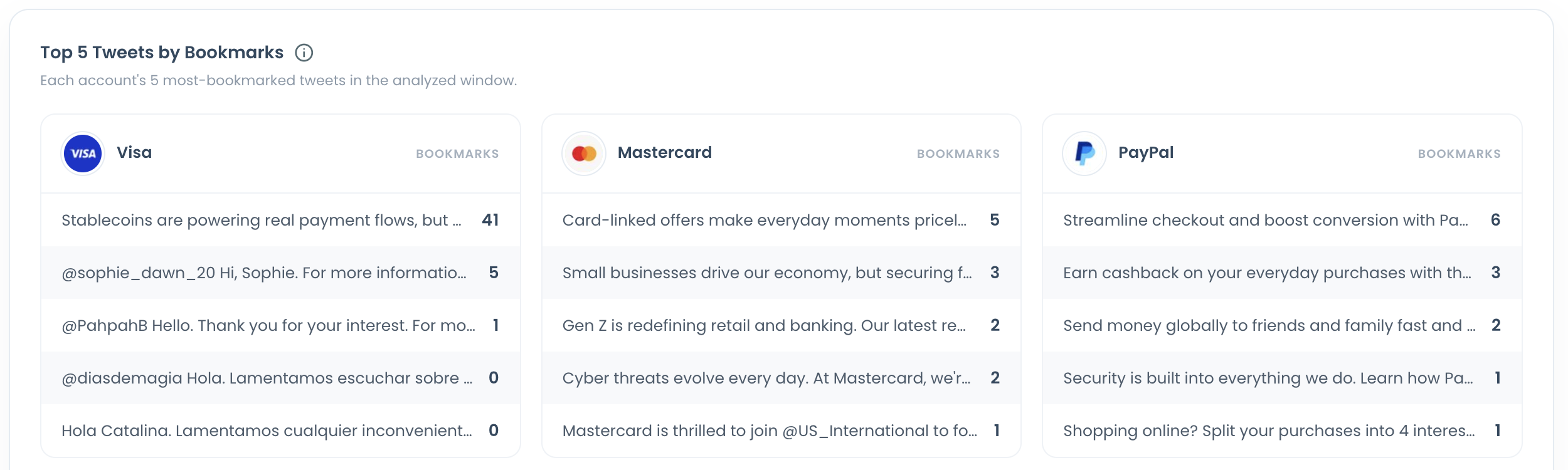
Why the bookmark list finds tweets the other lists miss
The bookmark leaderboard brings up reference-style content that never appears in the engagement top five. That is the product behavior worth knowing: a rival's most useful tweet, by the audience's own filing habits, can be absent from every public-facing ranking.
Two cautions apply. A bookmark count shows saving behavior and does not reveal why each person saved the tweet. And bookmark totals are usually small next to likes, so inspect the substance of the tweet before you credit its format.
What to do with a rival's most-saved tweets
Treat a rival's bookmark leaders as a list of problems the audience wants solved. Of all the competitor top tweets in the report, these are the closest thing to a reader request. Then check your own side. If you want to see your most bookmarked tweets, compare their subjects with the rival's five.
Saved tweets also age differently. A reaction to this week's news fades, while a checklist stays useful, which is the idea behind what an evergreen tweet is. Turning your own tips into threads or checklists is how you earn the same kind of save.
Where the four leaderboards sit in Circleboom's X competitor report
The four leaderboards are part of Circleboom's X Competitor Analysis & Benchmark Report, a 9-section report that sets up to 5 X accounts side by side. You can include your own account plus up to 4 competitors, or compare up to 5 other accounts.
A ranking depends on having every post in the pile. Circleboom is listed in X's Enterprise customer directory and retrieves each account's recent tweets through X's official API.
That is why the five on top can be trusted to be the five on top. Tools that collect by scraping can return an incomplete set.
With Circleboom, you can compare a competitor's top tweets with your own in one dated report, read on the same basis for every account.
Setup is short. After you log in to Circleboom, the report is the first item under the Monitoring menu. You enter the handles, start the analysis and choose between a single report and one that repeats every month.
The two panels next to the five-tweet lists
Two more panels complete the section. The top tweet head-to-head places each account's single best tweet in one row with engagements, impressions, replies and bookmarks beside it, which puts the ceiling of each account in plain view.
The under-performers panel lists each account's lowest-engagement tweets. Its use here is contrast. If an account's weakest tweets share a feature with its strongest ones, that feature explains neither.
The window every ranking is drawn from
Every leaderboard ranks tweets inside the analyzed window, which holds up to about 3,200 recent tweets per account. X's own timeline volume limits give 3,200 most recent posts as the maximum for a user's posts timeline.
So best always means best within that window. A frequent publisher's window covers a shorter period than an occasional publisher's, and a tweet from years ago can sit outside it.
Side trip for the full list: every recent tweet of a public account downloaded into one file, the same kind of window the leaderboards rank.
How to read a top tweet on X before you borrow from it
Read a top tweet on four points, then test whether it is a pattern:
- Topic: what the tweet is about.
- Format: text, image, video or poll.
- Context: when it was posted and what was happening.
- Interaction mix: which response carried it.
Treat a leader as study material. It guarantees nothing. Before any of the competitor top tweets in front of you becomes a template, check whether its traits appear elsewhere in the same account's leaders.
Your own leaders are the second half of the comparison. In Circleboom, Twitter engagement analytics is where your account's strongest tweets can be inspected in full.
If likes are the only measure you need for your own account, a single lookup will do, and you can see your most liked tweets without a comparison.
When the pattern is clear, write your own version in your own voice. Circleboom's tweet inspiration page helps with that step, and copying a rival's wording does not.
What a Twitter leaderboard cannot tell you about a rival
A leaderboard reports observed results on a dated sample. It does not explain them, and three limits are worth keeping in view:
- No list shows profile visits or URL clicks for a rival, because those metrics belong to an account's owner.
- A ranking shows that a tweet won, never why. Timing, a repost from a large account or the topic of the week can each be the cause.
- Running the report again refreshes a rolling sample, so a tweet can drop off a list because newer posts arrived.
None of this weakens the lists. It sets the strength of the claim you can make from them. A rival's top tweets are evidence of what an audience responded to during the window, and that is a solid base for a test in your own account.
A short checklist for your next look at a rival's best tweets on Twitter
Use these five checks the next time you study a competitor's best tweets:
- Name the question first: interaction, reach, conversation or saves.
- Open the list that answers that question before any other.
- Mark every tweet that appears on two or more lists.
- Read the replies before counting a most-replied tweet as a success.
- Check a winner's traits against the other four leaders on its list.
One most-liked tweet is a guess. Five tweets on each of four lists, for every account you compare, give you something you can defend when someone asks how you chose your next topic.
→ Open the leaderboards for your competitor's top tweets
Top tweets FAQ: leaderboards, limits and saves
Which accounts can I add to a top tweets comparison?
Any public X account with 3,000,000 followers or fewer can be added. Private accounts cannot be analyzed, and the follower ceiling applies to every column of the report, including your own account.
Can I get more than a competitor's five best tweets, with numbers for each?
Yes, with a separate export. Circleboom's Export Tweets downloads up to 3,200 tweets from a public account as a CSV file that includes impressions, likes, retweets, replies and bookmarks for each tweet. You can then sort the whole file by any of those columns yourself.