
Every dormant account in your following list holds a slot in a public number and sends nothing to your feed, and X will not hand you a list of them. The count you are after depends entirely on whose definition of inactive you read it against.
Circleboom sorts every account in your following list into one of three activity bands, Active, Moderate Active, or Inactive, by reading account age and lifetime tweet frequency through official X Enterprise APIs. The Inactive Following view returns the count and the accounts behind it in a single sortable table.
→ See how many accounts you follow are inactive
The number shifts depending on which definition produced it, which is worth understanding before you unfollow anybody.
How to check how many accounts I follow are inactive on X
The flow below moves from reading the list to acting on it, and the reading half matters more than the acting half.
Screen recording: the bulk unfollow running in metered batches, the single step in this flow that alters anything on your X account.
https://www.youtube.com/watch?v=Y5qZYxld4VM
Pull the list X never assembles for you
- Log in to Circleboom Twitter and grant read access to the account whose following list you want examined, through official OAuth.

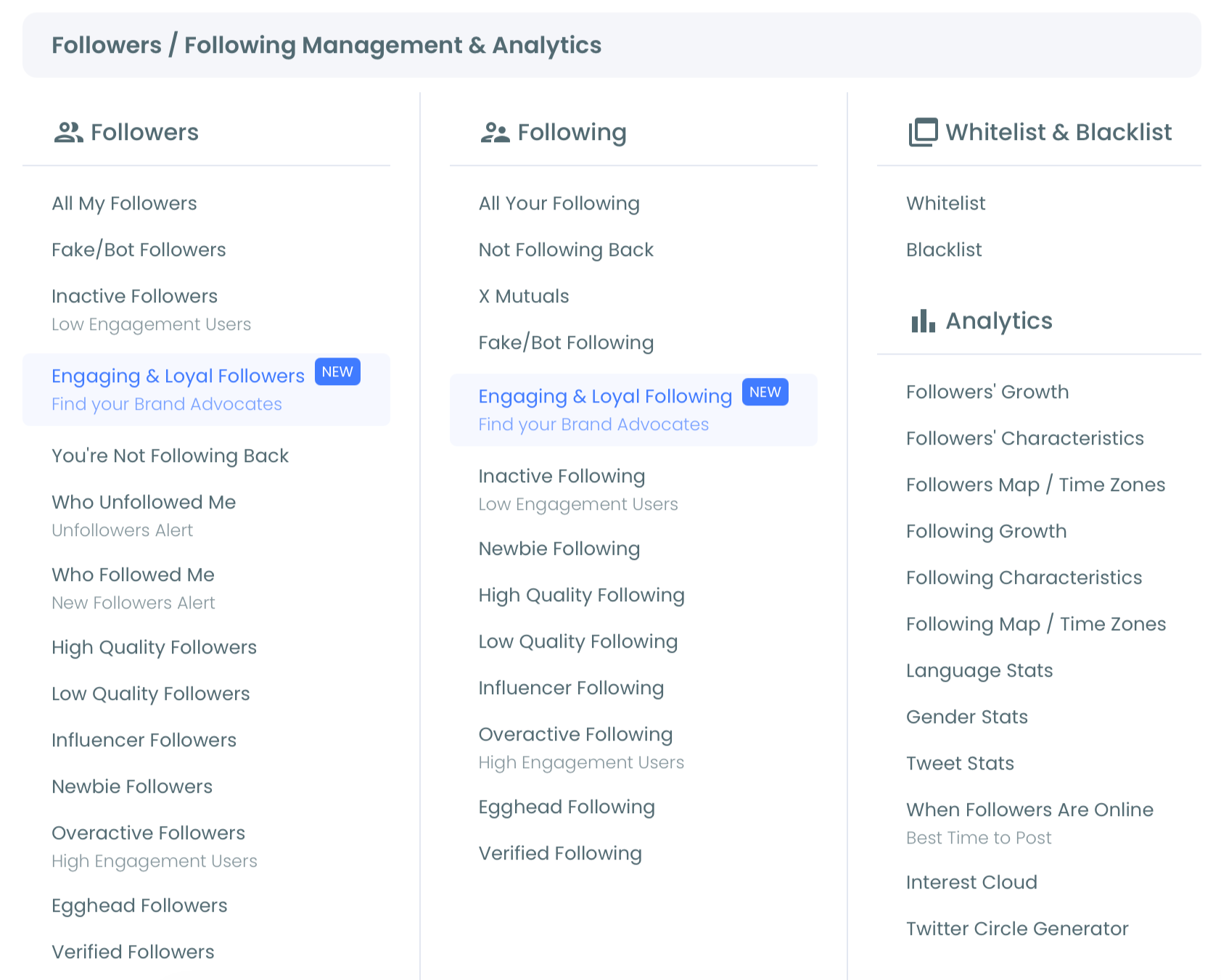
- Follower / Following Management and Analytics is the menu to open. Inactive Following waits in its Following group.
Read the classification before you trust the total
- Check the Active & Inactive column on each row. It carries one of three labels: Active/High Engagement user, Moderate Active/Medium Engagement user, or Inactive/Low Engagement user.
- Sort by the Tweets column ascending so the most dormant accounts surface first. Clicking a column sorts ascending, and clicking again sorts descending.
- Open Filter Options and narrow the segment using Join Date, Tweet Count, and Follow Ratio, so the accounts you are about to judge share more than one weak signal.
Protect the quiet accounts that still earn their place
- Whitelist the low-frequency accounts you want to keep using the shield icon or the Add to List dropdown. The shield label carries across every Circleboom feature and lifts those accounts out of bulk actions entirely.
- Select the remaining rows and run Unfollow. Circleboom meters the work at 50 unfollows inside each 15-minute window, capped at 800 daily, then carries any remainder into tomorrow without being asked.
That ordering earns its place because every step shrinks the risk carried by the next one.
The classification tells you where to look, the filters tell you which accounts fail on more than one count, and the whitelist makes the protection permanent before anything irreversible runs.
At a glance: connect, open Inactive Following, read the band, filter, whitelist, unfollow.
What inactive is actually measured from
Inactive is a threshold on observable behavior, not a status X publishes. That distinction is the whole reason two honest tools can hand you two different numbers for the same following list.
X's own inactive account policy defines the term by sign-ins. It states that inactivity is based on logging in, and asks for one sign-in in any rolling 30-day period.
The same page adds the part that matters for anyone counting from the outside. It warns that some activity leaves no public trace at all, which puts a definitive answer beyond reach for anybody who is not X.
So X's definition exists, and nobody outside X can measure it.
What is public is posting.
Circleboom's classifier reads two signals from that public record. Account Age is how long the account has been on X. Tweet Frequency is total tweets across the account's lifespan.
The same evaluation weighs accounts that have gone a year without meaningful activity, and accounts that post sporadically without any consistent engagement pattern.
Why an independent study reaches for the same measure
Pew Research Center arrived at the same shape of measure without any product to sell. Its study of Twitter lurkers defined a lurker as someone averaging fewer than five tweets per month since first opening their account.
Among U.S. adult Twitter users in that research, 49 percent, close to half, sat below that line.
A lifetime rate, not a recency cutoff. Pew landed there for the same reason Circleboom does: it is what the platform lets an outsider see.
Is a quiet X account the same as a dead one?
No, and treating them as the same is the most expensive mistake in this cleanup. The classifier reads posting, so an account that reads, bookmarks, monitors a niche, or curates without publishing looks identical to one whose owner walked away years ago.
Circleboom's own documentation is direct about the limit: the inactivity classification does not capture whether an account is actively reading, curating, or monitoring without posting.
Official brand accounts, archived reference accounts, quiet analysts, and institutional sources all post rarely and still repay the follow.
That is why the safe first pass is a review, not a purge.
A mirror version of the decision exists on the audience side, laid out in the guide to removing inactive and spam followers on Twitter. There the question is whether to remove somebody, not whether to stop reading them.
What an inactive following costs your timeline
An inactive follow charges you twice and pays you nothing. It inflates your following count, a number visible on your public profile, and it contributes zero posts to the feed you open every day.
Run the arithmetic. Suppose 40 percent of a 2,000-account list has gone a year without meaningful activity. That is 800 slots occupying a public number and producing nothing, leaving a feed assembled from the other 1,200.
Here is the part people get backwards. Clearing that 800 takes nothing away from what you see, because none of it was arriving anyway.
It frees room for the accounts that do post to appear more often, and it lets you follow new active accounts without pushing your total higher.
Start by opening the view that counts them. The Inactive Following view for your own account gives you the total and the rows behind it before you decide anything.
If a broader read of your list is what you want, Twitter follower quality and following quality scores both sides on the same scale.
The three bands, and where the judgment calls live
The Active & Inactive column is not a yes-or-no flag. It returns Active/High Engagement, Moderate Active/Medium Engagement, or Inactive/Low Engagement, and the middle band is where almost every real decision sits.
An account in the middle band is posting, just not often or not with any pattern the classifier can read as engagement. Some of those accounts are seasonal. Some are institutional. Some are on their way out and have not finished leaving.
The table gives you what you need to tell them apart:
- Tweets shows lifetime volume, which only becomes meaningful once you read it against Joined.
- Joined shows account age in days, so a thin tweet count on a young account reads nothing like the same figure on a decade-old one.
- Follow Ratio separates an institutional source with an inbound-heavy audience from an abandoned personal account.
- Follower Quality exposes each account type on its own control, so inactivity stays separated from authenticity rather than blended into one score.
Protected accounts deserve a second look, since most of what they do is invisible to anyone outside their approved followers.
The two-signal rule for the middle band
The rule that has held up: unfollow on two weak signals, never one.
Inactive plus non-reciprocal is a case. Inactive plus a bio that no longer matches anything you cover is a case. Inactive on its own is a prompt to look, not a verdict.
The two-signal discipline shows up again in how to remove inactive Twitter accounts.
When the accounts you are weighing never followed you back either, accounts not following back isolates that overlap directly. Stacking the two filters usually shrinks the candidate set faster than any single quality threshold does.
Where the dormant follows in your list came from
Dormant follows accumulate through ordinary behavior, not carelessness, which is why the layer is usually larger than people guess.
Event and campaign follows are the densest source. You follow thirty accounts during a conference week, the event ends, and most of them drop back to a baseline posting rate of near zero. Nothing went wrong; the connection simply had a shelf life.
Courtesy follow-backs are the second source. Somebody followed you, you followed back, and their account went quiet a year later without either of you noticing.
Then there is plain attrition. People move platforms, change habits, or go quiet for reasons that are nobody's business, and any list left untouched for three or more years carries a dormant layer built purely by drift.
The practical consequence is that this cleanup is periodic, not one-off. Running it right after a launch or a conference catches the residue while you still remember who those accounts were and why you followed them.
The field guide on how to unfollow inactive Twitter accounts treats the job as maintenance rather than a single purge, which is the right frame for a list that keeps drifting.
Doing it without putting the account at risk
The retrieval and the unfollow go through the same door. Circleboom is an official X Enterprise Developer company, so both halves of this run under sanctioned access, at the platform's own pace rather than around it.
That pacing is not decoration. The throttle sits at 50 actions per quarter hour and 800 in a day, and the guidance is to work far under it.
Batches of roughly 100 to 150 keep a large cleanup looking like a person making decisions rather than a script emptying a queue.
Open the audit first and let the classification answer how many accounts I follow are inactive while nothing is selected yet.
Two constraints are worth internalizing before you select anything. Unfollowing cannot be reversed automatically through Circleboom, and an unfollowed account can still follow you and interact with your posts, because unfollow is not a block.
If you want a record of the segment before it goes, the Export button writes the filtered rows to CSV and shows the remaining token balance on the button itself.
The batching approach in remove fake and inactive Twitter accounts covers the same gradual pattern in more detail.
What actually matters here
Over the next quarter, the number you care about is not how many accounts you follow. It is how many of them are still writing.
Those two figures come apart quietly. One sits on your public profile and only ever climbs. The other is what your feed is actually assembled from, and nothing on X displays it.
Three months on, the change you notice will not be a shorter list. It will be that the accounts you kept show up more often, because the slots around them are no longer held by accounts that were never going to post.
Pull the current reading before you plan the next one: check which accounts you follow have gone inactive and start from a real number rather than an impression.
What people ask about the inactive accounts you follow
Will unfollowing inactive accounts change what shows up in my timeline?
Not in the way people expect. Accounts classified as inactive were contributing little or nothing to your feed already, so removing them takes almost nothing away and leaves more room for accounts that post regularly to appear.
How long does it take to unfollow a few thousand inactive accounts?
Not in one sitting. The 15-minute allowance is 50 and the daily one is 800, so a backlog of 2,000 clears over roughly three days, with the queue resuming each morning on its own.
Why does the same account read as inactive in one tool and active in another?
Because inactive is a threshold somebody chose, not a status X publishes. X defines it by sign-ins, which are private, so anything measuring from outside has to work from posting instead and pick its own cutoff. Circleboom reads account age against lifetime tweet frequency, so an account that posted heavily for years and then stopped lands differently than it would under a recency-only rule.