
You opened your blocked accounts page, scrolled for a while, and gave up somewhere in the middle. X prints no total anywhere on that screen, which is why the question has no answer inside the app.
The block list was built to be browsed one account at a time, not counted.
What this guide gives you.A real count of the accounts sitting on your X block list.A breakdown of that total by account type, join date, and quality signal.A safe path to reversing the blocks that no longer make sense.
Circleboom retrieves every account you have blocked on X and renders the whole block list as one sortable table you can filter, count, and act on. Check how many people I have blocked on Twitter before you decide anything about it.
How to find out how many people I have blocked on Twitter
Eight moves, and their sequence carries most of the value.
Load the block list as a table instead of a scroll
- Log in to Circleboom on the handle whose block list you intend to read.
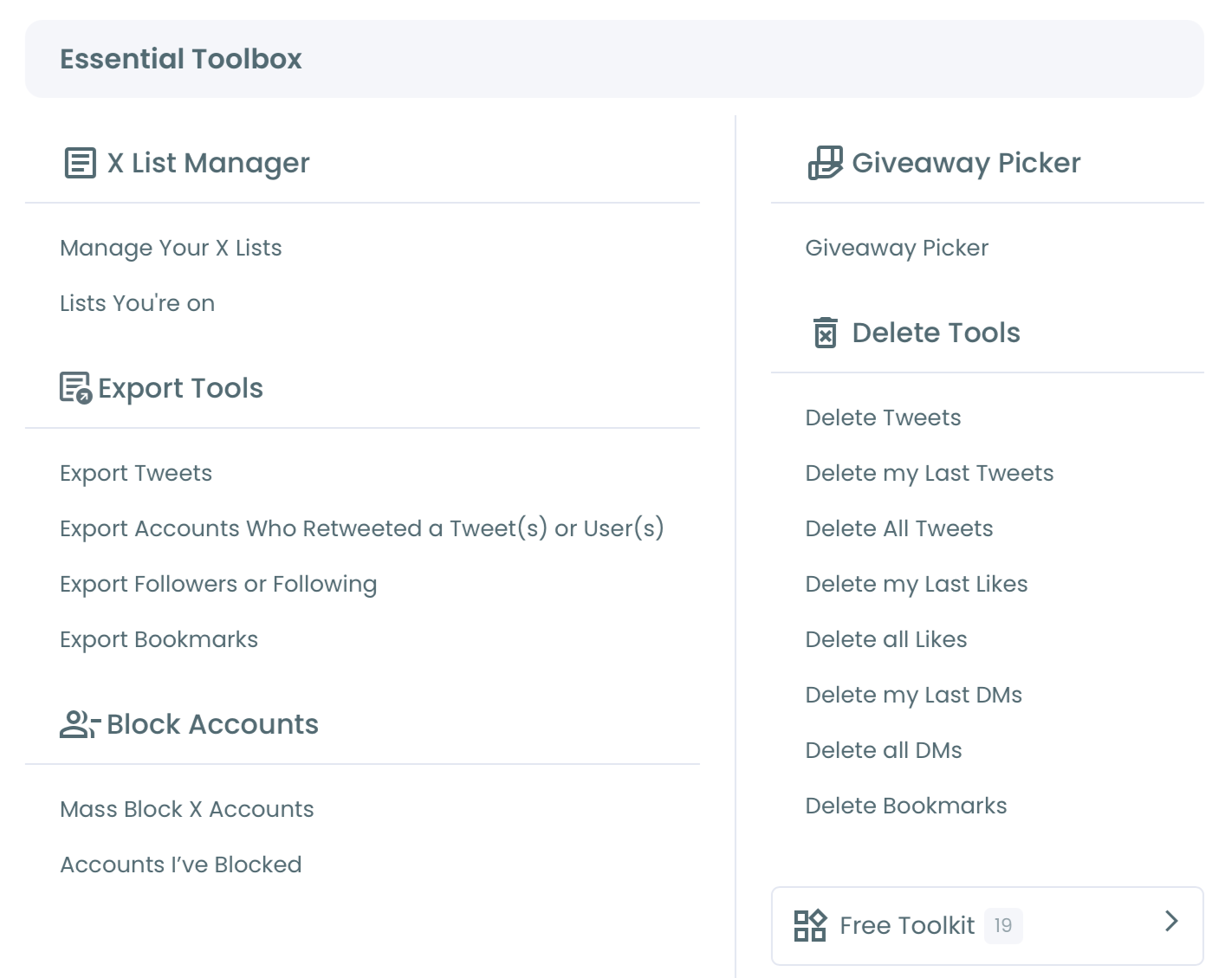
- Head into Essential Toolbox, then the Block section, then Accounts I've Blocked.
- Read the page header. The screen is titled Manage Your Blocked Accounts, and every blocked account arrives as a row with real profile data attached:
- Name, with the @username and the profile location.
- Tweets, the account's total post count.
- Joined, the date the account was created.
- Following and followers, plus the follow ratio between them.
- Active and inactive, Circleboom's engagement classification for that account.
Turn one long list into numbers you can read
- Check the pagination control at the bottom of the table. It reports a total for the entire result set rather than the current screen, which is where your block count actually becomes readable.
- Open Filter Options and apply one quality filter at a time. Pagination recalculates against the whole filtered set, so each filter gives you a subtotal rather than a guess.
- Set a Join Date range to separate blocks you applied years ago from the ones you applied last month.
Keep a record before you reverse anything
- Export the filtered list as a CSV. The export is token-based and consumes search tokens from your plan, and it gives you an exact row count plus a permanent copy of the current state.
- Select the rows you want to reverse and use Unblock Users, or click the per-row unblock icon on a single account.
Sequenced that way, every step removes ambiguity before it removes rows.
Counting first tells you the scale of the problem, filtering tells you what kind of problem it is, and exporting means that whatever you unblock next is recoverable as a record even though the unblock itself is not.
Quick recap:
- Connect the account and open the block list.
- Read the pagination total for the raw number.
- Filter to produce subtotals by type and by date.
- Export, then unblock only what the subtotals justify.
On screen: the whole blocked-account table loading in a single view, with row data attached instead of an endless scroll.
Why X never shows you the number
X treats the block list as a safety setting, not as a dataset. Its own documentation for managing your block list describes two views, All and Imported, plus a per-account unblock button. There is no count, no sort, no filter, and no export.
The Imported tab is worth pausing on. It holds accounts that landed on your list because you imported someone else's block list, which means part of your total may reflect a judgment that was never yours.
Most people who go looking for this number are not curious. They are trying to decide something:
- Whether a cleanup went too far.
- Whether an old conflict is still costing them reach.
- Whether a mass block from a bot wave caught real accounts along the way.
None of those decisions survive a scroll. You need the count first, then the shape of it. That is the reason to check your blocked Twitter accounts in a view that can do arithmetic.
The native screen still has one job worth knowing. It is where you confirm a specific account's status before you reach for a tool at all. For that, how to view a list of people that I have blocked on Twitter covers the settings path on both desktop and mobile.
What the composition of your block list is telling you
The total is the least interesting number on the page. What the block list actually reports is the accuracy of every filter you have ever pointed at your audience.
Circleboom's Filter Options panel on the blocked accounts view carries the same criteria used across the platform, and each one converts the block list into a different subtotal.
The three subtotals worth pulling first
Run these three filters in sequence and read the pagination total after each one:
- Fake and spam. A high share here means your past blocks were aimed at the right targets.
- Verified. A meaningful count of verified accounts on a block list is unusual and worth reviewing row by row.
- Follower count above a threshold. Set a minimum of a few thousand followers and see who appears.
A concentration of active, high-follower, or verified accounts in your blocked list is evidence that the criteria behind an old mass block were too broad.
That is a feedback loop most people never close. A campaign built on a follow-ratio threshold or an egghead filter will catch some legitimate accounts along with the intended ones. The block list is the only place that miss ever becomes visible.
The same logic applies in the other direction, before you block anything. Targeting guides like how to block Twitter bots spend most of their words on the selection step rather than on the action itself, for exactly this reason.
There is a useful sanity check hiding in the follow ratio column. Bot and spam accounts cluster at the low end, following thousands while being followed by almost nobody. A blocked account with a healthy ratio and a real posting history probably arrived on the list through a filter rather than through a decision.
The profile data attached to each blocked row is the same data X holds, not a scraped approximation of it. As an official X Enterprise Developer company, Circleboom retrieves your block list under the same access tier it uses everywhere else on the platform.
When a long block list is fine and when it is a problem
A big block list is not automatically a bad one. Someone who has been posting for a decade in a contested niche will have blocked hundreds of accounts for entirely sound reasons, and shrinking that number for its own sake is a mistake.
The question is whether the list still reflects decisions you would make today.
Three patterns suggest it does not:
- Blocks applied during a single event, where the event has long since ended.
- Blocks inherited from an imported list you never reviewed.
- Blocks applied by filter rather than by judgment, where the filter was tuned loosely.
A block list that grew from one bot wave is a different object from one that grew across ten years of individual decisions. The first is a snapshot of a moment. The second is a genuine boundary, and it should mostly stay where it is.
Reading the join dates tells you which one you have. If most of your blocked accounts share a narrow creation window, you are looking at a network rather than a history. Guides on batch blocking Twitter followers describe how those clusters form in the first place.
Once you know how many accounts I have blocked on X, you can decide which of the three patterns you are dealing with in about five minutes.
Is it safe to unblock accounts in bulk on X?
Yes, with two constraints that change how you should plan the session.
Reversing one account is immediate and needs nothing installed. The per-row action goes straight through the official API, so a single click undoes a single block.
Doing it in bulk works differently.
That path runs inside a desktop Chrome add-on built for mass unblocking, which is not the one used to apply mass blocks in the first place. Circleboom stages your selection, hands the queue over, and each row is processed in turn.
Rate limits apply exactly as they do to blocking. When the quota is reached the process pauses on its own, typically for somewhere between 1 and 20 minutes, then resumes. Your browser and the extension both have to stay open for the whole run.
The safety question that matters more is what unblocking restores. A reversed block returns that account's ability to see your posts, follow you, reply, and send you messages. It takes effect the moment the extension processes the row, with no grace period in between.
Unblocking is also as irreversible as blocking was. There is no pause button mid-run and no undo afterward, so an account restored by mistake has to be blocked again by hand.
If you need the mechanics of a bulk session, how to mass unblock on Twitter walks through the extension side. You can also run the same operation from the dedicated mass unblock Twitter accounts page.
What your block list will never tell you
No column on that page records why anything is on it.
The block list shows account data and nothing about the decision behind each row. There is no reason field, no timestamp for the block itself, and nothing marking which bulk operation a given row came from.
Join Date records when the account was created, not when you acted on it.
That gap has one practical consequence worth acting on.
The only durable record of a blocking decision is the export you take before the operation runs, not the list you read afterward.
Export the candidate segment to CSV before the extension starts, and that file becomes the audit trail: who was in scope, what quality signals they carried, what the filter had matched.
Do it after the fact and you have a list of the blocked, with no way to reconstruct why. The same discipline is why teams keep exported Twitter account data alongside any bulk moderation run.
For accounts you want to keep blocked but also want to track, the per-row Add to Blacklist action flags them inside Circleboom without changing anything on X. The block stays, and the label carries into every future workflow.
How to use this block list review
Leave the block list unreviewed and it quietly keeps working on your behalf, applying a moderation policy you set under conditions that no longer exist.
Every stale block is an account that cannot see your posts, cannot reply, and cannot follow you, for a reason you can no longer name.
Review it and the cost disappears. You get an accurate count, a breakdown that tells you whether your past filters were sound, and a short list of reversals worth making.
Start with the number, then read the shape of it, then act on the handful of rows that fail the test. Kick off your review here and see everyone you have blocked on Twitter.
Questions people bring to a block list audit
Does unblocking someone make them follow me again?
No. X is explicit that blocking an account you were following makes you unfollow each other, and unblocking does not restore that. If you want the follow back, you have to follow the account again yourself, and so do they.
Can I see how many people have blocked me?
No, and no tool can honestly claim otherwise. X does not publish who has blocked you or how many accounts have, and the only signal you ever get is the notice on an individual profile when you visit it.
Does a large block list hurt my reach on X?
X publishes no penalty tied to the size of your block list, so there is no documented ranking cost to carrying a long one. The real cost is narrower and easier to measure: every blocked account is one that cannot see, reply to, or amplify your posts, so a list padded with legitimate accounts quietly shrinks your addressable audience.