
Most people ask this expecting a number, and there is no number. There is a mechanic, and the mechanic is what quietly breaks almost every repost schedule I have built.
I used to treat a repost the way I treat a post. Fire it, and it counts. That is wrong.
X gives your account exactly one live repost of any given post, and the second one cannot exist until the first one stops existing. A plan that ignores that turns into one repost followed by a long queue of nothing happening.
How many times can you repost the same tweet on X?
As often as you want, but only one at a time. The repost control is a toggle, so an existing repost has to be undone before the same post can be reposted again. Circleboom automates that pair on X as an official X Enterprise Developer company, reposting your tweet and clearing the repost before the next window opens.
→ repost the same tweet more than once
How I repost the same tweet more than once on X
This is the routine I ended up with once the manual version kept collapsing.
Get the post into the editor with the right account connected
- Log in to Circleboom Twitter using the X profile whose reposts you want scheduled.
- Your next stop is the X Post Planner menu. Start a fresh draft there, or reopen something already waiting in your queue.
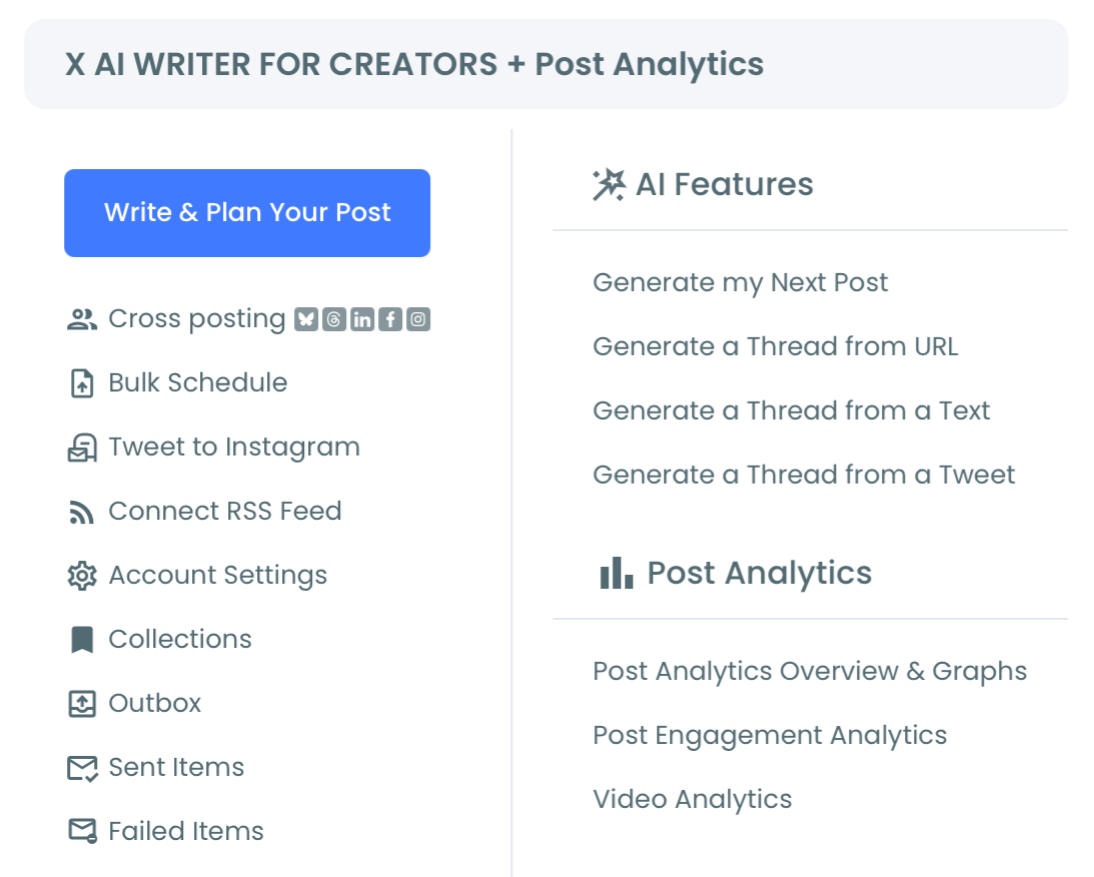
- Write the post, or paste in copy you have already tested. Evergreen material earns a cycle. A reaction to something happening today does not.
Set the pair of delays that makes a repeat possible
- Click the repost icon (the cycle arrows) in the post editor toolbar to open the Auto Repost / Un-RePost panel.
- Check RePost after and set the hours and minutes steppers to the gap you want between publication and the first repost.
- Check Un-RePost after and set how long that repost stays live before Circleboom takes it down. Leave that box unchecked and the repost stays up permanently, which ends the cycle after a single round.
- Set Repeat this cycle to however many windows you want, then publish or schedule the post with the configuration saved onto it.
That order holds up because the un-repost is what frees the toggle. The login earns official API access on your own account, the editor holds the post the cycle acts on, and the second delay clears the repost so the third setting has something left to repeat.
Set a repeat count without an un-repost and you have configured one repost with a stack of no-ops behind it.
One-line version: authorize the profile, load the post, fill three fields in one panel (repost delay, un-repost delay, repeat count).
Why the undo is the step everyone skips
The undo is not housekeeping. It is the enabling step, and skipping it is why a repost plan reads fine on paper and produces one impression spike in practice.
Think about what the button is doing. While your repost is live, the icon on that post is highlighted and the option under it reads Undo Repost, not Repost.
The control is not a counter that increments. It is a switch with two positions, and your account can hold only one position at a time on any single post.
So the honest answer to how many times can you repost the same tweet is a question about undos, not about a cap. Every additional repost needs an undo standing in front of it.
Check that framing against your own habits before you build anything. Most people who ask about frequency have never once undone a repost on purpose.
That is also why the manual version fails. Undoing a repost twelve hours later means being awake, remembering, and finding the post again, three days running. Nobody keeps that up past week two.
An un-repost also passes quietly. There is no notification when a repost comes down, no message to the original author, and no marker left on your profile where it used to sit. The window opens, the window closes, and the only trace is in your own analytics.
What X's own repost page actually says
X documents the undo plainly. Its X Repost FAQs explain that clicking the highlighted repost icon undoes the repost, which removes it from your timeline without deleting the original post.
Two things follow from that sentence, and both matter for scheduling.
The first is that undoing costs you nothing you wrote. The original post keeps its replies, its likes, its bookmarks, and its position in your archive. Only the repost, which is a pointer to that post, goes away.
The second is that the engagement a repost collected does not vanish with the repost. Someone who liked your post after seeing your repost of it still liked your post.
That combination is what makes cycling safe to run repeatedly. You are not gambling with the asset. You are opening and closing a window in front of it, and the asset behind the window is untouched either way.
If your posts have been getting quietly filtered rather than simply missed, the shape of that problem is different. Start with avoiding duplicate content ghosting on Twitter instead, because a cycle will not rescue a post the feed is already suppressing.
Does X penalize reposting the same tweet repeatedly?
Not by a count, because there is no count to breach. The platform does not publish a maximum number of reposts per post. It publishes descriptions of conduct it acts on: bulk, aggressive, indiscriminate, duplicative.
That distinction is worth sitting with, because it changes what you should be watching.
A count is something you can satisfy. Behavior is something you have to judge. Two reposts of a genuinely useful thread across a week is not the same act as forty reposts of a promotional link in an afternoon, even though both are "reposting the same tweet."
The three questions I ask before setting a repeat count:
- Would a follower who saw the original be annoyed to see it again, or glad?
- Does the post still say something true and useful at the time the repost fires?
- Is this post one of a handful on cycle, or is my whole feed on cycle?
If the honest answer to the third question is "my whole feed," the repost count was never the problem.
Frequency reads as spam when the account has nothing else going on. The same cadence on an account publishing fresh work daily reads as curation instead.
The other budget a repost cycle spends
There is a second budget worth knowing about. X documents per-day action allowances for an account, and a repost is an action like any other, so a dozen posts each running an aggressive cycle spend from the same pool your original posts draw on.
That rarely bites a normal publishing schedule. It bites the account that put its entire back catalog on repeat.
If your reach has already dropped, work through preventing a Twitter shadowban first, then bring the cycles back slowly.
Which of your posts earn a second window
Start with a post that outperformed, not a post you wish had performed. The two get confused constantly, and the second one is why repost cycles get a bad reputation.
Screen recording: where the repost icon sits in the post editor and what the Auto Repost panel asks for.
https://www.youtube.com/watch?v=CrmQ5dnCjsg
The candidates worth cycling share one property: their value does not decay. A framework, a how-to, a resource list, an explanation of something people keep asking about.
Circleboom lets you set a repost cycle on X on exactly those posts and leave the rest of your calendar alone.
Time-sensitive posts are the opposite case. A post that says "starting now" or references something happening this afternoon becomes confusing when it reappears twelve hours later, and confusing is worse than unseen.
Read the impressions before you commit a cycle
Picking well needs data rather than memory. Impression Analytics shows which posts pulled reach the first time around.
Read the two numbers together. If a post you loved never got seen, cycling it is a reasonable bet. If a post nobody engaged with also had plenty of impressions, the post itself is the problem, and a second window will not fix it.
That same read is what Twitter content performance analysis is for when you want the pattern across a quarter rather than one post at a time.
The same logic applies to an evergreen tweet that is three months old and still pulling profile clicks.
What changed once I stopped counting reposts
The number I started tracking was not reposts per post. It was how much of a day one post occupied.
Two reposts that each stay up for twelve hours give a post a full day of presence across two audience segments. Six reposts that each stay up for thirty minutes give it three hours and six separate notifications.
The second version fires more often and delivers less, which is exactly backwards from how the frequency question is usually framed.
Run the arithmetic on your own account and it gets clearer. A post with 8,000 followers behind it and a typical first-pass reach of a tenth of them has roughly 800 people who saw it and 7,200 who did not.
A single twelve-hour repost aimed at a different waking window is not repetition to most of that 7,200. It is a first impression.
Once the un-repost delay became the setting I tuned, the repeat count stopped feeling risky. It is a number of windows, and windows have a length.
That reframe also fixed my scheduling. I stopped asking how many reposts a post could survive and started asking how many hours of feed presence it deserved. A resource thread might deserve thirty-six hours spread across three days. A decent-but-ordinary post might deserve twelve.
And when a repost simply will not go through, the cause is usually mechanical rather than about limits. A greyed-out retweet button points at the original post's own settings, not at anything you did.
Set one cycle this week
The answer to the frequency question is unlimited over time and one at a time in practice, with an undo between every repeat. That is the whole mechanic, and it explains why the Auto Repost panel carries two delay fields instead of one.
Pick one evergreen post that already earned attention. Set a repost delay long enough to reach a different time zone, an un-repost delay that closes the window before the next one opens, and a repeat count of two or three. Watch it for a week before you scale to a second post.
Circleboom runs that whole pair through official API access on your own connected account, which is why the cycle behaves the same way a manual repost and undo would.
Kick off your first one here: → repost one tweet on a repeat schedule
Three questions about undoing a repost
Can I have two reposts of the same tweet live at once?
No. Your account holds one repost of any given post at a time, which is why the repost icon switches to Undo Repost while yours is active. A second repost of that post only becomes possible after the first is undone.
Does un-reposting delete the original tweet or its likes?
No. Un-reposting removes the repost from your timeline and leaves the original post exactly where it was, along with every reply, like, and bookmark it collected. That includes engagement people gave it after finding it through your repost.
What happens if I delete the original post mid-cycle?
The cycle has nothing left to act on, so that interval fails. Circleboom's repost cycles only work on posts that still exist at the moment the repost is scheduled to fire, which is a good reason to leave a cycled post alone until its cycle finishes.