
Skip the ranking and your content plan, outreach list, and partner shortlist get built on whoever your feed happens to show you. X does not publish a board for any niche, so the biggest accounts in yours stay a guess until you rank them yourself.
A Twitter leaderboard fixes that guess with one keyword search, one sort, and a list you keep.
By hand on X: open profiles one at a time, copy each follower count into a sheet, and re-sort every time a name is added. With Circleboom: one keyword search returns up to 5,000 influential X accounts in a sortable, exportable table, retrieved through official X Enterprise Developer access.
→ Build a Twitter leaderboard of your niche's biggest accounts
The steps, the ranking columns, and a refresh routine follow.
Why a niche Twitter leaderboard comes before content or outreach
A leaderboard is a ranked list of the accounts that matter most in one topic, ordered by a metric you choose. It answers three planning questions at once:
- Whose posts to study.
- Whom to pitch.
- Whose audience you are competing for.
Without one, those answers come from memory. Memory favors accounts that post often or that you already interact with, and neither is a measure of size.
X explains how to find people on X in its help center, and that article stops at locating accounts. The gap is in the ranking: X's native search has no way to filter by follower range, engagement level, and topical relevance at the same time.
That is why I build the board outside X, starting with a search made to rank the biggest Twitter influencers in a niche.
The same ranked set feeds more than one job. Brands use it to shortlist partners when they pick Twitter influencers for your brand.
A leaderboard turns "who matters here?" from an opinion into a sorted column.
What a Twitter leaderboard is built from in Circleboom
Circleboom's Find Influencers search turns one niche keyword into a table of up to 5,000 influencer profiles. Names, bios, profiles and tweets all count as matches, so accounts that talk about the topic show up even when the word is not in their name.
The table has seven columns, and every header sorts:
- NAME and JOINED, for identity and account age.
- TWEETS, for posting volume.
- FOLLOWING and FOLLOWERS, for the two sides of the follow graph.
- FOLLOW RATIO, followers divided by following, a common signal of reach.
- ACTIVE & INACTIVE, the engagement view of each account.
Unlike a general account search, Find Influencers applies influence filtering before the list appears, through three engagement tiers: High, Mid and Low Engagement Influencers. All three are checked by default.
When the board is ready, export Twitter accounts as a CSV file. The file carries Username, Name, Location, CountTweets, CountFriends (following), CountFollowers, the verification and quality flags, CreatedAt and Bio.
Follow ratio is not one of the exported fields, so rebuild it in your sheet as CountFollowers divided by CountFriends. That one formula keeps both ranking columns in the file you share.
Circleboom is the place to sort a niche into a Twitter leaderboard without copying a single number by hand. What follows is the order that keeps the ranking clean.
Should micro and macro accounts share one Twitter leaderboard?
No. Rank each size tier on its own board, because a single board sorted by followers hands the top rows to the largest accounts every time and hides the niche specialists below them.
The follower count filter makes tier boards easy. These are the bands I use:
- Micro-influencers: 5K to 50K followers.
- Mid-tier: 50K to 500K followers.
- Macro-tier: above 500K followers.
Run the same keyword once per band, with the follower minimum and maximum set to that band. Each board then compares accounts of a similar size, so a strong 30K account is not buried under a 2M account from outside the niche.
Reach in most topics is uneven, and the way it spreads is the subject of influence distribution on Twitter. Tier boards are the practical answer to that unevenness.
The engagement tiers work as a second axis. A board of High Engagement Influencers only, run with the other two boxes cleared, gives you accounts whose audiences respond, not only accounts with large audiences.
Size tiers decide who competes with whom. Engagement tiers decide whose audience is awake.
Expect thin tiers in narrow niches
The mix across tiers depends on how specific the keyword is. Broad terms return accounts across all three engagement tiers, while narrow niche terms may return fewer results, concentrated in the Mid and Low tiers.
A High-only board in a small niche can come back with a handful of names. Read that short board as information: the niche holds few accounts in the High class, so the Mid tier is where to look for partners next.
I keep the tier boards as separate tabs in one sheet, with the same columns in the same order. Cross-tab comparisons then stay honest, because a reader never sees a 20K account ranked under a 900K one.
Can you rank X accounts in one region or language?
Yes, for region, with the Location filter. It is a free-text field in Filter Options, so typing a city or country narrows the board to accounts that list it on their profile.
Location is self-reported, which means an account that leaves the field blank will not match. Treat a regional board as accounts that say they are there.
For a language community, write the niche keyword in that language. The search matches names, bios, profiles and tweets, so a keyword in the target language pulls accounts whose profiles or posts use that word.
Scoping by topic and place together has its own walkthrough: influential users on a topic within a region.
Verification can narrow a board further. The Verification Status dropdown limits results to verified or unverified accounts.
When verification is the whole point of the board, Circleboom also has a list of verified Twitter accounts.
A checkmark shows an account met X's verification criteria. It does not prove authority in your niche, so keep it as a column to read unless your board needs it as a rule.
Why a regional board needs a narrow keyword
Find Influencers returns up to 5,000 profiles per search, and the Location filter narrows that set after it loads. When a broad keyword fills all 5,000 rows, the filter can only choose among them, and accounts from your market beyond the cap never enter the table.
A narrower keyword fixes that. Pair the niche term with a word the local community uses, so the regional accounts sit inside the first set instead of outside it.
How to build a Twitter leaderboard in Circleboom, step by step
The flow takes ten steps across four phases.
Open the influencer search
- Log in to Circleboom Twitter and authorize the X account you research from.

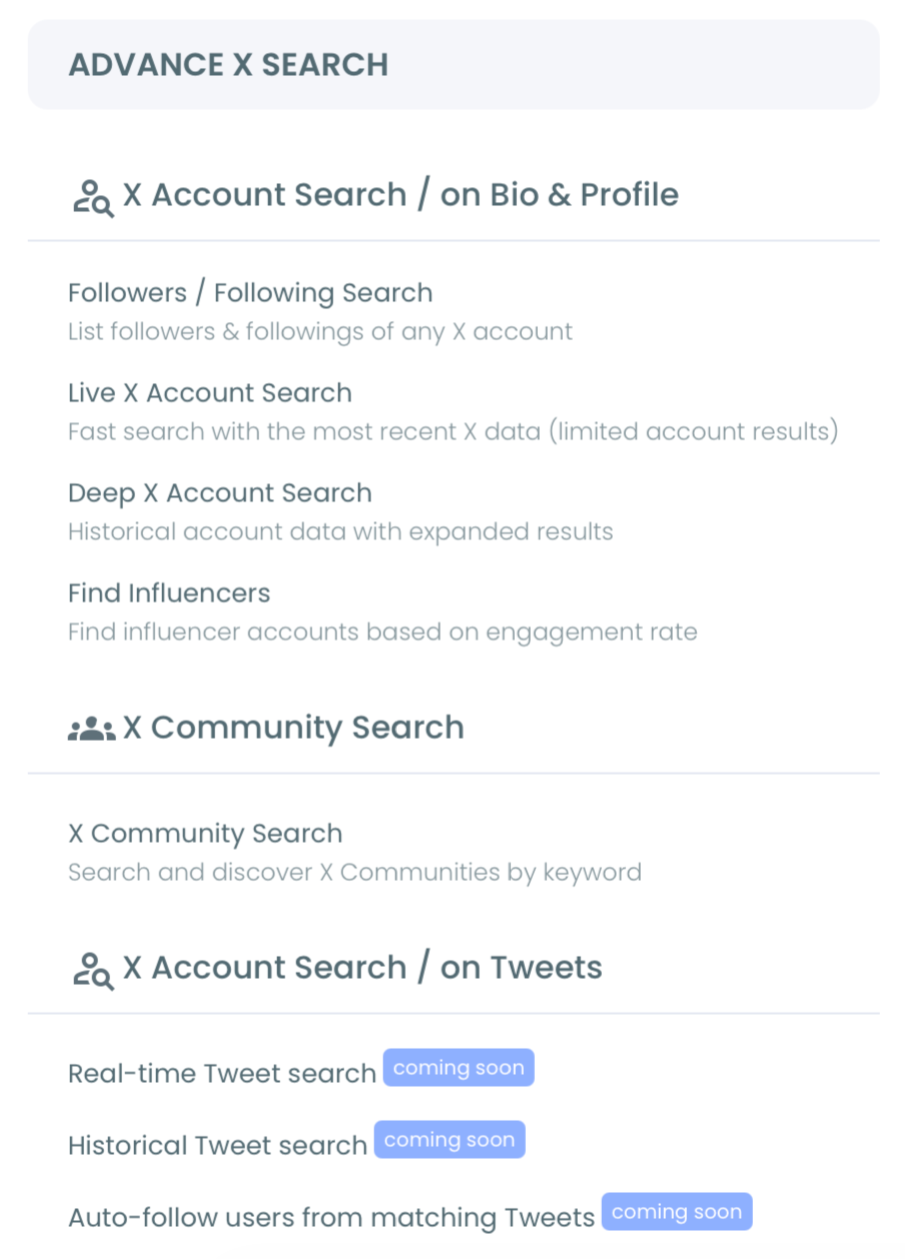
- Open the Advanced X Search menu, then click Find Influencers.
Define the niche and the tiers
- Type the niche keyword into the search box, using the word your niche uses about itself.
- Keep the High, Mid and Low Engagement Influencers boxes you want, with at least one checked, and click SEARCH.
Filter and rank the results
- Open Filter Options and set the Fake/Spam and Inactive controls so those accounts leave the view.
- Enter a minimum and maximum follower count for your tier, plus a location if the board covers one market.
- Sort by the FOLLOWERS header, clicking a second time if needed so the largest accounts come first, and keep FOLLOW RATIO in view.
Export the board and save it as an X list
- Tick the top accounts and click Export for a CSV copy of the board.
- Rank the CSV in your sheet by CountFollowers, and add a ratio column that divides CountFollowers by CountFriends.
- Select the same accounts again, open Add to List, choose Twitter List, and create a private list for the board.
The order protects the ranking. A column sort has no view on quality, so the filters must remove fake and off-tier accounts before the sort decides who is first. A finalist-only export then spends tokens only on rows that made the cut.
The keyword search behind this board, shown end to end on a niche other than yours.
https://www.youtube.com/watch?v=hPPu49XaLGc
One habit belongs between steps 7 and 8. Open the profiles of your top rows with each row's link icon and read what they post now.
The table shows counts, while the profile shows fit, and a keyword match only tells you the account touched the topic.
How to keep a Twitter leaderboard current
Re-run the search and re-export on a schedule you choose. The results reflect each account when the search ran, and Circleboom does not refresh a board or store its ranking history on its own.
Re-run the niche from your recent searches
The Search History panel on the Find Influencers entry page keeps your recent keywords, so you can re-run a niche without retyping it. Reapply the same filters and sort, and the board rebuilds from fresh numbers.
Save each export with the date in the file name. Two dated files are all a ranking history needs.
Pick a refresh rhythm that fits the niche
How often to re-run depends on how fast the niche moves, not on a fixed calendar. A niche built around launches or news reshuffles faster than a slow professional field.
I set the next re-run date when I save the first export. I move it earlier whenever the board is about to feed a pitch or a report, because a stale ranking costs the most on the day someone acts on it.
Turn two exports into rank movement
Put the older and newer CSVs side by side and match rows by Username. The difference in CountFollowers shows who grew, and re-sorting the newer file shows who moved up or down.
Accounts that appear only in the newer file are new entrants. Accounts that drop out may have changed focus, gone quiet, or fallen outside your follower band.
Keep dropped accounts in a second private list instead of deleting them. Move to List shifts them out of the board and into the archive list in one action, and removing an account from a list never unfollows it, so nothing changes on your profile.
Keep the private list in step with the board
The private list is the part of the board you read every day, so update it when the ranking changes. Circleboom's Twitter List Manager handles that: Move to List, Remove from List, and Export List Members all run from its Members view.
Export List Members also works as a snapshot tool, because each export records who was on the board on that day.
Mind the processing pace when you add accounts. Circleboom creates up to 100 lists per 24 hours and adds members at 5 per 15 minutes, so a 30-account board takes about 90 minutes to fill by that arithmetic.
For larger boards, see adding people to Twitter lists in bulk.
Before you share or pitch from your Twitter leaderboard
A board earns trust when the person reading it can see how it was built. I write the method at the top of every sheet before anyone sees the rankings.
Run this check before the board leaves your hands:
- Note the keyword, tier boxes and follower band in the sheet header.
- Confirm Fake/Spam and Inactive were filtered out before the sort.
- Read the recent posts of every account in your top 10.
- Keep follow ratio next to followers, so size and pull read together.
- Date the file and set the day you will re-run the search.
A ranking with its method written on it can be checked. A ranking without one can only be believed.
→ Open Find Twitter Influencers and rank your Twitter leaderboard
Twitter leaderboard FAQ: ranking, lists, and updates
How do I keep fake accounts off a Twitter leaderboard?
Filter them out before you sort. In Filter Options, use Fake/Spam, Inactive, Overactive and Eggheads, then read the finalists' profiles, because Circleboom's quality flags are computed from public signals and a keyword match is not vetting.
How can I tell whether two leaders share the same audience?
Run both through Circleboom's Account Comparison, which shows overlap, gaps and shared audiences between accounts. For the wider version of that check, see analyzing a competitor's Twitter account.
Must I follow the accounts on my Twitter leaderboard?
No. X's page on X Lists confirms a list can hold accounts you do not follow, and a list can stay private, so the board never touches your following list.