
Roughly one in five U.S. adults uses X, and every public profile in that crowd displays its follower count to anyone who visits, no follow required. Reading the number takes a glance; knowing what it hides is the step almost everyone skips.
Profile visit: three seconds to the raw number on any public X account, no follow needed, and no idea what that number contains. Circleboom: a few minutes to the graded version, because Circleboom sorts the followers behind an X account's count into Fake, Inactive, Low Quality, and Loyal tabs through official X API access.
→ Check someone's follower count without following
The tabs answer the question the count only raises.
Do You Have to Follow an Account to See Its Follower Count on X?
No. X displays follower and following totals on the profile page itself, so opening any public profile shows the count immediately, with no follow request involved.
That settles the literal question in one move.
The only exception is visibility scope, not the follow button. A protected account limits what non-approved followers can reach beyond the basic profile.
X's own page on public and protected posts spells out what stays hidden until the owner accepts a follow request.
You do not even need to bring your own account for the basics. Public profiles stay reachable from a plain browser session, and Twitter search without an account walks through how much of X remains readable when you are not logged in at all.
For counts that move, there is a live option. Circleboom's live Twitter follower counter tracks a handle's follower total as it changes, which beats refreshing a profile tab in the middle of a launch or a giveaway.
Why the Raw Count Is the Weakest Number on the Profile
People check follower counts to make decisions with money and reputation attached: sizing up a competitor, vetting an influencer before a fee, or deciding whether an unfamiliar account deserves trust. Pew Research Center's Americans' Social Media Use survey puts X at roughly one in five U.S. adults, and inside an audience that large, the count works as shorthand for credibility.
The shorthand fails quietly. A follower count is a sum with no quality dimension: 40,000 followers could mean 40,000 genuine readers or a majority of bots, dormant profiles, and empty shells, and the profile page presents both cases identically.
Circleboom sits on the judgment side of that gap: it audits the follower base behind an X account and labels every follower Fake, Inactive, Low Quality, or Loyal through approved API access.
Watching the total move does not close the gap either. You can check real-time Twitter followers count for any handle and catch spikes as they happen, but movement tells you that followers arrived, never who they are.
The fix is to grade the number before you use it. You can check a follower count without following the account and hold the four-tab version of the same number within minutes.
What Sits Behind a Follower Count: The Four-Tab Audit
Circleboom's Twitter Follower Checker connects to an X account and splits its entire follower base into four tabs, each one holding a different follower type:
- Fake Followers. Bot and spam accounts with no real activity; they distort engagement metrics and damage credibility.
- Inactive Followers. Accounts that no longer post or engage, which quietly shrinks the audience's effective reach.
- Low Quality Followers. The gray zone: signals weaker than a genuine active user without being outright fake or fully dormant.
- Loyal Followers. Genuine, engaged accounts, the slice of the audience that carries the real value.
The audit runs on the account you connect, which makes it the fastest way to grade your own number and a working model for judging anyone else's.
The signals doing the grading
The result page includes an Understanding Fake Followers panel that names the evaluation inputs, and the same signal set drives all four categories at different thresholds:
- Profile completeness.
- Tweet frequency.
- Account age.
- Follow/follower ratio.
None of that rests on guesswork or scraped data. Circleboom is a verified Enterprise partner of X, so the audit reads follower data through approved access and your account stays inside X's rules while it runs.
The table under every tab
Each tab lists its followers alongside the numbers that justify the grade:
| Column | What it tells you |
|---|---|
| Tweets | Total tweet count; a fake follower typically sits at zero. |
| Joined | How long ago the account joined X. |
| Following | How many accounts it follows; heavy imbalance here is a spam tell. |
| Followers | Its own audience size, often near zero on fake accounts. |
An eye icon opens any follower's profile, and a Remove button sits on each row, so cleanup can start inside the audit result instead of becoming a separate project.
When the audience you want to grade belongs to someone else, the browsing half still works. The Twitter Follower Viewer searches and analyzes another account's followers without you following anyone.
The tooling question has a longer answer, too. For what third-party audits can and cannot reach, see whether a tool can analyze somebody's followers and following on Twitter end to end.
If your own number is the one under scrutiny, run a free Twitter follower check without following anyone and read the tabs yourself.
Watch the audit happen: an X account connects and the four tabs fill with graded followers, Fake through Loyal.
The Second Number Worth Checking: Exact Account Age
Follower quality is one axis; account age is the other. A native X profile shows a join month and year, which is enough to say "old account" and nothing more precise.
Circleboom's join date tool returns the full calendar date, weekday included, for any public username you type in. You can look up any X account's exact join date without following the account.
The precision matters when a report or a vetting decision hangs on how established a profile is.
Age reads matter most in clusters. A wave of engagement from accounts created inside the same recent window is a classic coordination fingerprint.
The same instinct applies when a rival's total jumps overnight: check someone's new followers on X covers who just arrived, and creation dates say how fresh they are.
Treat the join date as a supporting signal rather than a verdict. Pair it with tweet activity and follower structure before judging an account.
How to Check Someone's Follower Count Without Following Them, Step by Step
To check someone's follower count without following them, open their public X profile and read the number; no follow, login, or notification is involved. Grading a count takes one more move: Circleboom's free checker connects through X's own authorization and returns the four-tab audit, and the join date tool dates any public account.
The eight steps below run the whole workflow.
Open the free checker page and connect through X's authorization
- Open the Twitter Follower Checker page. It is a free public tool: no Circleboom login, no signup wall, and no password stands between you and the page.

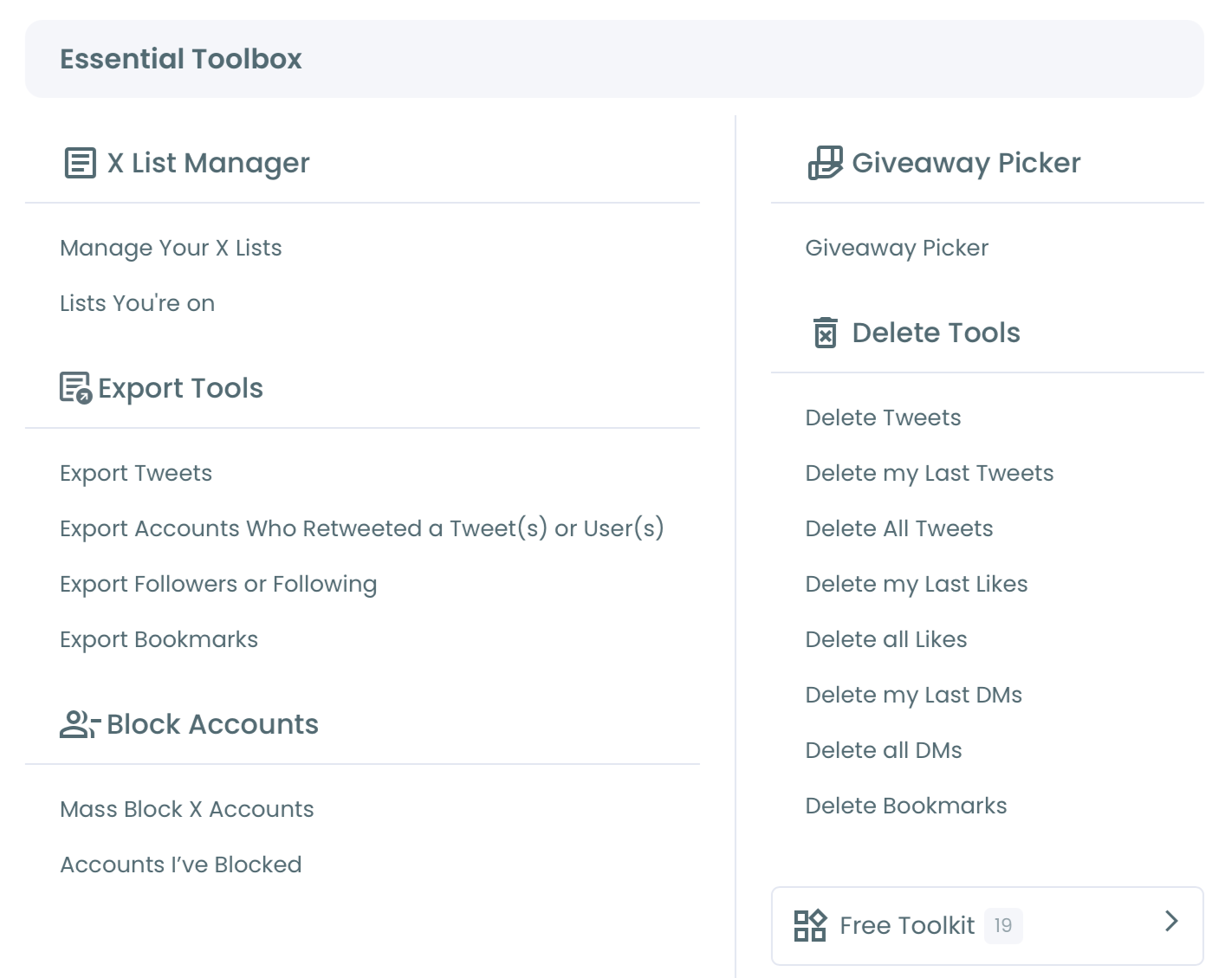
- Find the same checker inside the Essential Toolbox menu if you already use Circleboom logged in; the public page and the dashboard entry run the identical audit.
- Click the Connect X button and approve the connection on X's authorization screen. Circleboom does not request your username or password; access runs through X's own sign-in.
Read the graded result, tab by tab
- Start with the headline figure once the audit loads: the number of identified fake followers set against the total follower count, so the first thing you see is already a graded number.
- Switch between the Fake Followers, Inactive Followers, Low Quality Followers, and Loyal Followers tabs to review each segment as its own list.
- Inspect any row that surprises you: the follower's Tweets, Joined, Following, and Followers figures sit in the table, with an eye icon to open the profile and a Remove button beside it.
Date-check anything that looks off
- Move to the join date tool for account age: type any public username into the input field (letters, numbers, and underscores; the interface supplies the @) and click Search.
- Read the result line below the search field: the account's full creation date with the weekday attached, where the native X profile shows only a month and a year.
That sequence keeps the effort where the value is. The count itself never needed special access, so the minutes go into the grading, and the two checks together (composition plus age) cover the two ways a number misleads.
At a glance: open the free page, connect through X's authorization, read the four tabs, then date-check anything suspicious.
What Changes Once the Count Is Graded
A graded count changes decisions. Ahead of a partnership or a paid collaboration, the loyal-to-fake ratio sets realistic engagement expectations; if 10,000 followers hide 3,000 inactive accounts, the honest ceiling on reach is 7,000 before any algorithm weighs in.
The mistake I see most often is quoting a competitor's follower count in a report without grading it first. The comparison looks careful and measures nothing, because two accounts with identical counts can carry opposite audiences underneath.
Reading order sharpens third-party checks too. Recency is often the first tell worth pulling: sort someone's followers on Twitter by most recent shows how to read the newest arrivals first.
That view pairs naturally with creation-date checks after a suspicious growth spike.
For your own account, the audit is more than diagnosis. The Remove button on each fake-follower row turns a reading session into a cleanup session, and the Loyal tab doubles as a shortlist of the people worth engaging deliberately.
The Count Was Never the Answer
Anyone can read a follower count without following, because X publishes it on every public profile; the advantage belongs to whoever knows what the count is made of.
→ Check any X follower count without following
Frequently Asked Questions
Can someone tell that I checked their follower count on X?
No. Opening a public X profile sends no notification, and neither reading the count nor browsing the follower list leaves any trace the account owner can see.
Does the Twitter Follower Checker work without connecting an X account?
No. The page itself loads free with no login, but the audit starts only after you connect an X account through X's authorization screen. Circleboom never asks for your username or password, and the connection is the only requirement.
Can I see the follower count of a protected account without following it?
The profile-level numbers stay visible, but a protected account keeps its posts and follower lists behind approved follows, so the deeper reads in this guide need the owner to accept a follow request first.
Is checking someone's follower count without following them against X's rules?
No. The count is public profile data that X displays deliberately, and Circleboom's checkers read data through approved API access, so nothing in this workflow touches scraping or policy gray zones.
How does Circleboom decide a follower is fake?
By a documented fingerprint: accounts with no profile photo, no bio, and zero tweets, or accounts following thousands of others while holding almost no followers themselves. Each graded row shows the underlying numbers, so you can verify any single call yourself before removing anyone.