
X shows you follower counts and impressions, but it never tells you what languages those followers actually read. So you keep posting in one language and guessing whether everyone understands it.
The fix is to read your follower base directly and get a ranked language breakdown, which Circleboom's Language Stats does in a couple of clicks.
Circleboom's Language Stats reads your follower list through official API access and returns a ranked breakdown of the languages your audience uses, from the largest segment down to the smallest. You see the exact share each language holds, so the choice to post in a second language becomes a number instead of a hunch.
→ check your Twitter followers language breakdown
Why X Hides This From You
The native platform gives you no language field for your audience. You can see who follows you, but not which language each of those accounts primarily reads or posts in. There is no toggle, no export, no chart.
That gap matters more than it looks. A creator can spend months posting in English while a quarter of the audience reads Spanish first, and nothing in the dashboard ever flags it.
The low engagement from that segment looks like weak content, when it is really a language mismatch.
To fix the wrong problem, you first have to see the real one.
This is part of a wider blind spot. X gives you almost nothing about who your followers are, which is why people end up asking the basics, like how to analyze Twitter followers at all.
Language is one slice of that picture, and one of the easiest to act on once you can read it.
What Language Stats Actually Reports
Language Stats classifies each follower by the dominant language of their public profile, then aggregates the result into a ranked distribution. As an official X Enterprise Developer company, Circleboom reads this data through sanctioned access, not scraping.
The output is two donut charts. The left one gives a plain English versus non-English split, which is the fastest way to see whether your audience is monolingual.
The right one breaks the non-English share into named languages with exact percentages, so you can tell apart a 4% scattering from a 20% bloc. That distinction is the whole decision: a 20% bloc is a content opportunity, a 4% scattering usually is not.
The numbers come from the same audience data behind a full Twitter account analytics view, so language sits alongside the rest of your audience picture rather than living in isolation.
Video walkthrough: finding out what languages your Twitter followers speak.
How to Read Your Twitter Followers Language Distribution
The flow is short, grouped into two phases so each step has a clear purpose.
Connect and open the report
- Log in to Circleboom Twitter and connect your X account with official OAuth.
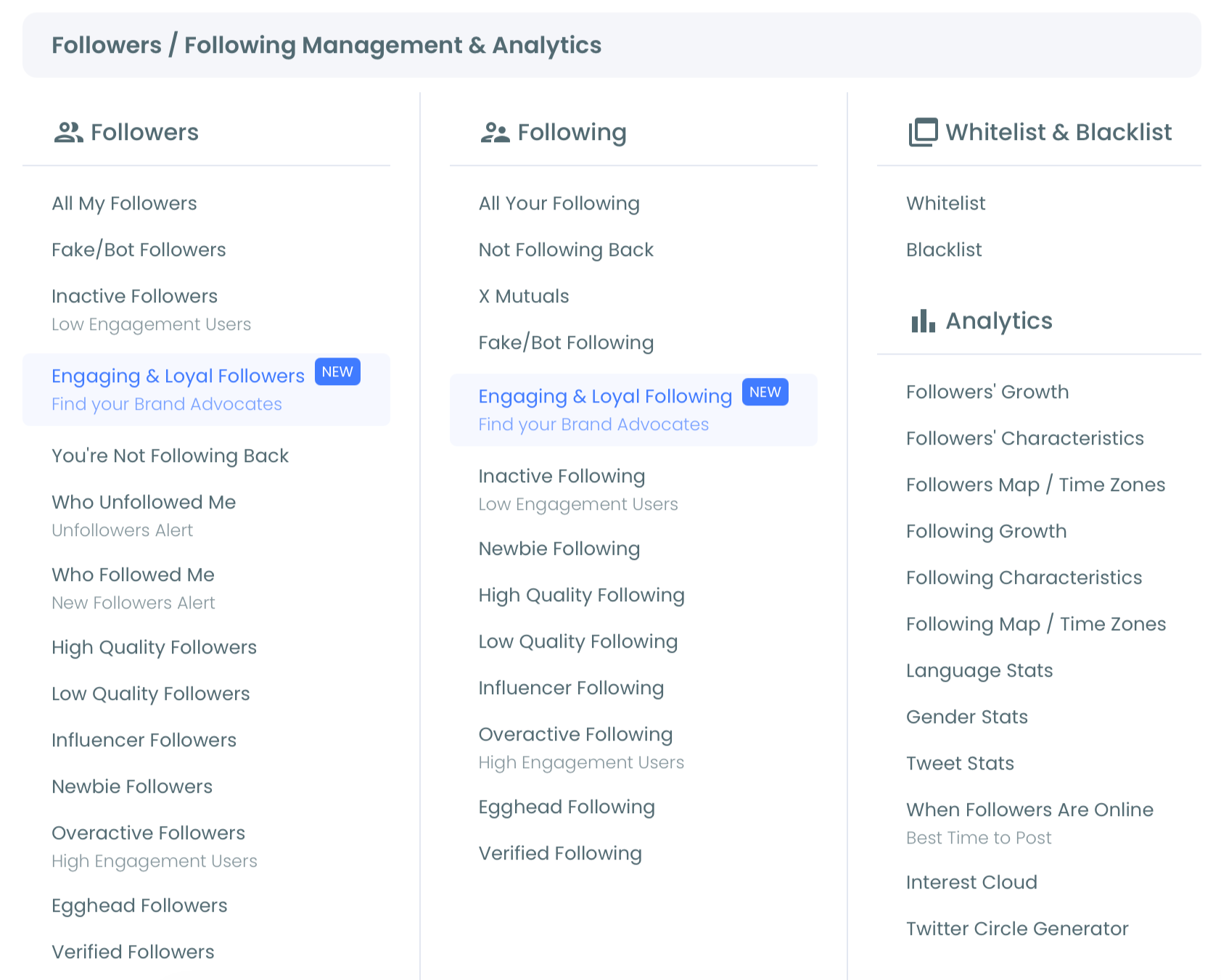
- Open the Follower & Following menu and select Language Stats to load the report.
- Read the Follower Language Stats tab, which opens by default and shows your follower distribution as the two donut charts.
Compare and decide
- Check the left donut first for the English versus non-English split, then read the right donut for the named-language percentages.
- Switch to the Following Language Stats tab to compare the languages your sources use against the languages your audience reads, and export either chart from the three-dot menu.
Each tab exports on its own, so switch and export again if you want both saved. The order is what makes this useful: you read the audience first, confirm the size of any second-language bloc, and only then weigh whether localized content is worth the effort.
Turning the Breakdown Into Posting Decisions
A language percentage on its own changes nothing. The value comes from what you do with it, and there are really three moves.
The first is matching your posting language to the dominant segment, which is obvious only once you have actually measured it. The second is testing content for a sizable non-primary bloc and confirming the result.
A hunch is cheap, but a content performance analysis tells you whether the experiment earned engagement.
The third move is pairing language with location. Language plus a followers and friends map tells you not just what your audience reads but where they are.
The same logic shows up when people work out the most common languages among their followers and map those languages back to regions.
If the second-language bloc is large enough to act on, the natural next step is producing posts in that language. An X Post Planner lets you draft and schedule them without a separate workflow.
Writing in the audience's own language tends to lift Twitter engagement rates more reliably than chasing a posting trick.
When a Second-Language Account Makes Sense
Sometimes the breakdown reveals a foreign-language segment big enough to deserve its own account rather than the occasional translated post. The threshold is not a fixed number, but the shape of the case is consistent.
If one non-primary language holds a large, growing share and those followers engage when you post in it, a dedicated account stops diluting your main feed and gives that audience a consistent home. If the segment is small or static, a few translated posts on the main account cover it without the overhead of a second identity.
Language Stats gives you the proportion that tells the two cases apart, and rerunning it after a campaign confirms whether your growth pulled in the right audience.
This is also the kind of read worth running on accounts that are not your own. If you are studying a competitor or a potential partner, the same method lets you analyze an account's Twitter followers and check whether their audience speaks the language your campaign needs.
Reading the Following Tab, Not Just Followers
Most people stop at the follower chart, but the Following Language Stats tab earns a look too. It shows the language mix of the accounts you read and reply to, which is a quiet driver of the content you end up making.
If your follower base skews 30% Spanish but every account you follow posts in English, your inputs and your audience are out of step. You are absorbing ideas in one language and serving them to people who would rather read another.
Closing that gap can be as simple as following a few strong accounts in the underserved language. Comparing the two tabs side by side turns a single language chart into a small content-strategy audit.
→ Read your followers language breakdown now
Common Questions About Twitter Follower Languages
How does Circleboom know what language a follower speaks?
It reads public profile signals, the bio text, the language of recent tweets, and the profile language setting where it exists, then estimates each account's dominant language. The result is directional, based on patterns rather than a label the user typed in.
Does X give me this data natively?
No. X exposes no language breakdown for your audience anywhere in its dashboard, which is the reason a dedicated analytics read is needed at all.
What share of a second language is worth acting on?
A non-primary language holding roughly 15% or more of your followers is usually large enough to justify testing content in it. Below that, the reach gain rarely covers the localization effort.
Can I compare my followers against the accounts I follow?
Yes. The Following Language Stats tab shows the language mix of accounts you follow, so you can see whether your information sources line up with the audience you are writing for.
How often should I recheck the language breakdown?
Rerun it after any event that changes your audience, a campaign aimed at a new language community, a viral post, or a sharp growth spike. New followers shift the proportions, and the only way to know whether they shifted toward the language you wanted is to read the chart again.