
Your X bookmarks were supposed to be a reading list. After a couple of years of tapping the save icon on anything that looked interesting, most accounts hold hundreds of saved posts nobody will open again.
Clearing that pile should take one pass, not one tap per bookmark.
What this walkthrough gives you.A safe order of operations that exports before it deletes.The filters that separate research you still need from dead weight.A repeatable reset that keeps the bookmark list usable next month.
Circleboom removes saved posts from your X bookmark list in bulk through official API access, with filters for date, keyword, language, and engagement.
→ clean up saved tweets
Why a saved tweets list stops working
A bookmark list fails quietly. Nothing breaks, no error appears, and the save icon keeps working exactly as it always did.
What changes is retrieval. A list with 40 entries is a reading queue you can scan in a minute.
A list with 600 entries collected across four years, a dozen topics, two job changes, and one abandoned side project is an archive with no index.
The saved tweets are still there. You just cannot find the one you want without scrolling past everything you do not.
That failure has a second layer.
Some of those saves point at accounts that were deleted or suspended, so the row still occupies a slot in your list while the content behind it has gone. You cannot tell which ones are dead until you tap each one.
Circleboom exists for the pass that fixes this. It loads the whole bookmark list into one table, lets you sort and filter it, and then removes what you select in a single operation instead of hundreds.
Once scrolling stops helping, the fastest move is to clear your saved tweets on X and rebuild the habit from an empty list.
Size is only half of the problem. Tapping the save icon costs nothing and commits you to nothing, so it gets used as a reaction rather than as a filing decision.
That is the distance between what bookmarks on X are for and what most collections actually turn into.
What X gives you for bookmark cleanup, and what it does not
X gives you exactly two bookmark actions: save a post, and remove that post from your saved list. Both operate on one post at a time.
The platform documents the feature honestly in its own bookmarks help pages, and the omission is visible there. There is no bulk delete, no expiry date, no folder-free way to clear a year of saves, and no export.
Removing 600 bookmarks by hand means 600 separate taps, each one requiring you to open the post first.
Search is the other gap people hit before they reach for a delete. Finding one saved post inside a large collection turns into its own project.
That is why how to search bookmarks on Twitter draws steady traffic from people who never intended to build an archive at all.
Circleboom fills the missing half. The Twitter Bookmarks Manager reads your saved posts through official channels and displays them as a sortable table with engagement columns.
Export and bulk delete both sit on that same screen, which is what lets you archive and clear in one visit.
That access matters more than it sounds. Circleboom is an official X Enterprise Developer company, so your bookmark data moves through sanctioned endpoints rather than a browser workaround.
Your account stays inside X's rules for the whole cleanup, however many rows you clear.
How to clean up saved tweets
Watch it run end to end: this clip shows the bookmark table loading and a full list being cleared in one action.
https://www.youtube.com/watch?v=eBkDEvVfwA0
Circleboom's flow to delete Twitter bookmarks in bulk runs in three phases, and the order is the part that protects you.
Load everything, narrow the selection, then archive before you delete.
Skipping the middle phase is how people lose research they meant to keep, so the filters come before the delete button, not after it.
Load your saved tweets into one table
- Log in to Circleboom Twitter and connect your X account.

- Open the Essential Toolbox menu, where Circleboom keeps its delete tools.
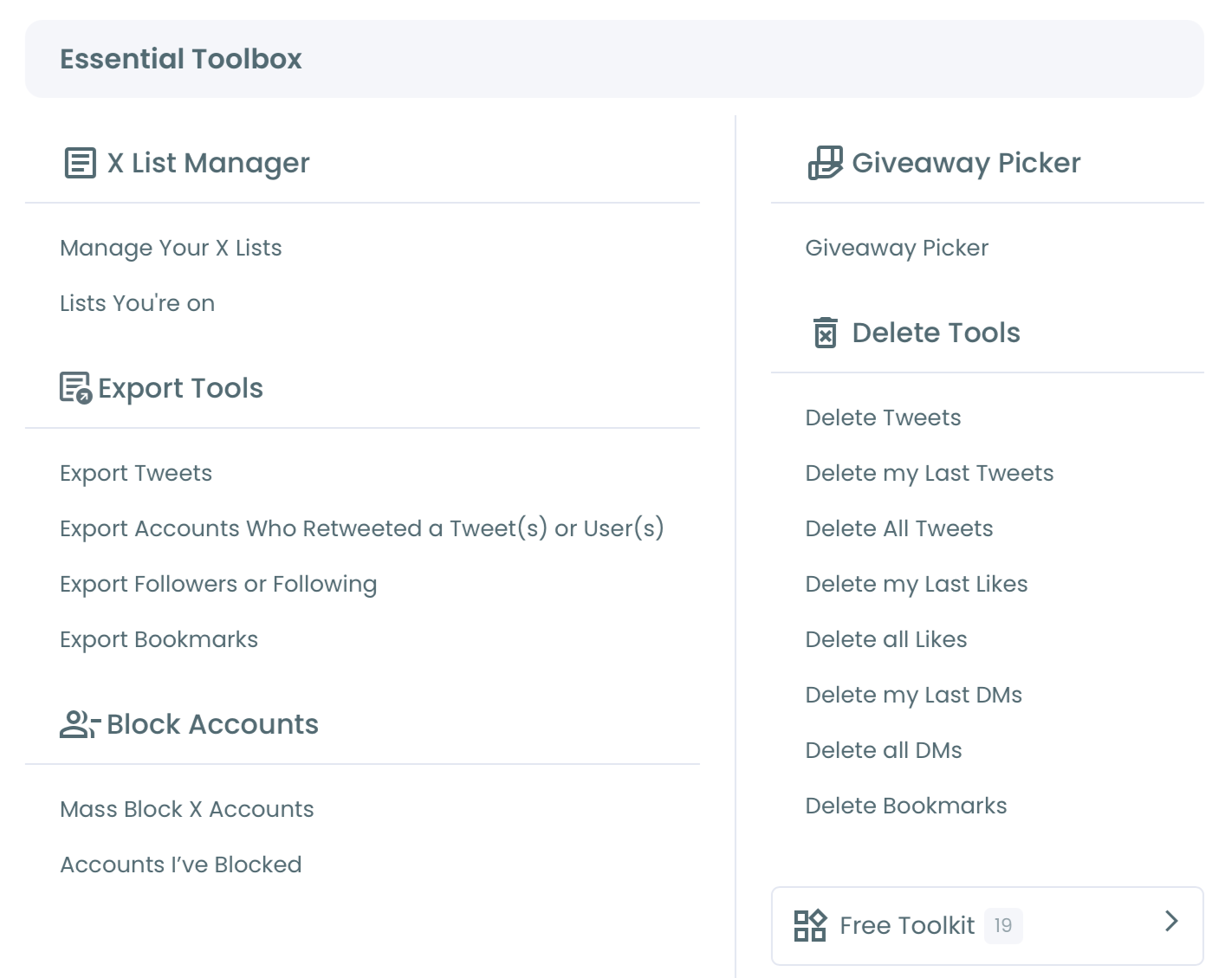
- Select Delete Bookmarks and let the table build. The page header reads "Displaying your N bookmarks," and every saved post arrives pre-selected by default.
- Click Sync My X Data for fresh insights so the table reflects your current list rather than an older snapshot. The button shows the last sync date beside it.
Narrow the list before anything gets deleted
- Open Filter Options and cut the selection down to what you actually want gone. The panel gives you several ways to slice the list:
- Date range, from an earliest to a latest save.
- Keyword, username, or hashtag inside the post text.
- Language, media presence, and post type.
- Minimum and maximum counts for likes, retweets, replies, and quotes.
- Minimum and maximum bookmark count or impressions.
- Review the rows that survive the filter and deselect anything you want to keep. Each row carries the post text, its engagement columns, and its creation date, which is usually enough to judge a save without opening it. A red trash icon on each row removes that single bookmark if you spot one obvious offender.
Archive the collection, then clear it
- Run the export before you delete anything. The Export button on the same page writes a CSV containing the post text, a link to the original post, impressions, likes, retweets, quotes, bookmark count, replies, and creation date. Export is token-based, so check your remaining token count first.
- Choose your delete action. Delete All clears every loaded bookmark; Delete Selected removes only the rows you kept checked.
- Confirm the irreversibility warning when Circleboom asks. Deleted bookmarks cannot be restored, and that CSV you just wrote is the only copy of what the list held.
That sequence holds up because each phase removes a way the next one can go wrong. The sync stops you filtering stale data, the filter stops you deleting research you still need, and the export turns an irreversible action into a recoverable one.
Reverse any two of those and the cleanup stops being safe.
Quick recap: sync, filter, export, delete, confirm.
Which saved tweets deserve to survive the cleanup
Not every old saved tweet is clutter, and the difference is not age.
A post you saved three years ago may still be the source you cite, while something you saved last Tuesday may already be spent.
Two questions separate them. Does this post still do a job, and is that job something you would notice losing?
Keep the saves that feed live work:
- Sources you cite.
- Competitor examples you compare against.
- Customer language you reuse.
- Screenshots that serve as proof of something.
Clear the ones that were context for a project you finished, ideas you already published, and links to accounts that no longer exist.
There is a third category worth naming. Some bookmarks are neither useful nor clutter but private, which is a different problem with a different fix.
A large bookmark list is a readable record of what you have been researching, and clearing it removes that record from the platform.
Nobody else can pull that record up, which is what seeing someone else's X bookmarks settles for good. The record still sits on the platform under your account, though, and only a deletion takes it off.
If the goal is privacy rather than tidiness, deletion is the point and the export is optional. If the goal is a working list, the export is the whole plan and the deletion is just what makes room.
People who want a middle path usually end up comparing the best Twitter bookmark managers before deciding how much of the collection to keep in-platform at all.
Before you clear a research-heavy collection, it is worth pulling the strongest saves out as content. A bookmark that survived two years of neglect is usually worth a thread, a newsletter section, or a post of your own.
Is it safe to delete X bookmarks in bulk?
Yes, with one caveat that is easy to state and easy to forget. Deleting a bookmark removes the save record from your account and does nothing to the original post.
The author still has their post. Other people who saved it still have their copy. Nothing about the deletion is visible to anyone else.
The save was never visible either: a post's bookmark count is public, but who bookmarked your tweet is not.
The caveat is permanence. There is no undo, no recycle bin, and no recovery path once the confirmation clears.
That question gets asked far more often after a wipe than before one.
Circleboom only ever touches your own bookmarks. It cannot read or modify another account's saved posts, and it runs every request through official API access rather than scraping the interface, so the operation stays compliant no matter how many rows you clear at once.
Run the export. It draws on your token balance and turns a permanent action into a reversible one.
The file is often more useful than the bookmark list ever was, because a CSV is searchable, sortable, and portable in a way the in-app list is not. It is also the step most people wish they had run first.
What the exported CSV is actually good for
The export is usually framed as insurance, but it earns its keep long after the cleanup is done.
Every row carries the post text, a link back to the original, and the engagement figures as they stood at export time.
That combination turns a pile of saves into something you can sort.
Sort by bookmark count and the posts other people also found worth keeping rise to the top. Sort by date and a research phase reappears as a block, which makes it obvious what a given month was actually about.
The saves you kept are a record of what interested you, ranked by what interested everyone else too.
Three uses come up repeatedly once people have the file in hand:
- Content sourcing, where the highest-engagement rows become thread or newsletter material.
- Competitor tracking, where saved posts from rival accounts read as a timeline of their messaging.
- Reference recovery, where a link in the CSV still works even after the save record is gone.
That last one matters more than it looks.
Bookmarks pointing at deleted or suspended accounts leave nothing behind in the app, but the CSV keeps the text you saved them for.
People who want the file without clearing anything can run the same operation as a standalone job and extract Twitter bookmarks on its own schedule.
Your saved tweets cleanup checklist
The whole reset fits in five moves, and none of them takes long once the table is loaded:
- Sync the list so you are working from current data.
- Filter by date, keyword, or engagement to isolate what should go.
- Export the collection to CSV as your archive.
- Delete all, or delete only the selected rows.
- Restart the habit with a rule about what earns a save.
The last one is what keeps the cleanup from being an annual chore.
A bookmark list works as an inbox, not a warehouse, and the reset is only worth running if what comes after it is different from what came before.
The same logic applies to the rest of your account, which is why people who clear their bookmarks usually go on to delete all Twitter likes next.
One export, one filter, one confirmation, and the list is a tool again.
What to know before you clear your saved tweets
Can I get a deleted bookmark back?
No. Bookmark deletion is permanent, which is why Circleboom shows an irreversibility warning before the removal runs. The CSV export is the only copy that survives the cleanup, and it is the reason the archive step sits ahead of the delete step in this workflow rather than beside it.
Can I delete only some of my bookmarks instead of all of them?
Yes. Circleboom pre-selects every loaded bookmark, but the Filter Options panel and the row checkboxes let you cut that down, and Delete Selected then removes only what is still checked.
Does the export include posts that have since been deleted?
Yes, for the data captured at export time. The CSV keeps the post text, the link, and the engagement figures as they stood when you ran it, so a save whose original post has since disappeared still leaves you a record.
Does exporting my bookmarks cost anything?
The export runs on your search-token balance, and the Export button displays the remaining count before you click it. Check that number ahead of a large collection so the file completes in one pass, since the export is what makes the deletion recoverable and a half-finished archive defeats the point.




)
)