
Circleboom's free repost cleanup removes 50 reposts per day, and that single number decides your whole plan.
An account carrying 180 forgotten reposts is finished in four sittings. An account carrying 4,000 needs a completely different route, and almost no guide on this query tells you where the switch happens.
To delete all reposts on X, connect the account that made them, let Circleboom load your repost history into a list, then select and confirm in batches. Circleboom removes reposts from your X profile through official API access, 50 per day on the free plan, with the counter resetting the next morning.
→ delete all reposts on X
The archive route further down is the one that matters once your count runs past a few thousand.
How to delete all reposts on X (Twitter), step by step
Six moves, and the last one is a calendar reminder.
Connect the account that owns the reposts
- Log in to Circleboom Twitter and link the profile whose reposts you want gone.

- Open Essential Toolbox from the left menu. The delete utilities share that menu with the export and list utilities.
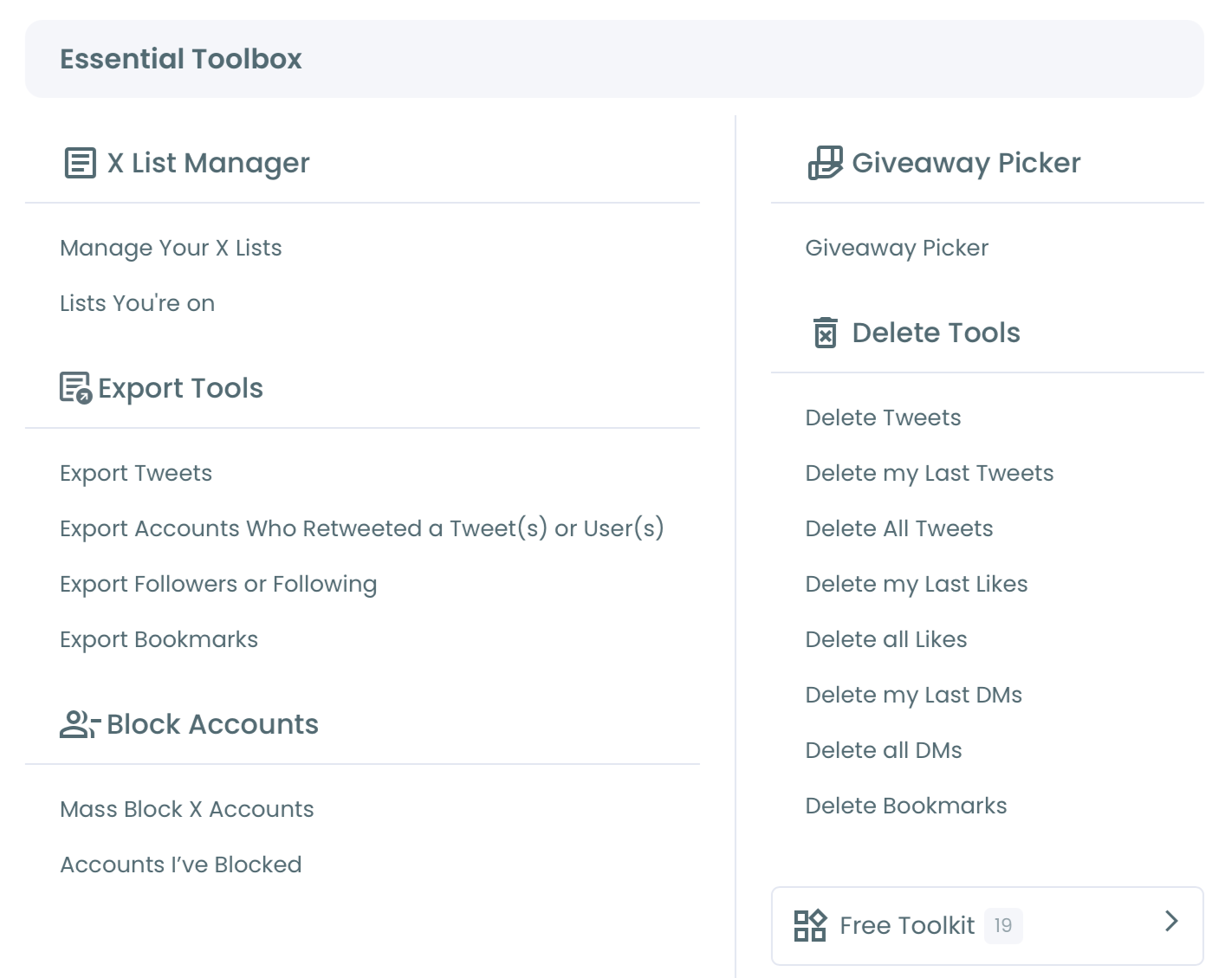
- Let Circleboom fetch your repost history and lay it out as a list. Every entry carries its context details, so an expired campaign repost is easy to tell apart from one you still stand behind.
Work through the list in daily blocks
- Select the reposts to remove, one at a time or in groups. Nothing leaves your profile until you say so.
- Confirm the removal. Circleboom then removes the selected reposts through your connected X account.
- Return tomorrow for the next 50. The free allowance resets daily, so a long history clears across sessions instead of collapsing into one run.
That order holds because the account connection earns sanctioned access before anything is touched, the loaded list puts review in front of action, and the confirmation step stops a bulk removal from running on autopilot.
Drop the review and you will delete amplification you meant to keep.
At a glance: connect, open Essential Toolbox, load the list, select, confirm, come back tomorrow.
Why X gives you no bulk undo for reposts
X removes reposts one at a time by design. Its own unrepost endpoint accepts a single post ID per call, so every "remove them all" promise is a loop over single removals underneath the button.
That design is why the native app only ever offers you the highlighted repost icon on one post. No screen inside X says "remove 400 reposts."
Manual cleanup therefore becomes a scrolling problem rather than a deleting problem. You end up hunting highlighted icons through years of timeline that reloads and reorders while you work.
The counting problem behind the scrolling problem
There is a second, quieter cost to all that scrolling.
You cannot count what you cannot see in one place, so most people start this job with no idea whether they are facing 200 reposts or 2,000.
The estimate they carry in their head is almost always low, because reposts feel weightless at the moment you make them and leave no trace in memory afterwards.
A loaded list solves the counting problem before it solves the deleting problem. Seeing the real number is what turns a vague intention into a plan with a finish date.
Run the sweep from a loaded list instead, and clear your entire repost history without touching your timeline at all.
If you have already tried and hit a wall, why I can't delete retweets and Twitter likes covers the usual causes.
One-click run, filmed end to end: what a loaded repost list looks like the moment the fetch finishes and the removals start.
https://www.youtube.com/watch?v=2zMXPpt8JN0
What the 50-a-day free limit actually costs you in time
Do the arithmetic before you start, because it decides which tool you should be using.
The free plan removes 50 reposts per day and resets daily, so your calendar is your repost count divided by 50.
- 150 reposts: three days.
- 500 reposts: ten days.
- 1,200 reposts: roughly four weeks.
- 3,000 reposts: about two months of daily sessions.
Past a thousand or so reposts, the daily batch stops being a cleanup and turns into a habit.
That is where most people quit halfway and leave a profile that is partly cleaned, which reads worse than one nobody touched. Knowing your number on day one is what prevents it.
Working from a phone changes the screens but not the math, and delete retweets on iPhone walks the same batches through the mobile flow.
Likes pile up on exactly the same curve, so you may want to unlike and delete all Twitter likes on a parallel schedule.
Which reposts to clear first when the list is long
Rationing changes the order of work. When you can only remove 50 a day, the question stops being "how do I delete everything" and becomes "what should leave the profile tonight."
Four categories are worth taking off first, roughly in this order:
- Reposts tied to a topic or brand you have since moved away from.
- Campaign amplification with an expiry date that has long passed.
- Anything boosting an account you would no longer want to be seen promoting.
- Reposts from a period of your life the account no longer represents.
Everything else can wait for a later batch, and some of it can stay. A repost of a genuinely good post from three years ago is not a liability just because it is old.
The point of triage is that the first 50 removals should carry more weight than the next 500.
That is also the sensible test for whether you need the archive route at all.
If the four categories above account for a couple of hundred entries and the rest are harmless, you are not doing a full reset. You are doing a targeted cleanup, and the daily batches are the right size for it.
When the archive path beats the daily batches
The archive route clears reposts across your full history in one operation, which is the answer the moment daily batches stop making sense.
Circleboom's Delete All Tweets wizard reads the tweet.js file from your X data archive rather than working through the API, and that is what lets it reach past the 3,200 most recent posts.
The part that matters for reposts is a row of checkboxes. Under "Which tweets do you want to delete?" the wizard lists Tweets, ReTweets and Replies, all checked by default.
Uncheck Tweets and Replies, leave ReTweets checked, and the run touches nothing you wrote yourself.
What the archive wizard needs from you
Three things are worth knowing before you request the file:
- The archive takes 24 to 48 hours to arrive after you request it in X settings.
- Only tweet.js is uploaded to Circleboom, never the whole archive ZIP.
- The file must come from the account linked to your Circleboom subscription.
The Approve and Delete panel then prints a final tally, broken out by tweets, retweets and replies, before anything runs.
Read that number. It is the last honest checkpoint before a permanent operation.
You can also re-upload the same tweet.js later with a different filter set, because already-deleted items are dropped before the new filters are applied. That behavior turns one archive download into as many targeted runs as you need.
The filters that make a repost-only run precise
The filters matter more for reposts than most people expect.
The keyword, username and hashtag filter searches tweet text, mentions and hashtags together, so filtering on a single handle isolates every repost you ever made of that one account.
Date ranges are inclusive at both ends, which makes "everything from the two years before the pivot" a single run.
The Protect List is the counterweight. Add specific entries to it and they survive a run that clears everything around them, which is how a full reset stops being all-or-nothing.
Open delete all your reposts on Twitter when the recent window is enough, and delete all tweets when it is not.
The older bulk approach still reads well in how to delete retweets like a pro if you want the shorter version.
Is it safe to delete all your reposts on X?
Yes, provided the removals run through sanctioned access rather than a browser script pretending to be you.
Circleboom is an official X Enterprise Developer company, which is why a run of hundreds of removals reads to X as an authorized client instead of abuse.
Two limits deserve naming plainly. Removing a repost never deletes the original post: it removes your amplification of that content from your own profile and activity history.
Archive-based deletion, by contrast, is permanent. Download the archive and keep it somewhere safe before you start, because afterwards it is the only record of what was there.
References from other accounts also survive. If someone quoted or replied to something you later remove, their content stays on X and you have no way to take it down.
Locked out by the original poster? How to delete retweets if you are blocked by the tweet owner covers that specific case.
What your profile looks like once the reposts are gone
Your timeline starts reading as your own work again.
Everything a visitor scrolls is something you wrote, which is a very different impression from a feed where two thirds of the posts belong to other people.
That matters most in the moments when someone is deciding about you. A hiring manager, a prospective client, a journalist checking a source: all of them read the profile as a single object, and old amplification is part of what they read.
There is a strategic version of this too.
Reposts are a record of what you were paying attention to at the time, and attention ages badly.
A pivot leaves behind a trail of endorsements for a direction you no longer take, and clearing that trail is cheaper than explaining it.
The follower relationship, the account age and the handle all stay exactly as they were.
Only the amplification record changes, which is the whole appeal: you get a new public position without starting a new account and losing everything an old one is worth.
One quieter benefit shows up in your own reading of the profile.
A timeline thick with other people's posts is hard to audit, and most account owners genuinely cannot remember what is on theirs past the first few screens.
Clearing the reposts makes the remaining content small enough to actually review.
The part worth keeping
You do not need a paid plan, a full archive download, or a free weekend to begin. Fifty reposts today is a real dent, and the counter is back tomorrow whether or not you use it.
Start with the oldest and most off-brand ones, because those carry the most risk per entry and the fewest reasons to keep. If you get through the list and want the full-history version afterwards, the archive route is still waiting.
Questions worth settling before the first batch
Does deleting a repost tell the original poster anything?
No notification is sent for an undo. The count on the original post drops by one, which is the only visible trace, and on any post with meaningful reach that change is invisible in practice.
Can I delete reposts without deleting my own posts and replies?
Yes. In the archive wizard the post-type checkboxes arrive all ticked, so untick Tweets and Replies and leave ReTweets on. Only your amplification history is then removed, and everything you authored stays up.
What happens if I close the browser mid-run?
Large deletion operations take time and API rate limits apply while they execute, so the browser should stay open until the run finishes. Interrupting mid-operation leaves the job partly done, and the safe recovery is to start a fresh run rather than assume the queue continued without you.