
You can delete old retweets on X before a certain date without deleting your original posts: use an archive-based cleanup, select ReTweets only, and set an inclusive end date. That distinction matters because X's normal Repost button removes one Repost at a time, while a historical cleanup needs a way to see the older record first.
To delete old retweets before a cutoff, download your X archive, upload itstweet.jsfile to Circleboom, select ReTweets, and apply the date range before approving the deletion. Circleboom removes the selected Reposts on X through official X Enterprise APIs.
→ delete old retweets
Keep your original posts and make the cutoff do the selecting.
The direct answer: use a date boundary, not endless scrolling
The native X route is fine for one recent Repost.
X says that selecting the highlighted Repost icon undoes your Repost and removes it from your timeline, not the original author's post. Its Repost FAQ also makes clear that turning Reposts off for an account does not remove old ones already in your timeline.
That leaves a practical gap when the Reposts are years old. A profile timeline is a display, not a dependable historical audit.
Scrolling until a date appears can be slow, incomplete, and hard to review twice. The better question is not "How far back can I scroll?" It is "What date should separate the public record I want to keep from the one I want to remove?"
Circleboom lets you delete old retweets from an uploaded X archive, with ReTweets selected separately from Tweets and Replies. That makes it possible to change the visible history without treating every post type as the same thing.
A cutoff date is a policy decision, not a calendar trick.
Treat the cutoff as an account policy
For example, a creator moving from a personal feed to a professional one may keep everything from the new direction onward and remove Reposts from before the change. A brand may keep campaign posts but clear old endorsements.
This is more deliberate than wiping a timeline because it creates a boundary a teammate can understand later.
If the goal is a total reset rather than a Repost-only cleanup, the broader Delete All Tweets page covers a different decision. It can include Tweets, ReTweets, and Replies.
For a year-by-year choice, delete old tweets by year is the useful adjacent workflow.
Why an archive changes the old-Repost problem
An X archive is the record that makes historical filtering workable. X describes its archive as a snapshot of account information starting with the first post.
Its archive download instructions explain how to request and retrieve the ZIP file from account settings.
Circleboom's Delete All Tweets workflow uses the archive because the API-accessible window reaches only the most recent 3,200 tweets. Old Reposts can sit outside that window.
The archive route lets Circleboom process the account's full tweet.js record, rather than asking a browser tab to load history it may not surface well.
Circleboom processes historical X posts so you can choose ReTweets, dates, and other filters before a permanent deletion. That is a different job from manually undoing a single Repost.
An archive-first workflow is the safer match for a cutoff-date request.
Keep the archive as the decision record
The archive is also your backup. Save the original ZIP and, if the content matters, keep a searchable copy before you act.
X says its archive can contain posts, Direct Messages, media, follower and following lists, and other account information. A deleted Repost may be gone from the public timeline, but your local archive preserves the decision record.
For readers deciding whether the task is truly Repost-only, how to delete retweets like a pro is a helpful refresher on the narrower cleanup goal.
How to delete old retweets with a cutoff date
To delete old retweets before a certain date, enter Circleboom, upload the tweet.js file from the matching X archive, choose ReTweets as the only post type, and use the End Date as the cutoff. The interface shows the final selection count before deletion, so the date choice is reviewable instead of hidden in a script.
Start from the account you intend to clean
- Log in to Circleboom Twitter and connect the X account whose historical Reposts you want to review.

- Request and download the X archive from your account settings, then keep the ZIP in a local folder as your backup.
The account linked to Circleboom must be the account represented by the archive. This is not a place to borrow a teammate's file or test with a different profile. Circleboom's archive workflow accepts the data file that belongs to the subscribed account.
Upload the right file and open the historical filters
- Open the Essential Toolbox and upload
tweet.js, not the full archive ZIP.
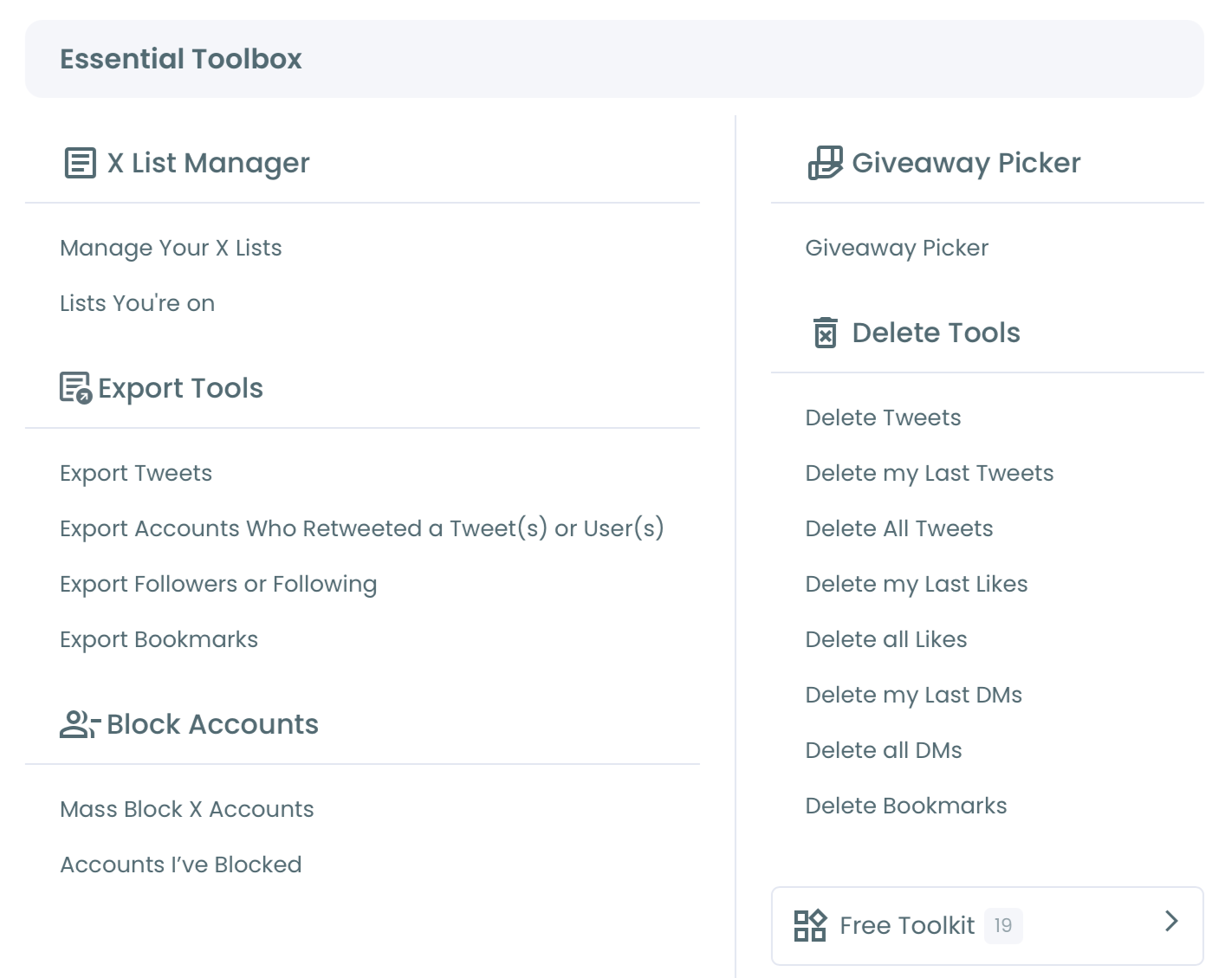
- Wait for the uploaded count and use that count as a basic check that the file was read before you narrow the selection.
The filename detail is easy to miss. The archive contains many files, but this workflow needs tweet.js.
Uploading the ZIP instead is not a workaround; it is the wrong input. Circleboom removes already deleted items from a repeat upload, which means you can run careful, separate filters against the same archive instead of trying to solve every cleanup question at once.
Make the cutoff select only reposts
- Leave ReTweets checked and clear Tweets and Replies in the post-type controls.
- Set the End Date to the last day you want removed, and leave the Start Date at the earliest relevant date if the goal is "everything before this point." The date range includes both boundary dates and every day between them.
- Check the Approve & Delete panel for the final count, then add any valuable exceptions to the Protect List before you confirm.
The important review is not only the number. Ask what may be inside that group: a Repost that documents a partnership, a personal milestone, a product launch, or a thread you still reference.
The Protect List gives a Repost-only cleanup a precision layer. Without it, a reasonable date rule can still remove a small set of posts you would rather keep.
The workflow works because post type and time do different jobs. ReTweets define what you are removing; the end date defines how far back the removal reaches.
Once you have made a clean selection, compare it with the how to remove reposts on X approach for a recent exception.
Filters that prevent a broad cleanup from becoming a blunt one
The date range is the main control for this task, but it is not the only check available.
Circleboom can also filter archive content by keyword, username, hashtag, language, media type, likes, and repost count. Those controls are useful when the date boundary catches more Reposts than your real policy intended.
Use a second filter only when it answers a concrete question. A keyword filter can isolate old Reposts tied to a prior project.
A media filter can separate visual posts from text-only Reposts. Engagement thresholds can protect highly cited items, though a low number does not automatically mean a post lacks value.
For that reason, I would start with date plus post type, inspect the count, and add one extra condition only if the count tells you the cutoff is too broad. Stacking every filter at once makes it harder to explain why a given Repost stayed or went.
The same logic applies if you later need a text-driven cleanup. How to remove retweets can help frame the Repost side of the task, while the archive filter keeps the broader historical context available.
What deleting a repost does and does not remove
Deleting your Repost removes your association with the original post from your timeline. It does not delete the original post, and it does not remove another person's Quote Post, reply, screenshot, or external reference.
X's own FAQ describes the native undo action in the same terms.
Deletion is permanent in Circleboom's workflow. The local archive remains the record you control, so do not treat the download as a formality.
Keep it before you approve the deletion and review the count with the same care you would use for a published-site redirect or a campaign takedown.
The difference between "old" and "harmful" also deserves attention. Old Reposts may merely be off-brand, while others could be legal, reputational, or customer-support evidence.
A date filter handles time well; it cannot decide the business meaning of a post. That is why the Protect List is not an optional afterthought for a brand account.
If your cleanup has grown beyond one date boundary, how to delete all retweets in bulk covers the case for a broader Repost sweep.
Video check: the mobile view of removing all Retweets and the difference between a broad cleanup and a single undo.
A practical decision rule for choosing the date
Pick a cutoff that maps to a real change in your account, not an arbitrary round number. A rebrand announcement, a job change, a new editorial policy, or the first post in a new content direction gives you a defensible boundary.
If you cannot explain the date in one sentence, do not delete yet.
Here is a simple review sequence:
- Name the change. Write the event that separates the old account purpose from the new one.
- Choose the last removable day. Use that date as the inclusive End Date.
- List exceptions. Add enduring proof, milestones, and still-useful posts to the Protect List.
- Review the count. Treat an unexpectedly high or low count as a reason to inspect the rule.
- Keep the archive. Save the pre-deletion record in the location your team uses for account history.
This framework is the information gain most generic deletion advice misses: a date filter is strongest when it expresses an account policy. It is not only a speed feature.
What to do after the cleanup
After you delete old retweets, check the live profile and make sure the remaining timeline tells the story you want it to tell. If the account is changing direction, prepare the first few original posts before the cleanup so the profile does not sit empty or confusingly between identities.
Circleboom can support the cleanup without asking you to delete everything. The archive-based filter, Protect List, and approval count make a targeted historical edit possible while you retain the account's username, followers, and age.
Manual undoing is sensible for a few recent Reposts; date-filtered archive cleanup is better when the review covers years.
Circleboom is listed on X's Enterprise customer directory, which matters when you are handing a third-party product a meaningful account task. Use the official archive route, keep a local backup, and make the selection before you press the permanent action.
Make the cutoff defensible
You do not need to erase your whole past to bring an X profile in line with its next chapter. Choose a date that marks a real change, preserve the archive, limit the selection to ReTweets, and inspect the approval count before you remove anything.
→ Start deleting old retweets by date
Questions to settle before deleting old reposts
Can I delete old retweets without deleting my own posts?
Yes. In Circleboom, select ReTweets and clear Tweets and Replies before you apply the date range. Review the final count in the Approve & Delete panel before confirming.
Does an end date include the date itself?
Yes. Circleboom's archive date filter includes the Start Date, End Date, and every day between them. Set the end boundary to the last day whose Reposts belong in the removal group.
Can I undo the deletion later?
No. The deletion is permanent, so retain the X archive before you act. The archive is your local record, not a restore button for the public timeline.
Why do I need tweet.js instead of the archive ZIP?
Circleboom reads the tweet.js data file from the archive and requires it to match the X account connected to your subscription. The full ZIP contains more material than the deletion workflow needs.