
If a hostile reply is sitting under your post, the urge to make it disappear is understandable. The important boundary is simple: you can delete your own reply, but you cannot delete a reply that another X user owns.
Can you delete another person's reply on X?
No. X only lets the author delete a reply. Circleboom helps you review and block selected X accounts through official Enterprise APIs, so repeated abuse can be handled at the account level rather than treated as automatic censorship.
→ how to delete people's replies on Twitter
That ownership boundary is the answer behind the search query how to delete people's replies on Twitter. It also explains why the best next action depends on whether the reply is merely unwelcome, violates a rule, or signals a wider campaign.
Can you delete someone else's reply on your X post?
No, a post author cannot delete a reply written by another account. Each X account controls deletion of its own posts, including replies. That is why a reply remains visible when you look at the conversation from your own account, even when it is misleading, rude, or irrelevant.
X does provide moderation choices with different results. You can report a reply to X Safety when it may break rules. You can also mute an account, block it, or limit who can reply to future posts. None of those options retroactively makes you the owner of somebody else's reply.
That distinction matters because how to delete people's replies on Twitter can otherwise lead people toward a promise no legitimate tool can keep. A service may help you find accounts, review a pattern, or stage a defensive action. It should not claim it can erase other users' speech from X.
Circleboom helps X account owners turn a repeated, documented pattern into a reviewed account-level block queue. It does not turn a third-party reply into content the post owner can delete.
Choose the outcome before choosing a tool
The same visible reply can call for very different responses. Start with the outcome you actually need:
- Preserve the conversation while changing what you see: mute the account.
- Stop that account from following, messaging, or interacting with you: block it.
- Ask X to assess a possible policy violation: report the reply.
- Prevent a similar pile-on on a new post: use X reply controls before publishing.
- Address a reviewed group connected to spam or harassment: stage selected accounts for mass block.
Blocking is not a delete button. X explains that blocking limits an account's ability to follow, view, and interact with the blocker, but it is not a way to edit another person's post. For a closer look at the practical tradeoff, see what muting or blocking does on Twitter.
If the reply came from a person you know and the issue is simply that you no longer want them in your audience, a lighter option may be appropriate. The Remove Followers workflow removes a follower but does not impose the stronger boundary of a block.
The right moderation action changes access. It does not rewrite ownership.
What X-level moderation can and cannot do
X-level controls are most useful when the incident is small or the decision is personal. They also leave a record of what was actually done, which helps when a team needs to distinguish a report from a block.
Delete your own reply
You can delete a reply you wrote by opening its menu and selecting Delete. That removes your content, not replies written by other accounts. If your real goal is cleaning your own reply history, how to delete replies on Twitter addresses that separate task.
Report a reply that may violate policy
Reporting sends the reply to X for review. It is appropriate for behavior such as targeted harassment, threats, impersonation, or spam when the content fits X's policies. A report is not a guarantee that X will remove the post, and it should not be used as a substitute for evidence or safety support in an immediate threat.
Mute an account
Muting is a viewing preference. It can help a creator stop seeing an account's posts and notifications without creating the full restriction of a block. The muted person may still be able to view and reply to a public post, so muting does not solve an active reply attack.
Block an account
Blocking is a stronger boundary. It is appropriate when the account should not be able to follow you, message you, or continue interacting with your account. If one persistent account is the issue, how to block a Twitter follower is the direct path.
Set reply controls on future posts
Reply controls are preventive. Before publishing, X lets you choose who can reply in supported post flows. They do not remove an already-published third-party reply, but they can reduce the surface for a new conversation that needs tighter boundaries.
When a single reply points to a coordinated problem
One offensive reply is usually an account-level decision. A stream of nearly identical replies, a bot-follow wave, or a group amplifying harassment calls for a different workflow: identify the accounts, review the evidence, then decide which should be blocked.
Circleboom's X search tools organize public-account lists into a reviewable table. Circleboom uses official X Enterprise APIs to retrieve the account data used in that analysis, while the final mass-block action remains a separate, user-confirmed browser process.
The Mass Block X Accounts feature can source a candidate set from a public account's followers or following, from retweeters of selected post URLs, or from a blacklist you have deliberately built. This can be useful when the pattern is tied to an amplification network rather than one comment.
It is not automatic censorship. Filters such as follow ratio, account age, profile characteristics, and location identify candidates. They are not proof that every account is malicious. Review uncertain profiles, protect known contacts with a whitelist, and keep a record when the incident is material.
For a related account-level pattern, how to mass block followers on Twitter shows why the selected group should be inspected before a strong action starts.
A reviewed workflow for repeated harmful replies
This workflow is for a real pattern, not a disagreement you dislike. If there is an immediate safety threat, preserve evidence and use the appropriate emergency or legal support in your jurisdiction.
Connect the account and open the right workspace
- Log in to Circleboom Twitter and connect the X account that needs protection.
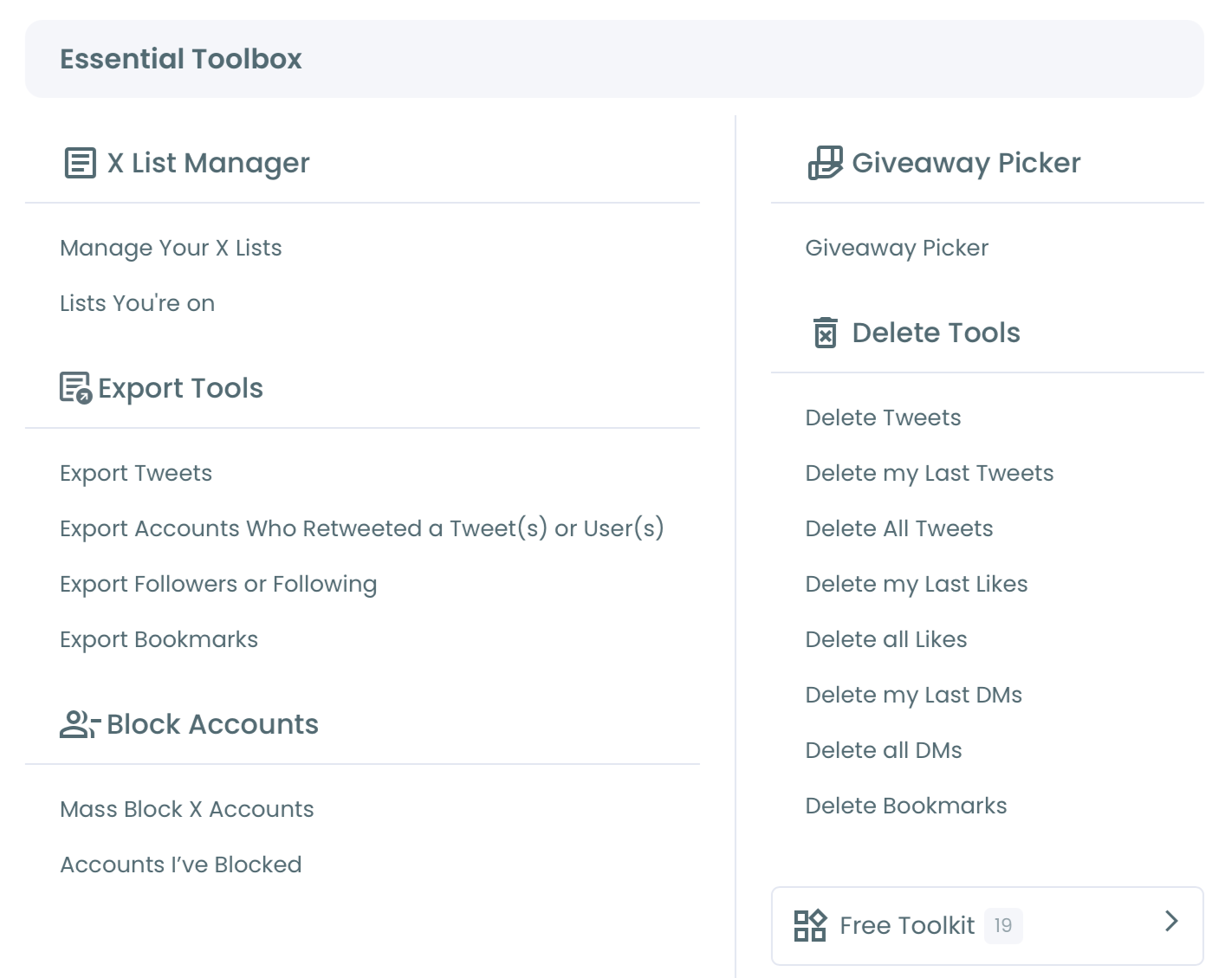
- Open Essential Toolbox and choose Mass Block X Accounts. This is the workspace for building a reviewed block queue, not for deleting third-party replies.
Build a defensible candidate set
- Choose a source that matches the observed pattern. Search followers or following of a public account when a known spam network is involved, or add affected post URLs to the Block Cart when retweeters are the relevant group.
- Filter and inspect the resulting accounts. Use signals such as follower quality, tweet count, join date, follow ratio, profile keywords, and location to narrow the list. Check individual profiles when a label alone does not establish intent.
- Whitelist people who should never enter the action. Protect customers, teammates, partners, journalists, or credible community members before you select a batch.
Confirm the boundary you intend to create
- Select reviewed accounts and add them to the Mass Block List. Staging is not the same as blocking. The persistent queue gives you a chance to remove mistakes before execution.
- Open the Twitter X Mass Blocker Chrome extension and click Start only after reviewing the queue. The extension must be installed, active, and running in an authenticated Chrome session. It processes blocks sequentially, so the browser needs to stay open.
- Let X pacing govern the operation. When a platform limit is reached, processing pauses and resumes when allowed. Do not interpret a pause as a reason to create duplicate queues.
The process separates evidence, selection, and execution. That is useful in a moderation incident because it gives the account owner a moment to reconsider before an account-level restriction takes effect.
If the reviewed evidence supports that boundary, open the Mass Block X Accounts workspace before you start the extension. The queue is the last place to catch a mistaken inclusion.
Short walkthrough: how a reviewed account list becomes a confirmed mass-block queue without claiming to remove anyone else's reply.
Why Chrome and review are part of the safeguard
The Mass Block action requires the Twitter X Mass Blocker Chrome extension. Circleboom's web interface stages and passes a confirmed queue to the extension; the extension performs blocks one by one in the browser while the Circleboom and X sessions remain active.
That requirement is not a claim of background automation. It keeps the account owner involved at the point a restrictive action occurs. Closing the browser can interrupt the operation, and a reached platform limit can pause it until X allows processing to continue.
Circleboom is an Official X Enterprise Client. That listing supports the data-access claim, but it does not grant Circleboom ownership of other users' replies or an exemption from X rules.
A moderation decision tree that stays honest
Use this simple test when you return to how to delete people's replies on Twitter:
- If you wrote the reply, delete your own post.
- If the other person's reply may violate policy, report it and preserve context.
- If you need peace in your own view, mute the account.
- If you need an account-level boundary, block it.
- If several accounts show a reviewed, evidence-backed pattern, consider a carefully selected mass-block queue.
The key is not finding a fictional delete control. It is matching the boundary to the harm. A one-person disagreement, unwanted follower, policy violation, and coordinated spam cluster are different problems with different consequences.
Keep records when the incident affects a team
Moderation becomes harder when several people publish from the same brand account. A simple incident note can make later choices more consistent without turning a reply thread into a surveillance project. Record the post URL, the reason an account was included, the action taken, and any exception that was whitelisted.
That record helps a team distinguish a block chosen for repeated abuse from a mute chosen to reduce noise. It also helps the next reviewer avoid adding the same person to a new queue solely because their name looks familiar.
For a material campaign, agree on a short threshold before anyone selects rows. For example, the threshold might require repeated spam language plus a connection to the same retweeter group. The threshold should describe observable behavior, not an opinion about a person's identity.
A defensible moderation record makes a strong action easier to review later.
Build a safer reply environment, not a false delete promise
You cannot delete another person's reply from X. You can decide how your account responds, report content that may break rules, reduce future reply exposure, and create a stronger boundary when repeated abuse warrants it.
For a reviewed pattern that genuinely requires exclusion, prepare a Mass Block X Accounts queue. It is designed to make the selection visible before the extension executes the blocks.
→ how to delete people's replies on Twitter
Common questions about reply moderation on X
Can I hide another person's reply from everyone on X?
No. You cannot delete or universally hide another user's reply simply because it is on your post. X may take action after a report if the reply violates its rules, but that decision belongs to X.
Does blocking remove an old reply?
Blocking restricts the blocked account's access and future interaction with you. It is not an editing tool for their existing post. The exact display behavior can vary with post visibility and account status, so do not treat blocking as a guaranteed reply deletion method.
Can Circleboom automatically block every negative reply?
No. Circleboom does not promise automatic censorship based on sentiment. Mass Block starts with a user-reviewed set, a confirmed queue, and an active Chrome extension.
Should I remove a follower or block them?
Remove a follower when you only need to end the current follower relationship. Block when you need the stronger restriction that prevents ongoing following, messaging, and interaction.