
One name can sit inside hundreds of your old posts. A co-founder you split from, an ex, a former employer, a client you tagged in every launch thread.
X gives you no way to gather those posts in one place, so most people scroll for a while, delete a handful by hand, and give up.
What this walkthrough gives you.A way to find every post where one @handle or name appears.Filters that separate the posts worth keeping from the rest.A delete run you approve before anything is removed.
Circleboom reads your uploaded X archive, matches a name, handle, or hashtag inside your tweet text, and deletes every post that contains it through official API access. Start with delete tweets mentioning someone.
Why one person's name ends up scattered across your timeline
A mention hides in three different shapes, and you probably used all three:
- Sometimes you typed the @handle.
- Sometimes you wrote the person's name as plain text with no handle at all.
- Sometimes you replied to them, and their handle sits at the front of the reply because X put it there, not because you typed it.
X search will not pull those three shapes together for you.
The platform's own advanced search is built to search the public firehose, not to audit your personal history, and it has no bulk action attached to the results.
There is a harder limit underneath that.
Any tool reading your account live through the X API can only reach your most recent 3,200 posts.
Say the person you want out of your history belongs to a chapter from four years ago. That content sits outside the window entirely.
The ability to remove tweets that mention a specific person therefore has to start from your archive file, not your live timeline.
The reason people go looking for this is rarely petty. A job search, a media appearance, a breakup, a company that no longer exists.
Our writeup on why you should delete tweets about your ex covers the emotional version of this cleanup. The mechanics below apply to any name at all.
What Circleboom matches when you search for a person
The keyword filter searches three fields at once: the tweet text, the @mentions inside it, and the hashtags.
That is the whole reason this works for a person rather than just a topic.
Type an @handle and you catch the tags. Type the plain name and you catch the posts where you talked about them without tagging.
Circleboom filters your full X archive by keyword, username, or hashtag. It then deletes every matching tweet, retweet, or reply on X. It does that as an official X Enterprise Developer, not through scraping.
That distinction matters more here than on most cleanup jobs.
You are about to hand a file containing your entire posting history to a third party.
The dedicated Delete Tweets by Keyword page covers the same filter aimed at topics and phrases.
Aimed at a handle, it becomes a person-level cleanup instead, and that is the shape you want when you set out to clear every tweet naming one account.
One clarification before you start, because the two get confused constantly.
Deleting your posts that mention someone is not the same as clearing the mentions other people sent to you, which is what our walkthrough on delete Twitter mentions addresses.
You control your own posts. You cannot delete theirs.
How to delete tweets mentioning someone
Watch the keyword filter run on a real archive:
https://www.youtube.com/watch?v=lJW4_85SvHo
The flow below runs in three phases: get the archive, filter it down to one person, then confirm the count before anything is removed.
Open Circleboom and request your X archive
- Log in to Circleboom Twitter and connect the X account whose history you want to clean.

- Open the Essential Toolbox menu, where the Delete Tools live.
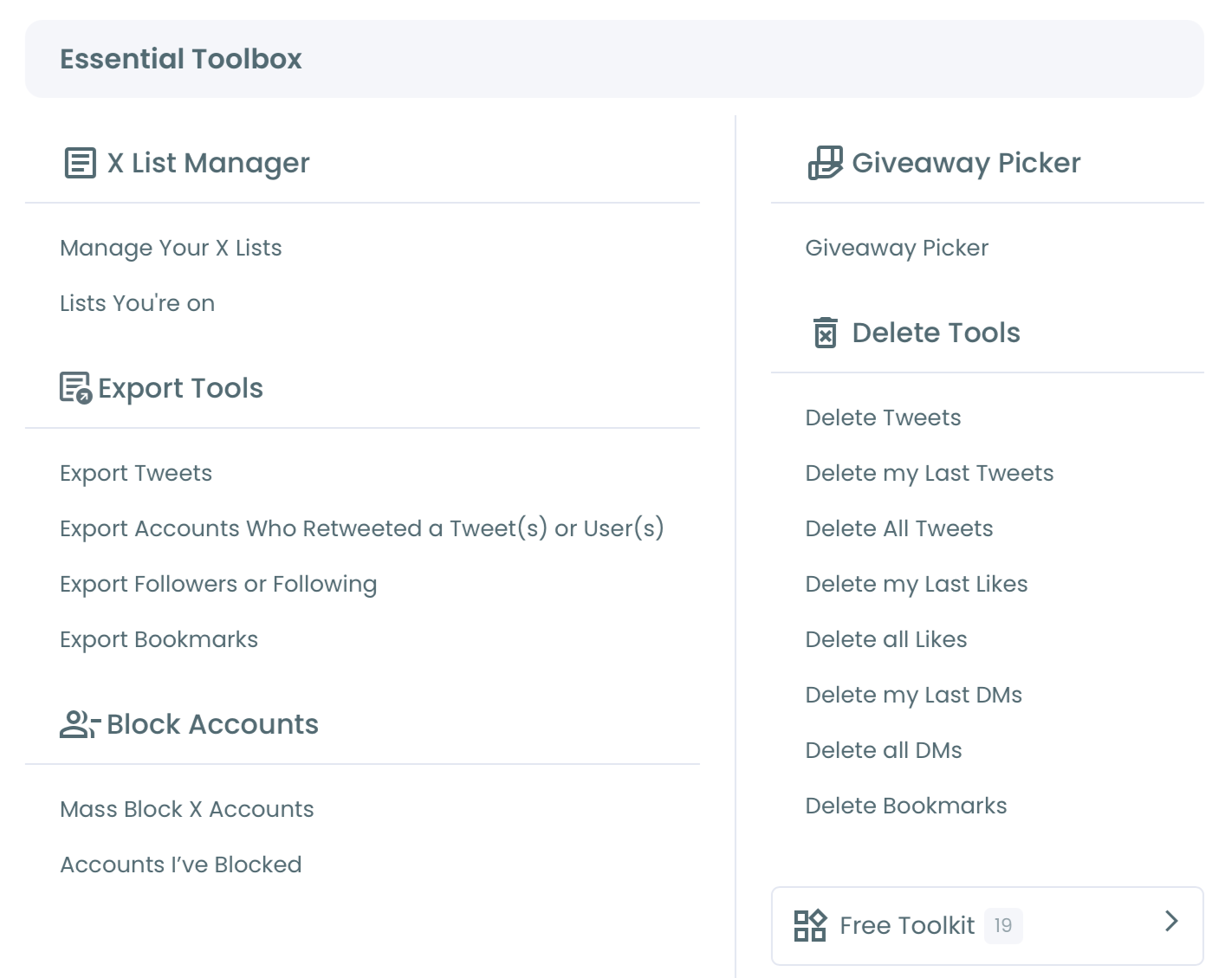
- Request your data archive from your X account settings. X generates the file on request and can take 24 to 48 hours to deliver it, and the X archive download instructions walk through where the button sits.
Filter the archive down to one person
- Upload the tweet.js file, not the full archive ZIP. It sits inside the folder you unzipped, and it has to come from the same X account linked to your Circleboom subscription.
- Type the person's @handle into the keyword, username, or hashtag field. Circleboom matches it against tweet text, mentions, and hashtags in one pass.
- Run a second pass on the plain-text spelling of their name if you also wrote about them without tagging. Nicknames and misspellings each need their own run.
Confirm the count before anything is deleted
- Check which post types should go: tweets, retweets, replies. All three are selected by default, so uncheck the ones you want to survive.
- Read the Approve & Delete panel on the right, confirm the number matches what you expect, then click Delete my Tweets.
That order protects you at every stage.
The archive gets you past the 3,200-post ceiling, the keyword field narrows the file before anything is touched, and the approval count catches a filter that ran broader than you meant.
Deletion is permanent, so that count is not a formality.
Filters worth stacking on the name search
The keyword field alone is often too blunt. A common surname will match strangers, and a short handle will match fragments you never intended.
Narrowing the run with a second filter fixes that without a second upload.
Stack any of these on top of the name:
- Date range, so only the years you were actually in contact are in scope.
- Post type, so replies go and original posts stay.
- Like and retweet count, so your highest-performing posts sit outside the run.
- Media type, so photo posts with that person survive or vanish as a set.
- Language, which matters on multilingual accounts where the same string means different things.
The narrower the filter, the smaller the regret.
You can re-upload the same tweet.js file as many times as you like and run a different filter each time. Already-deleted posts are excluded automatically on every later pass, so nothing gets processed twice.
If you would rather keep a copy of everything before any of it goes, export tweets as a spreadsheet first. Our roundup of best methods to delete tweets compares the archive path with the lighter options for recent posts.
Keep the posts that still matter with the protect list
Not every post naming that person deserves to go. A testimonial, a launch announcement, a thread that still brings you traffic, a photo from an event you would rather not lose.
The Protect List exists for exactly this: add specific posts to it and they are excluded from the delete run even when they match your filter.
That turns the job from all-or-nothing into something closer to editing.
You are not wiping a chapter, you are pulling one name out of it and leaving the rest standing.
Users who genuinely want the whole history gone can skip the list entirely, and the easiest Twitter archive eraser describes what a full reset looks like instead.
What deletion does not reach
Your posts are yours. Everything built on top of them by other accounts is not.
Quote tweets, replies, and retweets from other people that referenced your deleted posts can still exist on X, and no tool can remove third-party content on your behalf.
Search engines lag too. A deleted post can stay in a search snippet or a cached page for a while after it is gone from X, and screenshots are permanent by definition.
If someone was going to keep a record, they already have one.
Our answers to can you permanently delete tweets go through the edge cases in more detail.
That is not a reason to skip the cleanup.
It is a reason to be honest about what it buys you: a public timeline that no longer surfaces that name to anyone who scrolls it, which is what almost everyone actually wants.
When a name-level cleanup beats a full account reset
Deleting every post that mentions one person is a smaller decision than wiping your history, and the two get conflated constantly.
A full reset removes your account's entire public record: the proof, the announcements, the customer answers, the backlinks. A name-level pass removes one relationship and leaves the rest of the account intact.
Choose the narrow version when the problem is a person rather than a period. An ex-employer, a former partner, a client who churned badly, a friendship that ended in public.
Choose the full reset when the account itself no longer represents you. A rebrand, a career change, a personal account being converted into a business one.
In that case the name filter is beside the point, because everything is going anyway.
Timing is worth a thought as well. An archive request you make today arrives tomorrow, so the decision does not have to be made in the same sitting as the request.
Ask for the file, sleep on the scope, and decide when it lands.
There is a middle path most people miss. Run the name filter first, look at what comes back, and only then decide whether the wider cleanup is warranted.
The Approve & Delete count is a free preview of how entangled that person actually is with your history, and the number is often much smaller than the dread suggests.
Mistakes that make a name cleanup miss half the posts
Most incomplete runs come from the same handful of errors, and every one of them is avoidable before you click delete.
The first is filtering on the handle alone. People change usernames on X constantly, and a post from 2019 carries whatever handle they used in 2019. If you only know the current one, check an old post for the previous spelling and run that string too.
The second is forgetting replies. Replies default to selected, but plenty of people uncheck them to protect conversation threads, then wonder why a name is still all over their profile.
Most of your mentions of another account probably live in replies rather than original posts.
The third is uploading the wrong file. Only tweet.js is processed, and it has to belong to the account linked to your Circleboom subscription. A ZIP or a file from a second account will not go through.
The fourth is treating one pass as the whole job. Handle, plain name, nickname, and hashtag are four separate strings, and each needs its own run against the same uploaded file.
None of these cost anything to fix. Re-uploading the archive is free, the tool skips what it already removed, and a second run takes a fraction of the time the first one did.
Your next moves
Working through this in order takes one afternoon, most of which is waiting on X to build your archive:
- Request the archive today, since the 24 to 48 hour wait is the long pole.
- Export a backup copy of your history before you delete anything.
- Run the @handle filter first, then a second pass on the plain-text name.
- Add anything worth keeping to the Protect List before you approve.
- Check the Approve & Delete count against what you expect, then run it.
The whole point of the archive route is that it reaches the years the API cannot see, which is usually exactly where the name you want gone is buried.
→ Delete tweets mentioning someone by name
What to know before you start
Can I delete tweets mentioning someone without deleting everything else?
Yes. The keyword, username, and hashtag filter narrows the run to posts containing that string, and the Protect List lets you exclude specific posts that match but should stay.
What happens if I upload a tweet.js file from a different account?
Nothing gets processed. The file has to come from the same X account that is linked to your Circleboom subscription, and only tweet.js is read rather than the full archive ZIP. A mismatched or wrongly named file is turned away before any filter ever runs against it.
Can I keep the photos of that person and delete only the text posts?
Yes. The media type filter separates posts with a photo, video, or GIF attached from posts carrying no media at all, so you can point the name filter at one of those groups and leave the other group standing untouched.
Will deleting my posts remove their replies mentioning me?
No. Replies, quote tweets, and retweets from other accounts belong to those accounts. Removing your own posts breaks the context, but the third-party posts themselves stay online unless their owners delete them.