

To download all tweets from a user, run an API-based export against any public X account and receive the most recent 3,200 posts as a structured CSV. That single method covers your own account and anyone else's, with no login to their profile required.
Downloading a user's tweets comes down to three things.Every public account's most recent 3,200 tweets, pulled in one pass.A clean CSV with text, dates, and engagement numbers on every row.Your own timeline or anyone else's, with no access to their credentials.
Circleboom exports tweets from any public X account into a structured spreadsheet through official, policy-compliant API access. Start by choosing to download all tweets from a user.

What "Download All Tweets" Actually Means on X
Two very different requests hide inside the phrase "download all tweets from a user," and picking the wrong one wastes hours.
The first is your own full history. X gives that to you through its account archive, a machine-readable ZIP of HTML and JSON files that starts with your first post. It is complete, but it only works for the account you are logged into, and it can take a few days to arrive. The official steps live in the X archive help page.
The second request is the one most people actually mean. They want a readable, sortable file of a user's tweets, often someone else's, ready for analysis today. X has no native button for that.
This is where an API-based export earns its place. A quick primer on can I download my tweets is enough to confirm the idea before you commit.
From there, you can download all tweets from a user in a single pass, with no multi-day archive job to wait on and no ZIP to unpack. The file arrives ready to read.
The 3,200 Ceiling Is a Platform Constant, Not a Tool Feature
Here is the detail buried under most "best tweet exporter" lists: the 3,200-tweet limit is the same everywhere.
Browser extensions, Python scripts, and CSV exporters all read from the same public timeline endpoint X exposes, and that endpoint returns a maximum of the 3,200 most recent tweets per account. No plan, no paid upgrade, and no clever workaround extends it. When a tool advertises "unlimited" tweet export, it is either counting your own archive, which is a different data source, or overstating what the API allows.
That reframes the whole decision. You are not choosing a tool that beats the ceiling. You are choosing how clean, filtered, and safe the data is on the way out. The same point surfaces in the walkthrough on how to export all tweets of an X user to Excel or CSV. Every method it covers lands on the identical 3,200 cap.
So what if a user has 20,000 tweets and you need the early ones? For your own account, request the native archive, which reaches back to your first post. For someone else's account, the older tweets are simply out of reach through any compliant path, because X does not expose them beyond the recent-timeline window. Knowing that upfront saves you from chasing a "full history" export that no legitimate tool can deliver.
- Your own account, full history: use X's native archive. Slow, raw, complete.
- Any public account, recent 3,200, usable today: use an API export like Circleboom.
- Older than 3,200 on someone else's account: not available through any compliant method.
The ceiling is fixed; data quality and safety are what you actually pick between.
How Circleboom Downloads a User's Tweets Safely
Circleboom reads tweet data as an official X Enterprise Developer, so every export stays inside X's own rules rather than scraping the site behind X's back. That distinction matters most when the account you are exporting is not your own.
Each row in the file carries the tweet ID, username, creation date, language, tweet type, a media flag, the full text, and the engagement columns: impressions, likes, retweets, quotes, replies, and bookmarks. You can filter by date range, engagement threshold, post type, keyword, or language before the export runs. The CSV then holds the exact slice you want instead of a raw dump you have to clean later.
If your goal is a performance read rather than a backup, that filtering turns an export into Twitter content performance analysis you can sort in seconds. Circleboom sends the finished CSV to your email and also stores it on your account page, so a lost email never means a lost export.
Two accuracy notes keep expectations honest. The file is a point-in-time snapshot, so likes and impressions reflect the moment you ran the export and will not update afterward. Impression data also depends on the account and X's access level for it, so a handful of accounts return partial or zero impression counts. Everything else in the row stays reliable.
When the Account Isn't Yours
The export works the same whether the handle is yours or a stranger's, and that symmetry is the feature most guides miss.
For your own account, the export is a fast backup and a performance record you can keep offline. You can pull it before a cleanup, hand it to a stakeholder, or store it as a snapshot of what you published this quarter.
For someone else's account, the export is a research tool. You enter a competitor's or an influencer's public handle and receive the same structured file, with no access to their login and no request to their inbox. The only requirement is that the account is public.
When the handle belongs to a rival, that file becomes the backbone of a study you would otherwise run by eye. A companion read on Twitter analytics for another account shows how far the research goes once the numbers sit in sortable columns.
That single capability separates an API export from X's native archive, which never leaves your own account. It is also why the phrase "download all tweets from a user" usually means someone else's tweets, not your own.
- Your own account: backup, offline record, pre-cleanup safety net.
- A public account you study: competitor and influencer research, benchmarking, audits.
- A protected account: not exportable, since its posts are not public.
The mechanics are identical across the first two cases. You connect once, type a handle, and the file arrives. What changes is only why you are pulling it, not how. The tool does not care whose timeline it reads, only that the posts are public and sit within the recent window the API exposes.
How to Download All Tweets from a User
The flow, in order, from a blank screen to a downloaded file.
- Log in to Circleboom Twitter and connect your X account with official OAuth. You never hand over the target account's password, only your own session.
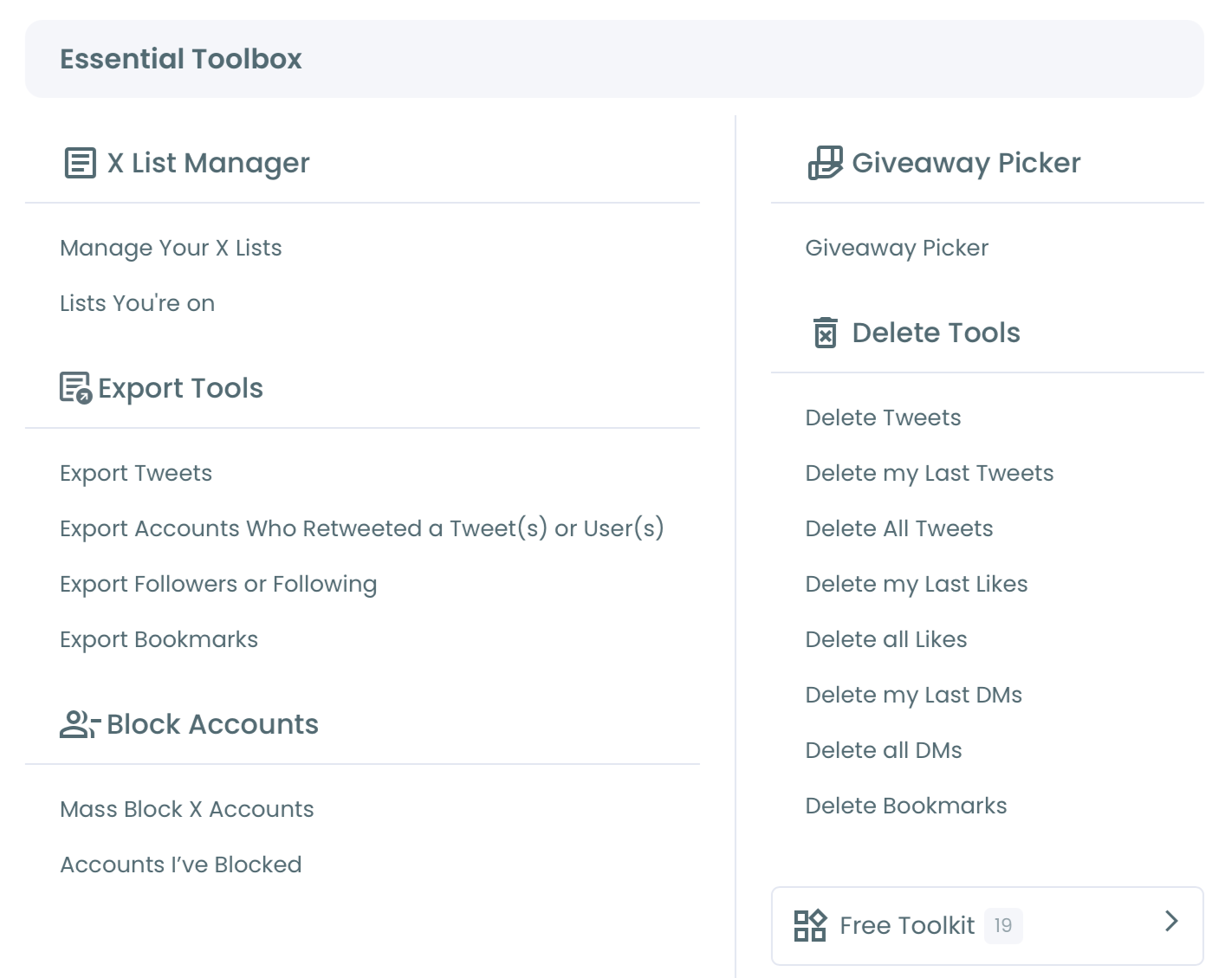
- Open the Export Tweets tool inside the Essential Toolbox.
- Type any public X username into the search field and let Circleboom fetch the tweet count so you know the scope before you commit.
- Set your filters, confirm the export, and enter your delivery email. The CSV lands in your inbox and on your Circleboom account page, ready for Excel, Google Sheets, or a BI tool.
That order works because the login earns official API access first, the username check confirms scope before you spend anything, and the filter step decides data quality before the file is ever built.
See it done end to end: the full username-to-CSV export for any public account in one short run.
Why the CSV Beats the Native Archive for Analysis
X's archive was built for compliance and personal backup, not for spreadsheets. It hands you nested JSON and HTML that most people never open twice.
An API export flips that. The moment the file opens, you can sort by impressions, filter to tweets above a like threshold, or isolate a campaign window, none of which the native download makes easy.
If you plan to keep the file in a shared workspace, the walkthrough on how to save your Twitter data to Google Sheets pairs cleanly with this step. It turns a one-time download into a living dataset your team can reference.
When you want the theory behind the numbers in those columns, Twitter analytics metrics and insights explains what each field is telling you. A column like impressions or bookmarks then becomes a signal instead of a mystery.
There is also a housekeeping reason to export first. If a tweet cleanup is coming, the CSV is your only recovery record, so many people export before they delete all your tweets rather than after. A finished export is the safety net a bulk deletion can lean on, because Circleboom cannot undo a completed deletion.
What the Engagement Columns Tell You
Each metric column answers a different question about a tweet, and reading them together is where the file earns its keep.
Impressions measure reach: how many times the post was served, whether or not anyone acted on it. A post with high impressions and low engagement was shown widely but did not connect, which is a content signal worth catching.
Likes and retweets measure approval and spread. A like is cheap, so a high like count with few retweets means people agreed but did not pass it on. Retweets cost the reader more, so they are the stronger signal that a post actually traveled.
Replies measure conversation. A high reply count can mean a post sparked discussion, or that it provoked disagreement, so replies are read alongside the text rather than on their own.
Bookmarks measure intent. When someone bookmarks a post, they plan to return to it, which is the closest thing X reports to lasting value. A quietly bookmarked post often outperforms a loudly liked one over time.
Reading these columns side by side turns a flat list of tweets into a map of what an account does well:
- Impressions: raw reach, before any reaction.
- Retweets and bookmarks: the durable signals of spread and intent.
- Replies: conversation volume, read with the text, not alone.
The native archive reports none of this in a usable form, which is the practical reason an analyst reaches for the CSV instead. The columns are already there in the file; you only have to sort them to see the pattern.
The Bottom Line
Downloading a user's tweets is one decision, not many. Native archive for your own full history, or an official API export for any public account's most recent 3,200 posts in a clean, filtered CSV.
The 3,200 ceiling is the same for every method, so the real choice is data quality and account safety, and an Enterprise-grade export wins both. Pull the file, sort it, and you have a working dataset in minutes instead of a multi-day wait.
→ Download all tweets from a user
Questions About Downloading Tweets from Any Account
Can I download tweets from another user's account?
Yes. Circleboom exports the most recent 3,200 tweets from any public X account, so you can pull a competitor's or an influencer's posts without their credentials. Protected accounts cannot be exported, since their tweets are not publicly available through the API.
Why can't I download more than 3,200 tweets?
The 3,200-tweet cap comes from X's public timeline API, not from Circleboom. It applies to every export tool and script that reads the same endpoint. The only path to older history is X's own account archive, and only for the account you own.
What format is the download, and what is inside it?
The export is a CSV you can open in Excel or Google Sheets. Each row holds one tweet with its text, date, language, tweet type, media flag, and engagement columns, including impressions, likes, retweets, quotes, replies, and bookmarks.
Is exporting someone's tweets against X's rules?
No, when the data comes through official channels. Circleboom retrieves public tweets through official, compliant API access and only touches publicly available posts, which keeps the export safe for your own account too. You can start your own download all tweets from a user run whenever you are ready.




)


