
The export job was already running when the marketing director sent the next message. "Can we get follower count, bio, and account-creation date on every row?"
The job was 1,400 rows into a 12,000-follower export, the columns had been configured at launch, and the answer was yes. By the time her email had been read, the CSV had finished, opened in Google Sheets, and showed exactly the three columns she asked about, plus seven more that turned out to matter once she started filtering.
Two hours later, the audience had been segmented into three target lists, the lookalike profile for the upcoming campaign was a defensible document, and the day's work was done.
A clean follower export turns the audience into a structured dataset you can actually filter, segment, and act on. The Circleboom workflow runs through the official X Enterprise API, collects the available profile signals on each account, and outputs CSV that opens cleanly in Google Sheets or Excel. The output is the input to the audience-segmentation, lookalike-modeling, and outreach-list work the export was supposed to enable in the first place. → Export your Twitter followers to a spreadsheet
Why the Export Has to Be More Than a Username Column
A username-only export is the default failure mode when you export your Twitter followers list. A list of 12,000 handles is not a usable dataset; it is a starting point that someone still has to enrich with manual lookups, browser scrolling, or another tool that does what the export should have done the first time. The cost of an underbuilt export is the operator time spent re-doing work that should have arrived complete.
The signal that matters is the column count. A defensible follower export includes username, display name, bio, follower and following counts, posting volume, account-creation date, verification flag, and any platform-exposed signals that are stable enough to query reliably. Each of those columns answers a different filter question. Account-creation date filters out probable bots and brand-new accounts. Bio text enables keyword-based segmentation. Follower count enables influence stratification. Posting volume separates active accounts from dormant ones.
Circleboom's piece on whether you can export your Twitter followers covers the platform-side constraints and explains why the export has to come from a sanctioned API path rather than a scraping tool, which is the structural reason the column set is reliable rather than partial.
What the Spreadsheet Should Let You Do
A complete export is judged by what the operator can do with it inside the spreadsheet. Three workflows justify the effort of building the column set right the first time.
The first workflow is segmentation. A filter that pulls followers whose bio contains a target keyword, whose follower count is above a threshold, and whose posting frequency is above a floor produces a high-quality outreach list in two clicks. The same filter run against a username-only export takes a week of enrichment work.
The second workflow is lookalike modeling. A frequency analysis across the bio text column and the follower-count distribution surfaces the audience archetype the account has actually attracted, which is often different from the archetype the operator assumed. The lookalike target for the next campaign comes from the data, not from the operator's prior beliefs.
The third workflow is competitor comparison. Exporting a competitor's public follower list (same column set, separate sheet) and joining the two datasets on username produces a shared-audience analysis that quantifies overlap, identifies untapped reach, and shows where the competitor is winning a segment the operator's own positioning could capture.
Circleboom's piece on exporting Twitter followers for hyper-targeted ads covers the ad-targeting variant of the same downstream work, and the column structure that makes the ads work is the same structure that makes the organic outreach work.
How to Export Twitter Followers to a Spreadsheet Step by Step
The workflow runs in two phases: the export configuration, then the CSV download and validation. A typical 10,000-follower export takes 15 to 25 minutes depending on platform rate-limit windows and account size.
Phase 1: Configure the Export
Log in to Circleboom Twitter
- Log in to Circleboom Twitter with the X account whose follower list you want to export, or with any X account if you are exporting another public account's followers. The login uses OAuth, so the credentials never pass through Circleboom directly.

Open the Essential Toolbox menu
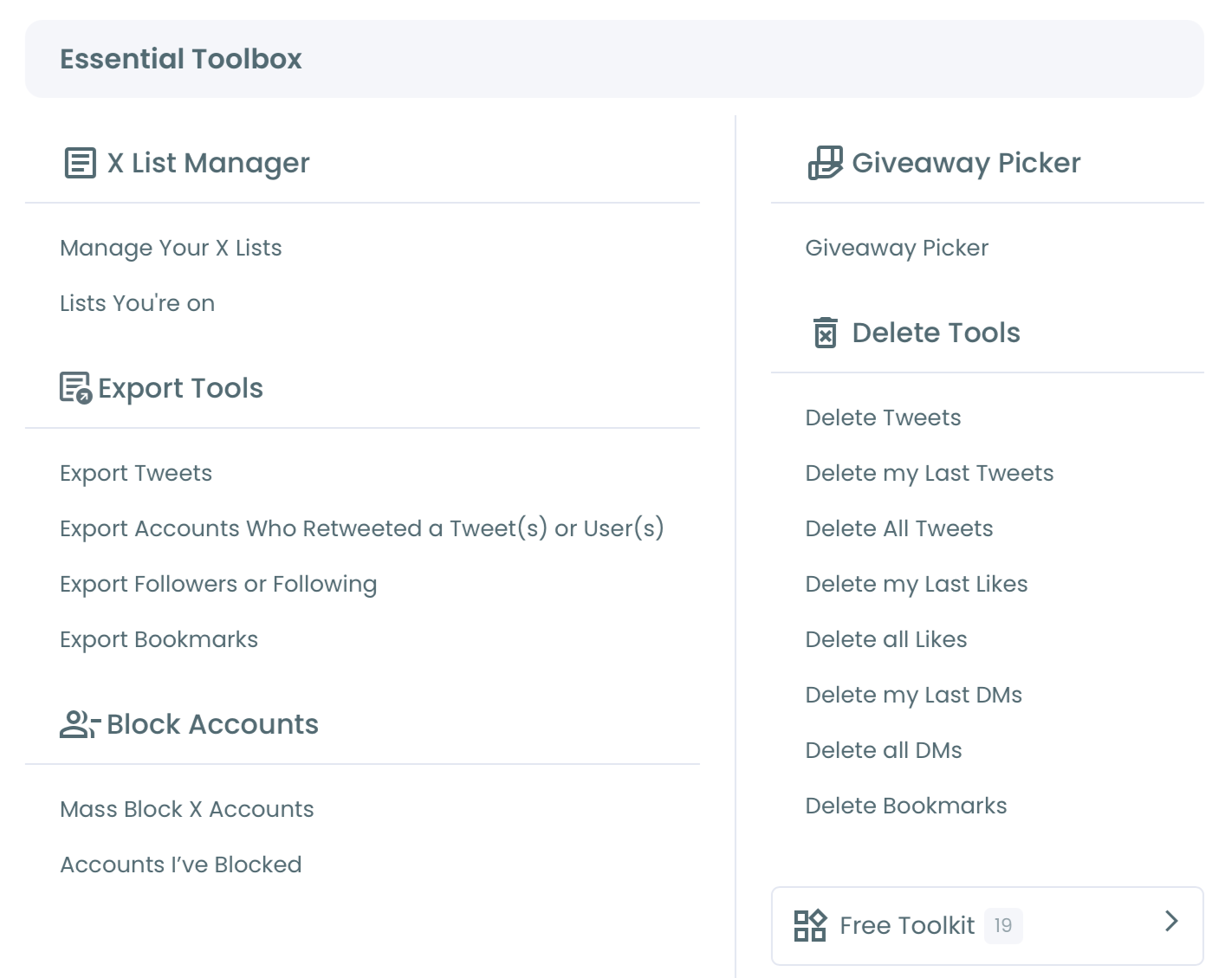
- Open the Essential Toolbox menu in the left navigation and find the Export Tools section. This is the surface where the follower and following exports live.
Choose the account and the export type
- Enter the username of the account whose followers you want to export and choose the export type: followers, following, or both. Confirm the column set defaults (username, display name, bio, follower count, following count, posting count, account-creation date, verification flag) and adjust if the downstream workflow needs additional or fewer columns.
Phase 2: Run the Export and Validate the CSV
Start the export job and wait for completion
- Start the export job and wait for completion. The job pace depends on follower-list size and the platform's rate-limit window. A list of fewer than 5,000 followers usually finishes in under five minutes; a list of 50,000 followers can take 30 to 90 minutes and may queue across two rate-limit windows. The job progress is visible in the dashboard.
Download the CSV and verify the column set
- Download the CSV file and open it in Google Sheets or Excel. Verify the column set matches the configuration; verify the row count matches the platform's published follower count (small variances are expected because of accounts that were suspended or deleted between the count and the export); verify the date format is consistent across the account-creation column.
Apply the first filter and confirm the data quality
- Apply the first filter the downstream workflow needs and confirm the result against expectation. A keyword filter on bio text should return a reasonable count; a follower-count threshold should produce a sensible stratification; an account-creation-date filter should match the rough age distribution of the audience.
The six-step sequence is the full workflow. The OAuth login earns sanctioned API access. The menu navigation reaches the export surface. The configuration step defines the column set. The export job runs against the X API. The CSV download produces the working file. The validation step catches column-format issues before they reach the downstream analysis.
Video walkthrough: the follower export, the column configuration, and the CSV download end to end.
What the Export Produces
The output is a CSV file with one row per follower, a complete column set covering profile-level signals, and a structure that opens cleanly in Google Sheets, Excel, Airtable, or any CRM that accepts CSV import. The file is the input to segmentation, lookalike modeling, and competitive analysis work; it is not the end product but the start of the work the export was supposed to enable.
The Circleboom workflow uses the official X Enterprise APIs for the data retrieval, which is the structural reason the column set is stable and the export is policy-compliant. The X API exposes the profile-level signals on a per-account basis, and the export job concatenates those signals into the CSV row by row.
Two adjacent surfaces extend the workflow. The export Twitter following list landing covers the following-side variant of the same export. The export Twitter analytics landing covers the analytics-export variant that pairs with the follower CSV for engagement analysis.
Related Circleboom reading on the follower-export theme.
- How do you export and save followers on Twitter on the practical follower-save workflow and the format choices that matter.
- How to export your Twitter data and save on Google Sheets on the Google Sheets side of the same export, including the import settings that preserve the date format.
Where the Export Goes Next
A 12,000-follower export produces a spreadsheet whose first ten minutes of filtering usually surface insights the operator did not have access to before. The bio-keyword filter shows which themes the audience is self-describing. The follower-count stratification shows where the inbound reach is concentrated. The account-creation-date filter shows the rough composition of new versus established accounts.
The next step depends on the downstream goal. Outreach lists come from the bio-keyword filter joined with the follower-count threshold. Lookalike modeling comes from the frequency analysis across multiple columns. Competitive analysis comes from a parallel export of a competitor's follower list and a join on the username column.
The compounding value shows up on the second and third exports. The first export establishes the column set and the validation routine. The second export is faster because the configuration is saved and the validation is a comparison against the prior month's file.
By the third export, the workflow is a 20-minute task that produces the input to the next campaign's audience work. Export your Twitter followers to a spreadsheet and the audience stops being a number on the profile and starts being a working dataset.
Still Wondering?
How large a follower list can the export handle?
The export job is limited by the X API's rate-limit windows and the platform's account-level limits, not by the export tool itself. In practice, exports up to a few hundred thousand followers complete inside one or two rate-limit windows. Exports of multi-million-follower lists run across multiple windows and may take a day or more to complete. The job progress is visible throughout, and the partial CSV is available at each window boundary in case the job needs to be paused.
Can I export the followers of an account I do not own?
Yes, as long as the target account is public. The export works against the publicly visible follower list of any open X account. Private accounts do not expose their follower list to non-followers, and the export reflects that platform constraint. The Circleboom export does not bypass the platform's privacy rules; it works inside them by using the sanctioned API surfaces that respect account-level privacy settings.
What columns are actually available, and which ones are optional?
The default column set covers username, display name, bio text, follower count, following count, posting count, account-creation date, and verification flag. Optional columns include location, language, profile-image URL, and pinned-post identifier where the API exposes them. Some columns may be sparsely populated because the underlying X profile does not have the field filled out, which is a data-quality reality rather than an export limitation.
How fresh is the data in the CSV?
The CSV reflects the state of the target follower list at the time the export job ran. The X API is live, so each row's profile signals are current at the row's fetch timestamp. Operators who need point-in-time snapshots typically run the export once and then re-run it on a cadence (weekly, monthly) to track changes; the differential analysis between two exports is often more valuable than any single snapshot.
Can the CSV be imported directly into a CRM?
Most CRMs that accept CSV import will accept the file directly, with the username column mapping to the X-handle field and the other columns mapping to custom fields. The import works most cleanly when the CRM is configured to expect a CSV with a header row and UTF-8 encoding, both of which the Circleboom export produces by default.