
You can see every recently created account in your follower list by reading follower join dates as a group, and Circleboom is where that view lives. The harder part starts after the list loads, because a fresh join date on its own proves nothing about the person behind it.
How do I see which of my Twitter followers just joined?
Circleboom reads the creation date of every account that follows you on X through the official X API and groups the newest ones together, with tweet count, follow ratio and engagement level sitting in the same row. Join date is a sorting signal, not a verdict.
→ brand new accounts following me on Twitter
Is a brand new Twitter follower a bot?
No. Real people join X every day, and every one of them starts the same way: zero tweets, no profile photo yet, and a following list three accounts long.
For roughly the first week, that profile is indistinguishable from a throwaway.
The reason people ask the question at all is that spam waves are built from fresh accounts, so recency and risk genuinely do overlap. They just do not overlap enough to act on.
X publishes its platform manipulation and spam policy in terms of coordinated behavior, not account age, which is the same distinction that should govern your follower list.
What to check before you judge a new arrival
Timing beats age as a first read. The question why am I all of a sudden getting new followers usually resolves to one post. Something travelled further than your normal reach, and new accounts followed it, because trending posts are what a new account sees first.
That timing matters. A cluster of fresh accounts after a giveaway means something different from the same cluster after a mention by a large account, and different again from a cluster that shows up in a quiet week with no trigger at all.
Pruning before you know which of the three you are looking at is how good followers get cut.
You can pull the newly created Twitter accounts in your followers in a single view and judge them against that context.
Read the cohort, not the account
Here is the shift that makes this segment useful: the unit of analysis is the group of new followers, not any individual new follower. One account created last Tuesday tells you nothing. Forty accounts created inside the same nine-day stretch, all arriving on your profile within two days of each other, is a shape, and shapes are readable.
The practical version is a share calculation rather than a character judgment.
Say your last 120 followers include 5 accounts younger than a month. That is ordinary churn.
Say the same 120 include 60 accounts younger than a month, all with follow ratios under 0.05. That is a cohort, and it arrived for a reason you can usually trace back to a specific post or campaign.
What the share number does not prove
Notice what the second reading does not claim. It does not say those 60 accounts are fake.
It says the share is far outside your normal pattern, which is a reason to look closer, and closer means the other columns rather than the join date you already have.
A cohort of 60 real newcomers from a genuinely viral post looks the same on the date axis and completely different on the tweet-count axis.
This is why the Twitter Join Date Checker matters more as a filter than as a lookup. A single date answers trivia. A date range answers whether your growth was real.
Reading the group instead of the profile also saves you from the worst failure mode here, which is removing a customer because they joined last month. Circleboom can list your newly created Twitter followers and friends as one block you scroll rather than a search you repeat.
What the follower table shows before you open a profile
Circleboom lays every follower out as a row, and the row carries enough to make the cohort call without visiting anyone's profile. The columns you will read most often are:
- Joined, which shows the account's creation date and how many days ago that was.
- Tweets, the total number of posts the account has published.
- Follow Ratio, the follower-to-following relationship expressed as a single number.
- Active & Inactive, which classifies the account as high, medium or low engagement.
Every one of those column headers sorts. Click Joined once for oldest first, click again for newest first, and the newest cohort stacks at the top of the page where you can actually count it.
If you would rather not check manually each week, you can monitor new Twitter followers without checking notifications and let the arrival list come to you.
Four columns read side by side is usually enough to settle a whole cohort in one sitting, which is the difference between a follower audit and a guess. Open the brand new accounts following me on Twitter view and the four values are already lined up for you.
Which filters actually change the answer
The filter panel opens as a side drawer from the Filter Options button, and not every control in it is worth your time on this segment. Three groups do most of the work.
Follower Quality is the first. It holds five separate dropdowns, one each for Eggheads, Protected, Fake/Spam, Inactive and Overactive, and each dropdown can show that account type, hide it, or make it the only type on screen.
Setting Eggheads to "only" against a narrow join-date band is the fastest way to isolate accounts that are both new and faceless.
The numeric ranges are the second group. Tweet Count, Follow Ratio, Follower Count and Following Count all take a minimum and a maximum, so you can describe the shape you are hunting instead of eyeballing it.
Text search is the third. Find in Bio & Name searches the display name and the bio together, which catches the copy-paste bios that spam batches share. Filter by Location and Filter by Language narrow the same way when a cohort arrives from one place.
Whatever combination you build, an Active Filters bar appears above the list showing each filter as a removable tag, with Clear All Filters to reset the whole thing. Check that bar before any bulk action; it is the only honest record of what is currently on screen.
How to find brand new accounts following me on Twitter, step by step
Hands-on: reading the Joined column and the join-date window on a live follower list.
https://www.youtube.com/watch?v=FQPflECsi8w
The flow below runs in three passes: load the segment, set the date window that matters to you, then split the genuine newcomers from the empty shells.
Circleboom pulls follower data as an official X (Twitter) Enterprise Developer. The consequence for this specific job is precision: the join dates are read from the platform itself, not estimated from a public profile page that only shows month and year.
Load the segment before you judge anything
- Log in to Circleboom Twitter and connect your X account.

- Open the Follower & Following menu, which holds every audience view Circleboom builds from your follower list.
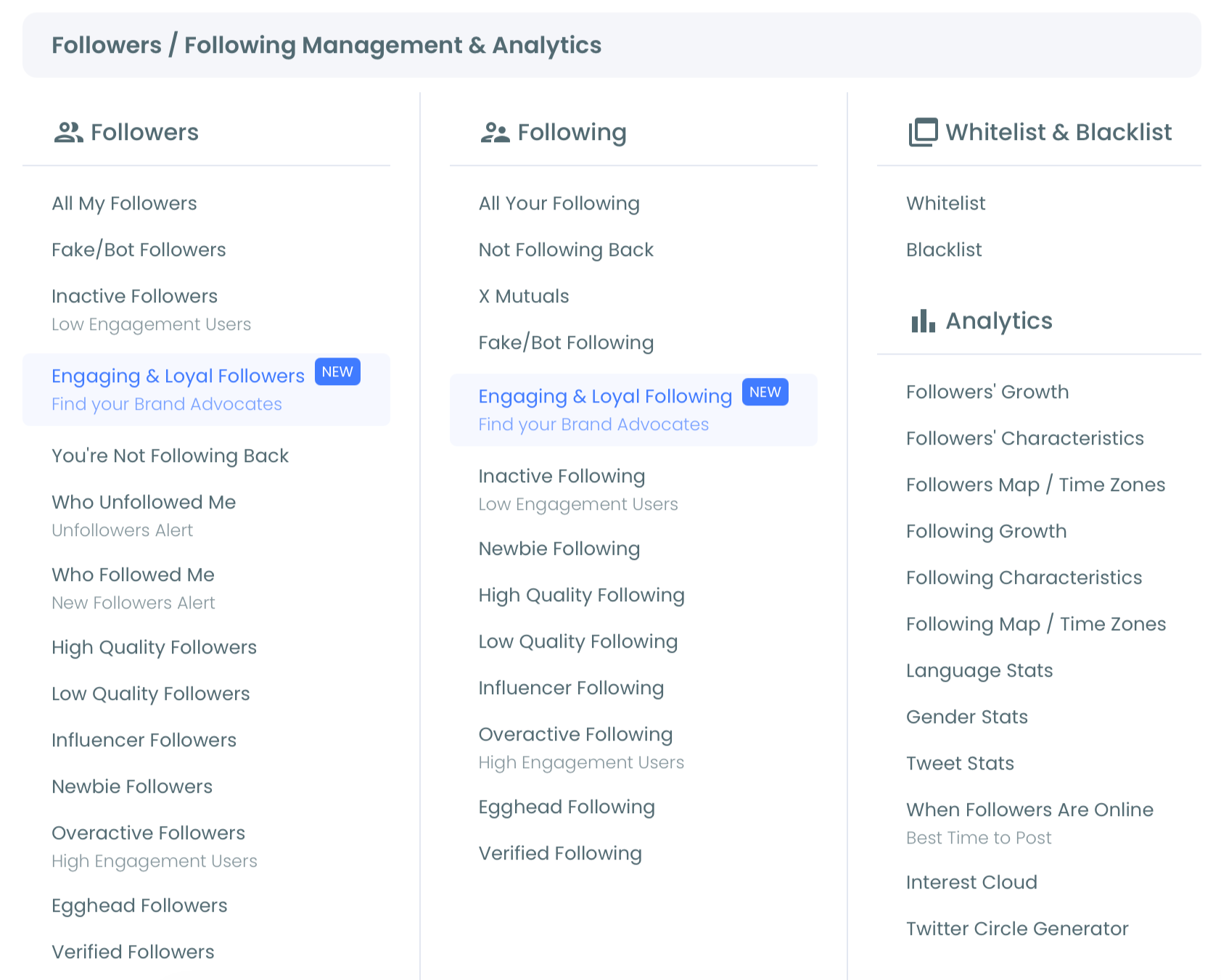
- Select the Newbie Followers view to see only the followers whose accounts were created recently.
Set the window that matches your growth event
- Click Filter Options and fill in the Join Date Earliest and Latest fields. Circleboom does not force its own idea of recent on you; you type the two dates and the list narrows to that band.
- Sort by the Joined column so the freshest arrivals sit at the top and the cohort becomes countable at a glance.
Split the real newcomers from the empty shells
- Add Tweet Count and Follow Ratio ranges in the same filter panel. An account with a handful of posts and a balanced ratio reads as a person; zero posts against a thousand follows reads as a follow farm.
- Whitelist the accounts you recognise before you act on anything else, using the Whitelist option in the Add to List dropdown so they stay out of every future bulk operation.
The protection step lands last for a reason, and it is the reason the order holds.
The date band cuts the population down to the arrivals you are actually asking about. The quality filters split that population in two. Only then can you see clearly enough to whitelist the people you already know, before any removal enters the picture.
Run those out of order and you are deciding on a list you have not defined yet.
Load, band, split, protect.
When removing a new follower is the right call
Removal earns its place when a new account combines several weak signals at once, not when it is simply young. The pattern worth acting on is a recent creation date next to zero posts, an empty bio, no profile photo and a following count in the thousands against double-digit followers.
Circleboom keeps whitelisting and blacklisting on the same screen for exactly this reason. It is worth reading how to blacklist and whitelist Twitter accounts on Circleboom before you run anything in bulk.
Bulk Remove Follower runs through the Circleboom Remove Twitter/X Followers Extension, because the X API does not expose follower removal to third-party tools directly. That is an architectural fact rather than a setting, so plan for the extension install if removal is where you expect to land.
The upside nobody mentions
One more habit worth building: check the arrivals list on a rhythm rather than in a panic. Circleboom also tells you who followed me on Twitter so the newest names reach you without a manual sweep.
There is a second reason to look early, and it has nothing to do with spam. A brand new follower is the easiest one to turn into a regular, because they are still deciding who is worth reading.
Reply to one of them in their first week and you are competing against almost nobody for their attention.
What the join date is for, and what it is not
A recent join date narrows your attention; it never decides anything.
Circleboom groups the newest accounts in your follower list on X, then hands you tweet count, follow ratio and engagement class in the same row so the decision rests on behavior instead of age. Read the cohort, protect the people you recognise, and act only where several weak signals stack up.
The segment stays readable for as long as the accounts stay new, which is a narrow window. After a couple of months a bot created during your growth spike looks exactly like a follower you have had for years, and the chance to sort them cleanly is gone.
→ list your newest Twitter followers
Questions about new followers on Twitter, answered
How far back can I set the join date filter?
As far as you want. The Join Date filter takes an Earliest and a Latest value, so you can band the list to a single week around a viral post or open it up to several years.
Will a wave of new followers hurt my engagement rate?
It can, arithmetically. Engagement rate divides interactions by follower count, so a burst of accounts that never read anything lowers the number without changing your content. That is a measurement effect rather than a reach penalty, and it corrects itself either when those accounts start reading or when you remove them.
Can I follow new accounts back in bulk from this view?
Yes. Select the rows you want and use the Follow action, and Circleboom paces the requests inside X's limits rather than firing them all at once. Sorting by join date first is a fast way to search Twitter accounts by join date before you commit to anything.
What happens to a whitelisted account later?
It stays out of bulk operations across the platform, which is the point of marking it. A whitelisted follower still shows in the list and still carries all its columns; it simply stops being selectable when you run a batch action, so a future cleanup cannot catch it by accident.