
The fastest way to find inactive accounts you follow on X is to run your full following list through Circleboom's Inactive Following view, which flags every account you follow that has gone quiet based on account age and tweet frequency. From there you filter, protect the accounts that matter, and unfollow the rest in safe batches.
Circleboom scans your entire following list and classifies each account as active, moderately active, or inactive on Twitter through the official X API, so you can spot dead follows without checking profiles one by one.
→ find inactive accounts you follow on X
Below: how the classification works, and the exact cleanup order that keeps your account safe.
Most guides on this topic quietly conflate two different problems. Cleaning inactive followers changes who is in your audience. Cleaning inactive following changes what reaches your feed, and it also corrects your public following count. This article is about the second one, because knowing how to find inactive accounts I follow on Twitter X is the cleanup almost nobody runs deliberately.
Native X gives you no way to see long-term inactivity across the accounts you follow. You can scroll your following list, but the interface shows you a name and a bio, not whether that account has posted in the past year.
So the inactive layer builds up silently: event follows that went cold, projects that shut down, people who moved to other platforms. If you want to clean up the inactive accounts you follow without opening a thousand profiles, you need a tool that reads activity signals in bulk.
Why Inactive Following Quietly Costs You
An inactive account you follow pays a double cost. It sits in your following count, a number visible on your public profile, without adding a single post to your timeline.
Consider the math plainly. If you follow 2,000 accounts and 800 of them have been silent for over a year, your feed is really being driven by 1,200 accounts, while your ratio and your following count are inflated by the dead 800. Trimming that layer does not reduce what you see. It makes room for active accounts to be more visible and lets you follow new, relevant people without pushing your following number higher. If you want the reasoning behind why this layer is worth clearing at all, Circleboom's guide on the need to unfollow inactive Twitter accounts lays out the strategic case. It runs from timeline quality to the ratio signals other people read off your profile.
There is a second reason this matters that most readers miss. X enforces a technical follow limit and a ratio-based cap once you pass 5,000 follows, documented in X's official follow-limit rules. Every inactive follow you carry is a slot spent on an account that gives you nothing back, which is exactly the wrong way to spend a limited resource.
Circleboom is an official X Enterprise Developer company, so every account it reads and every unfollow it runs happens through sanctioned API access, not scraping. That distinction matters most at the moment you act on your account at scale.
How to Find Inactive Accounts You Follow on X, Step by Step
To find the inactive accounts you follow, connect your account, open the Inactive Following view, confirm the classification with filters, protect the rare-but-valuable accounts, and unfollow the rest gradually. The whole flow runs in two phases.
Watch it work: how a full following list sorts into active, moderate, and inactive tiers before a single unfollow.
Connect your account and open the Inactive Following view
- Log in to Circleboom Twitter and authorize your X account with official OAuth.
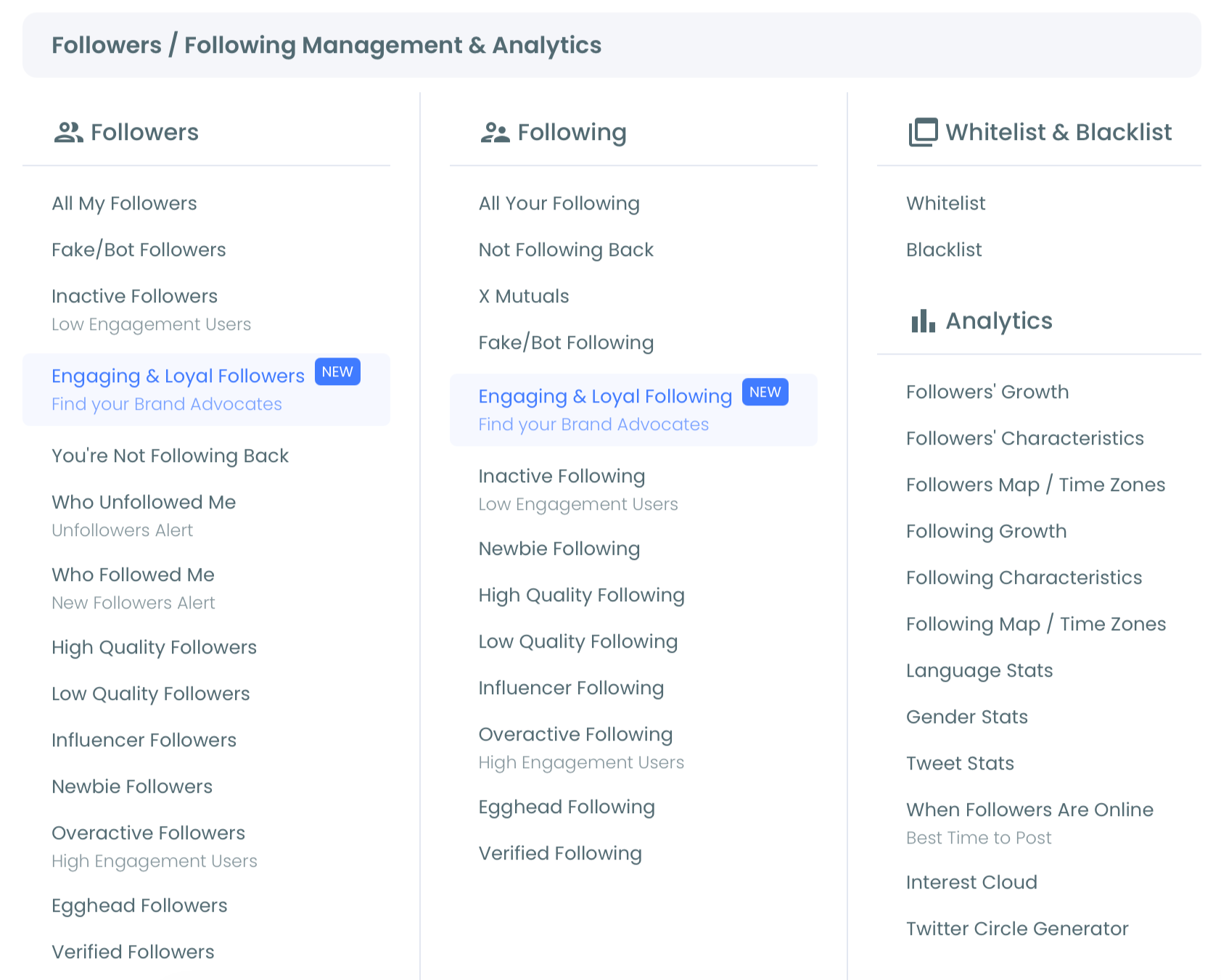
- Open the Follower & Following menu and select Inactive Following, the view scoped to accounts you follow rather than accounts that follow you.
- Let Circleboom retrieve your full following list through the official X API and classify each account by tweet count relative to account age and recent posting behavior.
Filter, protect, and unfollow the dead weight
- Sort by Join Date, oldest first, and by Tweet Count ascending to bring the most dormant, longest-standing follows to the top. These are your safest targets because they have had the most time to become active and have not.
- Whitelist the strategically silent accounts before any bulk action: official sources, clients, archived reference accounts, and niche experts who post rarely but still matter. Whitelist status persists across every Circleboom feature.
- Select the remaining accounts and run Unfollow in batches. Circleboom paces the work within X limits of 50 unfollows per 15-minute window and up to 800 per day, and it recommends staying near 100 to 150 at a time to keep well clear of platform detection.
That order is what makes the cleanup hold up. The login earns official-API access, the sort ranks the safest removals first, the whitelist shields the accounts you would regret losing, and the paced batches keep your account out of trouble. Skip the whitelist step and you risk cutting a quiet account you actually needed. The edge cases are where judgment matters most: a dormant account can still be a personal contact, a brand you may want back, or a source that posts once a year. Circleboom's walkthrough on how to unfollow dead Twitter accounts covers exactly those borderline calls, so a fast pass does not become a regretted one.
At a glance: connect, classify, sort by age and tweet count, whitelist exceptions, unfollow gradually.
What You Get After the Cleanup
A cleaner timeline is the immediate payoff, driven by accounts that have actually posted something worth reading recently. Your following count drops to reflect your real active network, which also improves your follower-to-following ratio.
The strategic gain is repeatability. Whitelisted low-frequency accounts stay protected from future passes, so you never re-validate them, and an exported segment gives you a record for client reporting. This is why the tool that helps you spot inactive accounts you follow is the safest first pass in any following-list maintenance: the accounts it flags contribute nothing by definition.
If you want to layer signals, combine inactivity with the not following back segment. An account that is both silent and non-reciprocal is a far stronger cleanup candidate than one weak signal alone, because activity and reciprocity are two independent tests, and a follow that fails both is rarely worth the slot it holds.
When you finish pruning, the Twitter unfollow tool handles the same paced processing for any other segment you build, so the workflow you learned here transfers to every future cleanup. Before you cut a borderline account, the companion on how to check mutual followers on Twitter helps you decide which quiet accounts are worth keeping.
Is It Safe to Unfollow Inactive Accounts You Follow?
Yes, when you do it gradually and review first. Every unfollow Circleboom runs goes through the official X API in full compliance with platform rules, and the operation is paced to respect the 50-per-15-minute and 800-per-day limits. For the full rate-limit reasoning, how to unfollow Twitter accounts without getting suspended breaks it down. The real risk is not safety, it is over-cutting: inactivity is a cleanup signal, not proof an account is worthless. Whitelist the quiet accounts you follow for periodic updates before you act.
Frequently Asked Questions
What counts as inactive in this tool?
Inactive means an account you follow that rarely posts or shows very low activity over its lifetime, judged on tweet count relative to account age, not just whether it tweeted this week. Circleboom labels each account you follow as Active, Moderate, or Inactive so you can filter on that classification directly.
Should I unfollow every inactive account at once?
No. Unfollow in reviewed batches of roughly 100 to 150 rather than clearing hundreds in one session, and whitelist any account you keep for occasional but important updates. Gradual, filtered passes are safer than one aggressive sweep.
Can I get this list as a file?
Yes. You can export the inactive segment as a CSV for team review, client reporting, or a record before you remove anything, which is useful when someone needs to approve the cleanup first.
How often should I run this?
Every few months is a sensible rhythm, because inactive follows accumulate quietly through natural attrition as people change their posting habits. A quarterly pass keeps your feed fresh without becoming a chore.
Does unfollowing an inactive account notify them?
No. X does not send any notification when you unfollow, so even a large pass stays invisible to the accounts you remove. That is part of why an inactive-following cleanup is low-risk socially: the only person who sees the shorter list is you. It also means you can act on the classification without hesitating over whether a quiet acquaintance will notice, which is what lets the whitelist, not social worry, drive your keep-or-cut decisions.
The Bottom Line
Finding inactive accounts you follow comes down to reading activity signals your eyes cannot process at scale, then acting on them carefully. Circleboom classifies your entire following list, ranks the safest removals first, protects the accounts that still matter, and paces the unfollows so your account stays healthy. The result is a following count that reflects your real network and a feed that earns its space.
Ready to prune the dead weight? Open the tool and find the inactive accounts you follow on Twitter in one pass.
)