
A mutual is an account you follow that also follows you back. Those two-way connections are the real core of your network on X, yet the platform gives you no single place to see them.
Your following list and your followers list sit in separate tabs, and X never marks where the two overlap. To find your mutuals, you have to compare both lists and keep only the accounts that appear in each one.
Circleboom cross-references your following and follower lists on X and returns only the accounts that follow you back, all through official X API access. The result is one filterable list of every mutual, ranked by engagement and ready to act on.
→ find your mutual followers on X
Below: what the list shows, how to pull it in four steps, and how to compare mutuals across two accounts.
Why X has no mutuals tab
X was never built to show reciprocity. It gives you a following count, a followers count, and two lists you can scroll, but nothing that flags which accounts sit in both.
If you have ever tried to work out what is a mutual on Twitter by eye, you already know the trap. Each list is ordered by recency, not by overlap, so a mutual near the top of one list can sit thousands of rows deep in the other.
That is fine when you follow 50 accounts. It falls apart at 500 or 5,000.
Nobody can hold two long lists in their head and mentally intersect them, which is why manual mutual-hunting turns into guessing after the first screen. The information you want is technically on X, but it is scattered across two views that were never meant to be read together.
That gap is the whole reason people reach for a dedicated view. When you want to see who follows you back on X without scrolling two lists side by side, you need something that reads both at once and keeps only the intersection.
What your mutuals list shows you
Circleboom's X Mutuals filter reads your following list and your follower list, matches them account by account, and keeps only the reciprocal pairs. What lands in front of you is not a raw dump of handles.
Each mutual arrives with context: an engagement classification, a follow ratio, a tweet count, and an account age, so you can tell an active mutual from a dormant one before you click anything.
Because Circleboom is an official X Enterprise Developer, every read runs through sanctioned API access rather than scraping, so the list comes back complete and the accounts you check are never notified. That privacy matters when your mutuals include clients, collaborators, or people you would rather not tip off.
To open your list of mutual followers on X, you connect your account once and the filter does the matching. If you prefer to browse raw profiles first, the Twitter follower viewer walks you through them one by one before you narrow down to mutuals.
How to find mutual followers on X (step by step)
The flow takes a few minutes and runs in one pass: connect, filter, then read the list. Each step narrows the work.
- Log in to Circleboom Twitter and connect your X account with official OAuth access.

- Open the Follower/Following management menu and choose the X Mutuals filter.
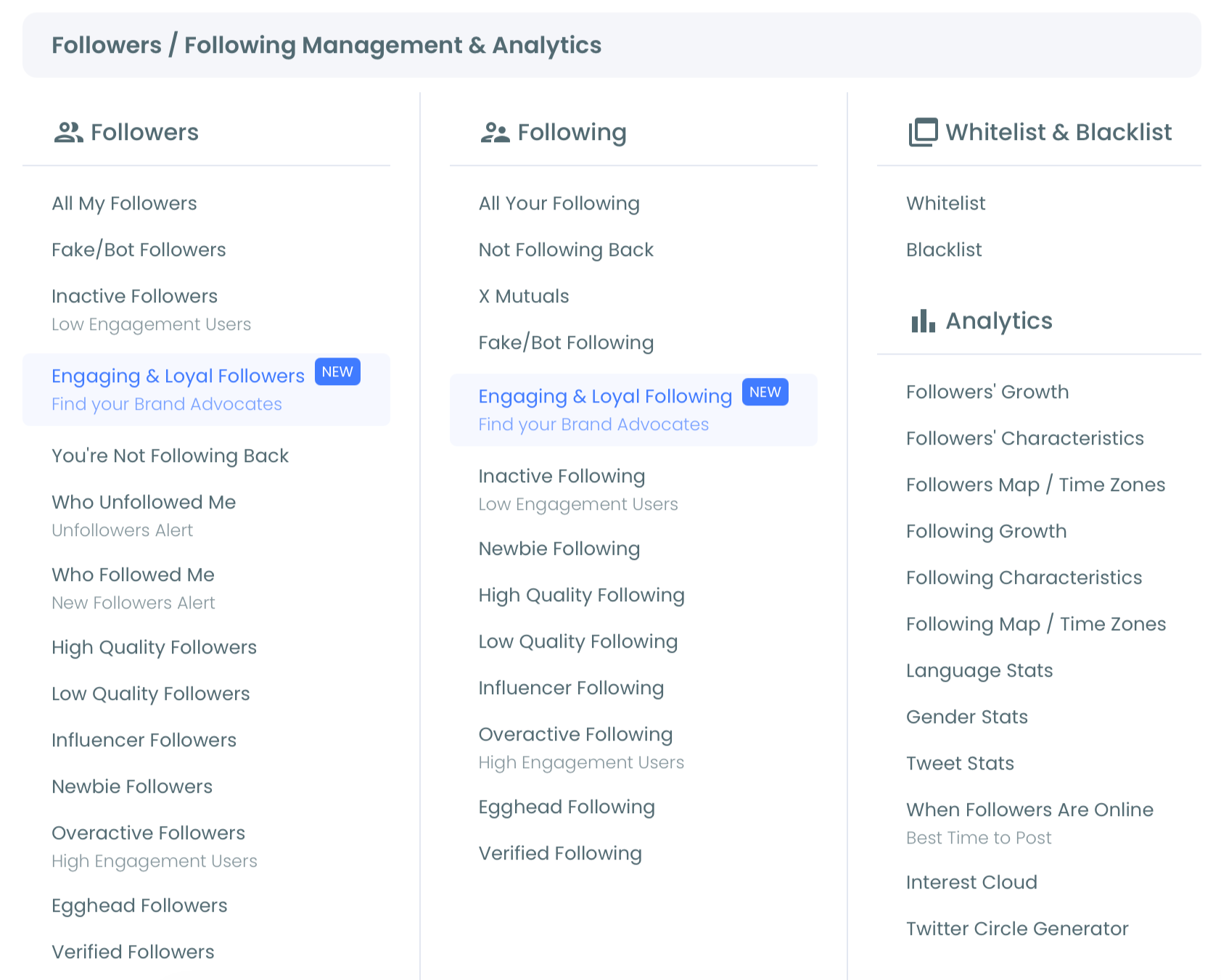
- Load your reciprocal list and let Circleboom match your following and follower lists into one view.
- Sort by engagement, then whitelist, list, or export the mutuals you want to keep.
That order holds because each step removes ambiguity. The login earns official access, the filter scopes the read to reciprocal accounts only, loading builds the intersection, and sorting turns the raw match into a list you can act on.
Skip straight to sorting and you are back to eyeballing two tabs.
Watch the X Mutuals filter isolate your two-way connections in one view.
Reading the mutuals table
The value is in the columns, not just the names. A mutual who has not posted in a year is worth less to your feed than one who replies to you weekly, and the table lets you see that difference at a glance instead of visiting profiles.
The four fields do most of the work when you check mutual followers on Twitter at scale.
For every mutual, the table shows the account's:
- Engagement classification, from engaging and loyal down to dormant.
- Follow ratio, so you can spot lopsided or spammy accounts.
- Tweet count, which separates active posters from lurkers.
- Account age, which flags brand-new accounts among your reciprocals.
Read together, those signals turn a flat list of 380 mutuals into a ranked one. You can pull the top tier, the accounts that both follow you and actually engage, and treat them as your inner circle, while the dormant reciprocals drop to the bottom where they belong.
What to do with your mutuals
Finding the list is the start. The point is what you do next, and Circleboom keeps every action attached to the same view so you never re-import handles. From the mutuals table you can:
- Whitelist mutuals to protect them before any follower cleanup.
- Add them to a Twitter List to build a focused core-network feed.
- Unfollow the accounts that follow you but that you no longer want to see.
- Export the whole set to CSV for a record or an outside workflow.
The whitelist action pairs especially well with cleanup: mark your mutuals safe first, then run an unfollow sweep on everyone else without fear of cutting a real connection. To study the highest-value reciprocals more closely, open the engaging followers and following view.
It ranks the accounts that interact with you most, which is usually where your best mutuals sit.
Finding the mutuals between two accounts
Your own mutuals are one question. The mutuals between two other accounts are a different one, and native X cannot answer it at all.
This is where Account Comparison earns its place: you enter two handles, and it returns every account that follows both of them, or every account that both of them follow.
That single move opens up work X simply does not support. You can compare yourself against a competitor to find the shared audience you both reach, or compare two creators to find the followers they have in common before a collaboration.
People who want to get mutuals on Twitter in a specific niche often start here. The overlap between two established accounts is a ready-made list of people already interested in the topic.
The X Mutuals filter answers "who follows me back," and Account Comparison answers "who do we share," and together they cover both sides of reciprocity.
Mutuals vs the manual method
The manual method is real, it is just slow and error-prone. You open your following list, open your followers list, and try to match them by memory or by flipping between tabs.
At small scale it works. Past a few hundred accounts it stops being reliable, because the lists reorder as accounts follow and unfollow, and you lose your place constantly.
A tool removes the two failure points at once: it never loses its place, and it never forgets a handle. The match is exact every time, and it comes back with the context columns you would never reconstruct by hand.
If you want the background on why reciprocity is worth tracking in the first place, this look at Twitter mutuals covers what the two-way relationship signals about reach and trust. The manual route can confirm a single mutual; it cannot build and rank a list of every one.
Who gets the most from a mutuals list
A mutuals list helps anyone on X, but a few groups live and die by it. Creators use it to find the accounts that actually reciprocate, so their replies and DMs go to people who will see them rather than into the void.
Community builders use it to draw the boundary of their real community, the people who both follow them and get followed back, then feed that group into a dedicated List.
Founders and small B2B teams treat mutuals as a warm list. An account that follows you back has already raised a hand, so it is a softer place to start a conversation than a cold profile.
Giveaway and campaign runners use the list the other way: they confirm the accounts they are about to reward are genuine mutuals, not one-directional followers gaming the entry rules.
The common thread is that each group needs the two-way relationship isolated, not the raw follower count. A large audience with few mutuals behaves very differently from a smaller one where most accounts follow back.
The mutuals list is what makes that difference visible, and it is usually more honest about your standing on X than any vanity number.
How often to refresh your mutuals list
Mutuals are not a fixed set. People follow you and unfollow you every week, and accounts you follow drift in and out of following you back, so a list you pulled two months ago is already stale.
For most accounts, a refresh every few weeks keeps the picture accurate without turning into a chore.
Refresh more often when you are in an active phase: running a campaign, growing quickly, or cleaning up who you follow. In those stretches the reciprocal set moves fast, and a fresh pull each week stops you acting on a relationship that has already changed.
Refresh less often when your account is steady and you are mainly maintaining, where a monthly look is plenty.
Cadence matters because most mutual actions are one-way doors in the moment. If you add mutuals to a List or export them for outreach, you want that snapshot to reflect who reciprocates now, not who did last quarter.
Each pull runs through the same sanctioned read, so refreshing is cheap: reconnect, reload the filter, and compare the new list against the old one. The accounts that dropped off are often a sharper signal than the ones that stayed.
Common mistakes when finding mutuals
The first mistake is treating every mutual as equal. A reciprocal follow from a dormant account that has not posted in a year is not the same asset as one from an account that replies to you weekly, and the engagement column exists precisely so you stop lumping them together.
Rank first, then act.
The second mistake is cleaning up follows before protecting your mutuals. Run an unfollow sweep without whitelisting your reciprocals first and it is easy to cut a real connection by accident, then have to rebuild it.
Whitelist the mutuals, then sweep everyone else.
The order is cheap insurance.
The third mistake is confusing your own mutuals with the mutuals between two accounts. The X Mutuals filter answers who follows you back. Account Comparison answers who two accounts share. Reaching for the wrong one wastes time, because neither can do the other's job.
The last mistake is doing it once and calling it done. Mutuals move, so a single pull is a snapshot, not a standing truth. Build the habit of a periodic refresh and the list stays worth acting on instead of quietly going out of date.
Finding your mutuals, in short
Your mutuals are the accounts you follow that follow you back, and X hides them across two lists on purpose. Circleboom reads both lists, keeps only the reciprocal accounts, and hands you a ranked table with engagement, ratio, tweet count, and age already attached.
From there you whitelist, list, unfollow, or export in the same view. When you are ready to load every mutual follower on X, connect once and let the filter do the matching that the platform never will.
Frequently asked questions
Does X have a mutuals tab?
No. X shows a following list and a followers list separately and never marks the overlap, so there is no native way to see only the accounts that follow you back.
A filter that reads both lists and keeps the intersection is what produces a true mutuals view.
Can I find mutual followers between two accounts?
Yes, with Account Comparison. You enter two handles and it returns every account that follows both, or every account both follow, which is something native X cannot do.
The X Mutuals filter handles your own reciprocals, and Account Comparison handles the overlap between any two accounts.
Will finding my mutuals unfollow anyone automatically?
No. Loading your mutuals is a read-only step that only shows the list. Any unfollow, whitelist, or list action is a separate choice you make afterward, so nothing changes on your account until you decide it should.