
How do you find out whether anyone with real reach is already following you on Twitter? X hands you a follower count and a reverse-chronological list, and nothing that separates a 400-follower lurker from a 90,000-follower account in your niche.
That gap is why most people never notice the best relationships sitting inside their own audience.
Circleboom Twitter reads your follower list on X and pulls out the high-reach accounts already following you, with follower count, follow ratio, and an activity classification on every row. A shortlist takes a couple of minutes instead of an evening of scrolling.
→ influencer followers on Twitter
The part nobody explains is how to read those rows, so keep going.
What Twitter shows you about your followers, and what it hides
X shows you who followed you. It does not show you who matters.
Your notifications tab lists new followers by arrival time, and the follower page lists everyone by roughly the same logic. Neither view carries a follower count next to a name, so the account with 62,000 followers and the account with 62 sit at the same visual weight.
The cost of that is quiet. Someone in your field follows you, waits for a reason to interact, gets nothing, and drifts. You never knew they were there.
Run the numbers on your own base and the stakes get concrete. If nine accounts inside a 6,000-follower audience each carry 40,000 followers of their own, one repost from one of them reaches more people than your entire audience combined.
That is the reason to see which influencers follow you on X before you spend a week building a cold outreach list.
There is a second reason, and it is the one most articles skip. Knowing who already follows you changes the shape of every pitch you write. A message that opens with "you have been following me for a while" lands differently than one that opens with an introduction.
The four signals that tell you a high-reach follower is worth your time
A big follower number on its own tells you almost nothing. Four columns in the results table, read together, tell you nearly everything.
Follower count sets the ceiling. Ratio, activity, and account age decide whether you ever reach it.
Here is the read that works, column by column:
- Followers is the size of the secondary audience a repost would reach. It is a ceiling, not a promise.
- Follow Ratio separates a genuine audience from a follow-back network. A high follower count paired with an equally high following count usually means reciprocal follows, not attention.
- Active & Inactive is the classification Circleboom applies to each account: Active/High Engagement, Moderate Active/Medium Engagement, or Inactive/Low Engagement. A large account marked Inactive is a parked asset.
- Joined shows the account age in days, which catches the inflated-but-new pattern.
An account that clears your follower floor, holds a follow ratio well above one, and reads Active is worth a follow-back and a place on a list. An account that clears the floor but reads Inactive is a trophy, not a relationship.
Sorting by follower count alone puts both at the top of your screen, which is exactly why the first sort is the wrong first move.
That distinction is the whole reason a dedicated view beats a manual scroll. Reach deserves to be treated as a segment, not a number. The case for how to find the hidden influencer among your X followers sits alongside this one.
One more column earns a mention. The Name column carries the display name, the handle, and the location, which is often the fastest disqualifier in the table.
A 70,000-follower account posting in another language from another continent is not a bad account. It is just not your amplification path, and spotting that at a glance saves a profile visit.
Why your own follower list beats a platform-wide influencer search
Both approaches exist inside Circleboom, and they answer different questions.
Our Find Influencers section inside the Advanced X Search menu scans the whole platform for accounts that meet influence criteria. It is the right call when you are building a target list from nothing and you do not care whether the account has heard of you.
Influencer Followers applies the same kind of criteria to one pool only: the people who already follow you. That pool is smaller and warmer. Every account on it has already made the decision to subscribe to what you post, which removes the hardest part of any outreach sequence.
The friction difference is real. A cold pitch has to earn attention, explain who you are, and make a case, all in a message the recipient did not ask for. A note to someone who follows you starts at the second step.
So the sequence that saves the most time is the reverse of the usual one. Check your own base first. Build the cold list afterwards, from whatever the warm list did not already cover, and you will find the cold list is shorter than you expected.
How to find influencers following me on Twitter in one session
Here is the flow, in order.
Watch the reach view build itself: a follower base sorting down to the accounts that can actually carry a post further.
Authorise Circleboom to read your X followers
- Log in to Circleboom Twitter and connect your X account.
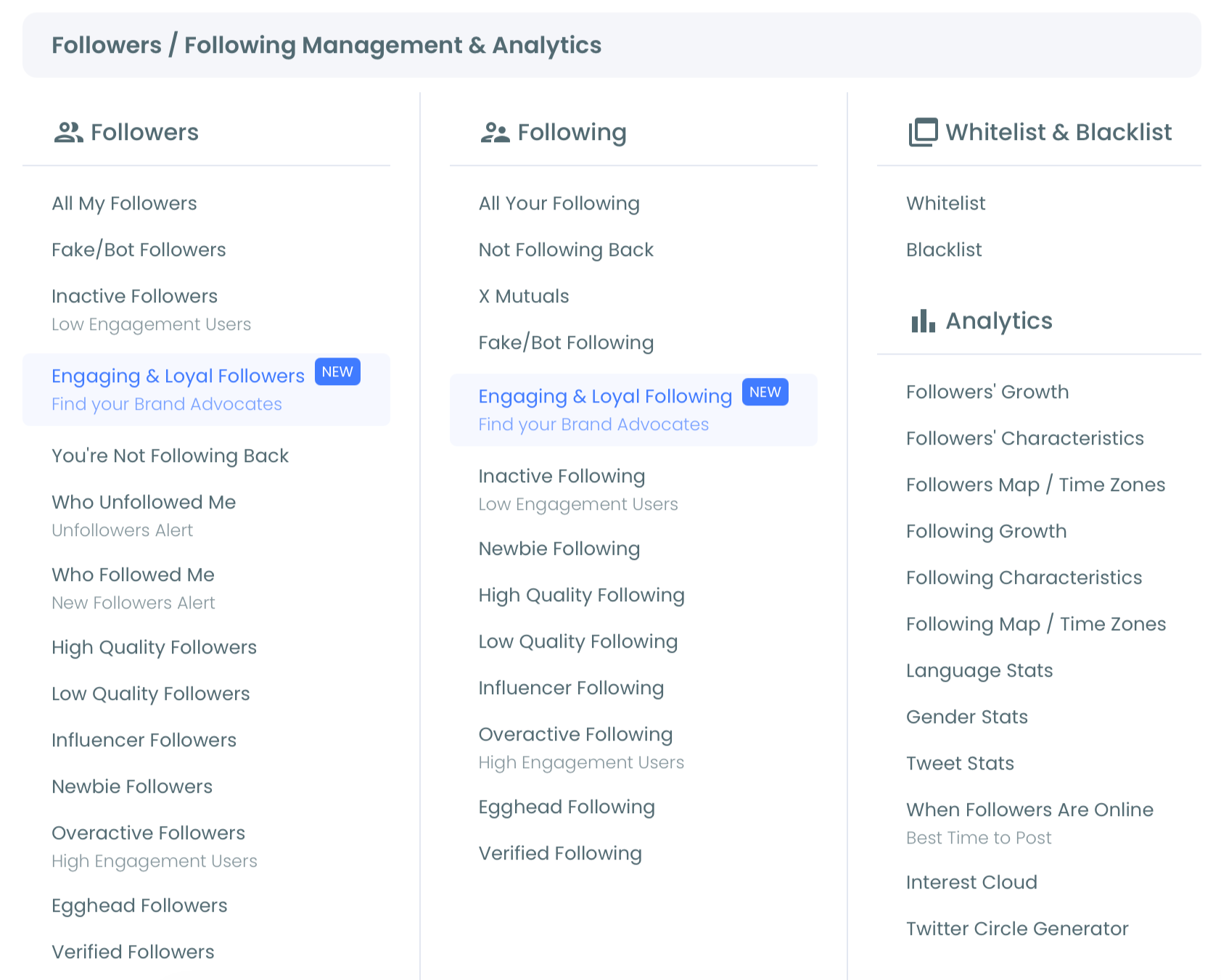
- Open the Follower and Following management menu, which is where every audience segment lives, and select the Influencer Followers section inside it.
Narrow the list before you look at a single profile
- Open Filter Options and set a Follower Count minimum that reflects your niche. A local services account and a developer-tools account will not use the same floor.
- Set the Engagement dropdown to the classification level you want kept, so the accounts marked Inactive/Low Engagement drop out of the view before you start reading names.
Qualify and act on what is left
- Type a topic word into Find in Bio & Name to keep only the accounts whose stated subject matches what you post about. Bio keywords are how you tell a relevant 30,000-follower account from an irrelevant one.
- Select the rows worth keeping and use the action bar: Follow to follow back, Add to List for a Twitter List or a Whitelist entry, or Export to pull the shortlist out as a CSV.
The order matters because each step cuts the pool before you act on it.
The login is what connects your own account, so the follower data is yours to read. The menu puts you inside that follower base rather than a platform-wide search. The follower floor removes the small accounts, the engagement filter removes the parked ones, and the bio keyword removes the irrelevant ones.
Act before you filter and you will follow back a media account that has never opened your profile.
The sequence in short:
- Connect the account.
- Open Influencer Followers under the follower menu.
- Set a follower floor and an engagement level.
- Search bio keywords for topic fit.
- Follow back, list, whitelist, or export.
Niches that run on smaller audiences need a lower floor. The companion approach to filter your X followers by follower count covers where to set it when 5,000 followers is already a lot.
Is it safe to follow back and add influencer followers to a Twitter list?
Yes, and the mechanics are worth knowing before you select 200 rows.
Follow actions run at a paced rate. Circleboom processes 50 follow actions every 15 minutes, up to 400 follows per day, and picks up the next day on its own when the daily ceiling is reached. Nothing fires in a burst, which is the behavior that gets accounts flagged.
Circleboom is named in X's Enterprise customer directory, and the consequence here is that reading costs you nothing on the platform's side. Pulling your own follower base is a permitted read rather than a borrowed one, so re-running this segment weekly, or three times in an afternoon while you tune a filter, is not behaviour X has any reason to look at twice.
List placement is quieter still. X's own documentation on About X Lists confirms you do not need to follow an account to add it to a List. A private list is therefore the safest first step with an account you are not ready to follow back.
Two housekeeping actions are worth running at the same time. Whitelisting marks an account as protected and excludes it from bulk operations everywhere else in the product, which is what stops a future cleanup from removing the exact people you spent this session finding.
The same label has a second life, and converting the whitelist to Twitter Lists is where that goes.
For ongoing organisation rather than a one-off pass, pairing the shortlist with the Twitter List Manager keeps the group visible after the session ends.
What changes once you know who your influencer followers are
The first thing that changes is where your attention goes.
Instead of posting into a follower count and hoping, you are engaging with a named group of accounts whose reposts carry weight. Replying to five of them regularly is a smaller job than chasing strangers, and it compounds, because their audiences start seeing your handle in their replies.
The second change is preparation. A media kit, a sponsorship deck, or a partnership email reads differently when it can name the high-reach accounts already in your audience instead of quoting a raw follower total.
The third is negative, and it is underrated: you stop wasting outreach on people who already follow you. Checking your own base first is the cheapest step in any influencer campaign, and it is the one most teams skip.
Exporting keeps the work portable. The Export Twitter Accounts path turns the shortlist into a CSV carrying the same columns you filtered on.
Export runs on a token system, with the remaining count shown next to the button. The broader mechanics of how to export and save followers on Twitter apply here without change.
When the group is meant to live inside X rather than a spreadsheet, the argument for how to use Twitter lists effectively is the better reference. A list you actually read every morning beats a CSV you open twice a year.
Ready to see the actual names? Pull up your influencers following me on Twitter view and read the first screen.
Five moves that cost you nothing
Five actions, in the order that costs the least time:
- Set a follower floor that matches your niche, not someone else's benchmark.
- Filter out the Inactive/Low Engagement rows before reading a single name.
- Follow back only the accounts whose subject matter overlaps yours.
- Whitelist the whole group so no future cleanup touches them.
- Export the shortlist and revisit it before your next campaign.
None of that requires a pitch, a budget, or an introduction. It requires knowing who is already there.
→ your influencer followers list on X
Questions people ask before running this check
Can I see influencers following me on Twitter without X Premium?
Yes. This view reads your follower list through Circleboom rather than through X's own analytics, so a Premium subscription is not part of the requirement. You connect your X account and the follower segments become available.
How many accounts can I follow back in one session?
Circleboom processes 50 follow actions every 15 minutes, up to 400 follows per day. When the daily ceiling is reached the queue resumes the following day on its own, so a large selection does not need babysitting.
Do the follower numbers update on their own?
The counts and classifications reflect the state at the last sync. An account that was large when the data was fetched may have since lost followers, gone private, or gone quiet, so re-check a row before you build a pitch around it.
What if a big account follows me but never engages?
That is a real pattern and worth naming. Large accounts sometimes follow for monitoring rather than interest, which is why the Active & Inactive column exists. Treat those rows as context for your audience quality, not as outreach targets.