
A recommendation request on X is a public tweet where someone asks their timeline to pick a product, a service, or a person for them.
Catching those tweets while the asker is still reading replies takes a live search anchored to a start date, not a scroll through the native feed.
What this walkthrough gives you.A working definition of a recommendation request and the phrasing that marks one.A live search setup that collects matching tweets from a start date you pick.A deduplicated account list you can follow, save to a list, or export.
Circleboom collects live tweets on X from a start date you set and pulls out the accounts behind them through official API access.
→ Run your first find recommendation requests on Twitter query and read the results as a list rather than a feed.
What a recommendation request on X actually is
A recommendation request is a tweet that hands a decision to other people.
The person posting has a need, no preferred answer, and an open invitation for strangers to fill the gap.
Three phrasing families cover most of them:
- Direct asks that name the category: "recommend me a booking system for a small clinic."
- Open polls of the timeline: "what is everyone using for email newsletters now?"
- Replacement asks after a bad experience: "need to move off my current help desk, suggestions welcome."
None of those phrasings mention your brand.
That is exactly why they are worth finding, and why brand-mention monitoring alone will never show them to you.
The value sits in the state of mind behind the tweet.
Somebody who asks the timeline for a suggestion has already decided to buy something and has not decided what.
Reading a market through that lens is the same instinct behind using Twitter for market research, applied to individual buyers instead of aggregate trends.
Why the window on a recommendation ask closes fast
A recommendation ask is only useful while it is unanswered.
The tweet gets replies within hours. One reply gets a thank-you, the asker moves on, and the conversation stops.
The post stays public forever, so a search that reaches backwards will keep returning it, long after the decision was made.
That is the difference between finding a tweet and finding an opportunity. Both look identical in a search result. Only the start date tells you which one you are holding.
X's own advanced search operators let you shape a query by phrase, language, and date on the native site.
What they will not do is deduplicate authors, hold a query open from a moment you choose, or hand you the accounts as a list you can act on.
Circleboom fills that gap by holding a keyword query open against live X traffic. Set the query once and anchor it to a recent start date.
You then spot recommendation requests on X as a table of tweets plus a table of the people who wrote them.
The same reach problem shows up on the publishing side. The question behind if my tweets are reaching the right audience has the same answer: look at who, not just how many.
Every hour a recommendation ask sits unread is an hour someone else is answering it.
Watch a live keyword search run end to end before you set up your own:
https://www.youtube.com/watch?v=OAbQZmQ1z2Q
How to find recommendation requests on Twitter, step by step
To find recommendation requests on Twitter, run a live tweet search from a recent start date using the phrasing people reach for when they ask their timeline to choose. Cut the results down with exclusions and engagement floors, then switch to the account view and work the profiles behind the matching tweets.
The seven steps below follow that order, grouped into three phases.
Open Real-time Tweet Search from the dashboard
- Log in to Circleboom Twitter and connect the X account you want the search to run under.
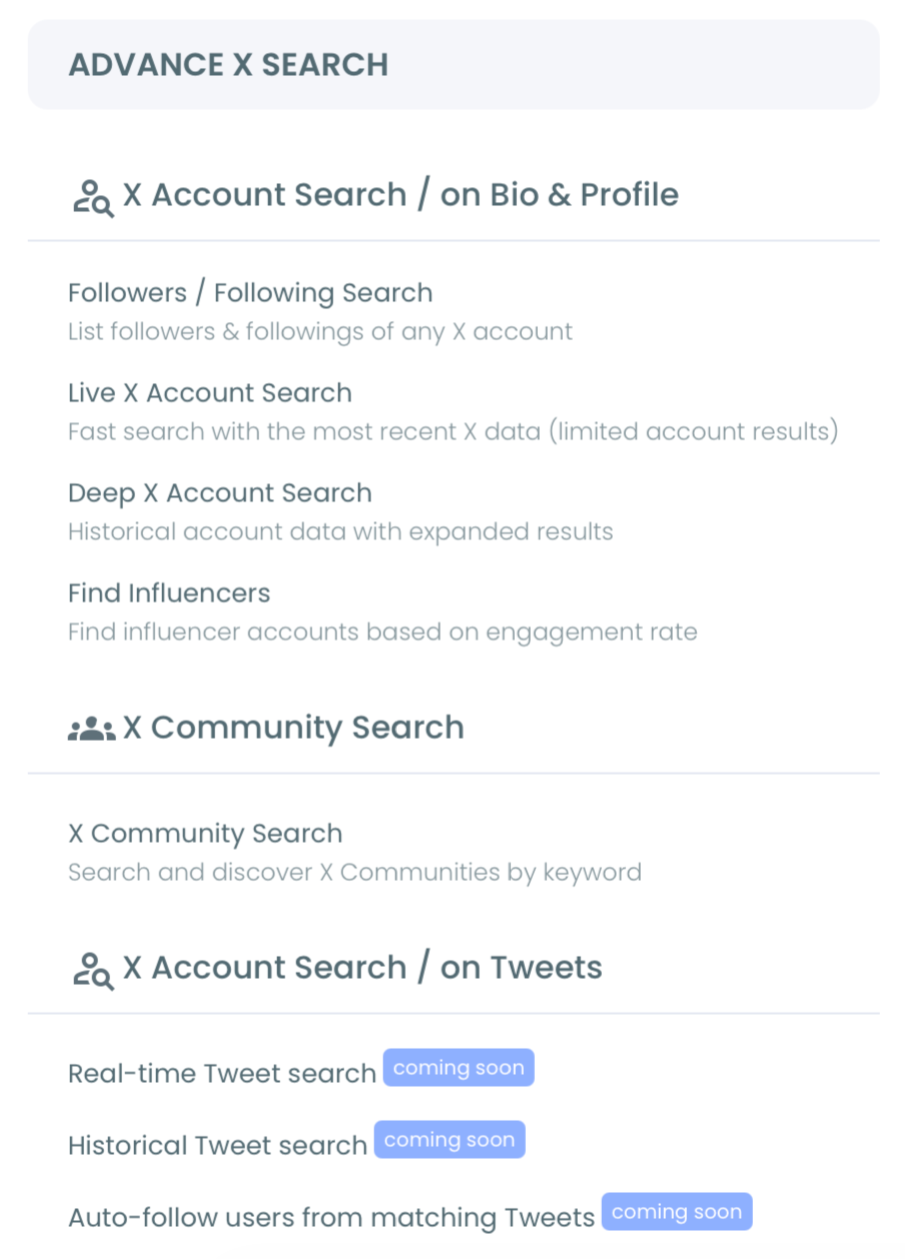
- Open the Advanced X Search menu and pick Real-time Tweet Search from the search tools inside it.
Shape the query around question phrasing
- Write the request in your own words, such as people asking their followers to recommend a booking system. Circleboom reads the sentence, offers refined search variations, and lets you switch to Advanced Search if you would rather build the query yourself.
- Set the keyword match type and the exclude list. Exact phrase catches a specific ask; contains and partial catch the variations around it. Exclusions are where giveaways, hiring threads, and your own brand mentions leave the result set.
- Choose the start date and the tweet count. Last 24 Hours, Last 7 Days, Last 30 Days, and custom ranges are all available, and the tweet count controls how much the collection pulls from your GetTweetTokens balance.
Work the accounts behind the tweets
- Click "Display Profiles of this search" to move from the tweet table to the deduplicated profile view, where every unique author appears once with tweet count, join date, following, followers, follow ratio, and an active or inactive classification.
- Follow, add to a list, or export the accounts that fit, using the per-row buttons for single profiles or the bulk actions across a checkbox selection.
Running the phases in that order protects the result.
The start date decides whether you are reading open questions or closed ones. The exclusions decide how much of the table you have to read yourself, and the profile view is the only screen where a matching tweet becomes a person you can contact.
At a glance: connect, open Real-time Tweet Search, describe the ask, filter, set the date, pivot to profiles, act.
Reading tweets is one way in; reading bios is another, and more targeted X account search covers that second path for the days when nobody is asking out loud.
Query and filter choices that decide result quality
Filter choices matter more here than in almost any other search, because recommendation phrasing overlaps heavily with marketing copy.
The filter panel groups everything behind a single Filters button, and an Active Filters bar shows what is currently applied. For this job, five controls carry most of the weight:
- Exclude terms, which is where promotional and hiring language gets removed.
- Replies, on when the ask usually appears inside a thread, off when it usually starts one.
- Links, usually off, since a tweet carrying a link is more often a broadcast than a question.
- Language, so you only collect accounts you can actually answer.
- Engagement minimums, which drop posts nobody responded to.
Media type, hashtags, cashtags, and verified-only sit in the same panel and matter more for event tracking than for recommendation hunting.
Circleboom's Twitter advanced search filters page lays out the full set if you want to plan the query before you open the app.
Query craft transfers between features, so the phrasing patterns in how to use Twitter advanced search apply directly to the live version.
If your category has a stable vocabulary, the keyword and hashtag tracker is the companion habit: one query watching the terms, another watching the asks.
What to check in the profile view before you reply
The profile view is where a keyword match either earns a reply or loses one.
Every unique author from the collected tweets appears there once, with the account-level columns Circleboom uses across its search features: name, tweets, joined, following, followers, follow ratio, and an active or inactive classification.
Column headers sort, so the table reorders around whichever signal you care about.
Four of those columns do most of the qualifying work on a recommendation search.
- Joined, because an account created days ago asking for vendor suggestions is usually not a buyer.
- Follow ratio, which separates a real practitioner from an account that follows everything it sees.
- Tweets, since a near-empty timeline gives you nothing to reference in a reply.
- Active or inactive, which tells you whether an answer will even be read.
The inline search bar runs across name, username, and bio, so a single term can pull the accounts whose bios put them in your category, straight out of the wider result.
On a broad query, that one move is usually the fastest way to shrink the list you actually have to read.
Read two or three of their recent posts before you write anything.
The tweet that matched your query tells you what they need; the timeline around it tells you how they talk, whether a competitor already answered, and whether the ask was rhetorical.
That reading step is also the safeguard on every bulk action further down the row.
Follow, Add to List, and Export all operate on the checkbox selection, so a careless select-all turns an unread table into an outreach list you cannot defend.
Once the shortlist holds, make the query a routine rather than a one-off. Re-run it each morning with a fresh start date to find recommendation requests on X. The profile view then does the qualifying every time.
Not every ask deserves a reply from you.
Recognizing which ones do is closer to editorial judgment than to lead scoring, and the accounts you skip protect the credibility of the ones you answer.
Is it safe to contact people asking for recommendations on X?
Yes, as long as the data reaches you through sanctioned access and you read profiles before acting in bulk.
Circleboom is an official X Enterprise Developer company, which means every live tweet in your result set arrives through approved channels rather than a scraping workaround.
Your account keeps its standing, and the profile data you act on is complete rather than partial.
The judgment stays with you.
A keyword match proves someone used a phrase, not that they want what you sell, so the profile view exists to be read rather than bulk-selected on sight.
Auto Follow deserves particular care.
Pointed at a live keyword stream, it keeps following every account the query produces, which is useful for a launch and risky for a broad recommendation query.
Set engagement thresholds and account filters first, then decide whether continuous following is what you actually want.
Live data is also unstable by nature.
Tweets get deleted, edited, or locked within minutes, engagement counts move while you read them, and only public accounts appear at all.
Export or list the strong matches quickly instead of treating the result as an archive.
One more boundary: a start date pushed far enough back behaves like a historical query and returns asks that already closed. That is a different job, and Circleboom's Twitter historical data feature is built for it.
What to do next
Turning recommendation asks into a repeatable channel takes four moves:
- Write down the three or four phrasings your buyers use when they ask for a suggestion.
- Run the query with a 24-hour or 7-day start date and an aggressive exclude list.
- Pivot to the profile view and save the strong accounts to a list before you reply to anyone.
- Re-run the query on a schedule that matches how often your category comes up.
The habit is what pays, not the single search.
A query you run once catches whoever happened to ask that morning; a query you run every day catches the whole month.
Answering well matters as much as arriving early, and the etiquette in how to engage with followers on Twitter applies to strangers asking for help too.
→ Open Real-time Tweet Search and track live recommendation asks on X
What to know before you start
How many tweets should I collect on the first run?
Start small enough to test the phrasing, because the tweet count draws directly from your GetTweetTokens balance. A short first collection tells you whether the exclude list is doing its job before you spend tokens on a wide pull.
Does the number of tweets equal the number of accounts?
No. The tweet count controls collection size only, and one account posting five matching tweets still appears once in the profile view. Expect fewer unique accounts than tweets collected, especially in a chatty category.
Can I keep the accounts without following them?
Yes. Add to List moves selected profiles into an X List, a whitelist, or a blacklist without touching your follow graph, which keeps a prospecting list separate from the feed you actually read.
What happens to tweets that get deleted after I collect them?
Tweets removed after collection can still appear in your saved results, and the link will fail when you open it on X. Treat the account rather than the tweet as the durable part of the result.