
Your top engagers on Twitter are the followers who have retweeted you more than once, and X ships no screen that ranks them. Circleboom builds that ranking by reading back through your recent posts, pulling the retweeter list for each one, and counting how often each follower shows up. What comes out is a sortable table with a Times Retweeted number beside every account.
Circleboom finds your top engagers on Twitter by working back across your 3,200 most recent posts on the official X API, collecting the retweeters of each one, and matching that set against your current follower list. Every account that survives carries a Times Retweeted count you can sort on.
→ Run your top engagers on Twitter list
That one column is what turns a follower list into a shortlist.
How to find your top engagers on Twitter, step by step
The whole flow lives inside one feature, and it runs asynchronously: you start it, walk away, and come back to a finished ranking. Circleboom has to call the X API once per post to collect that post's retweeters, which is why the wait is measured in hours instead of seconds.
Watch the run: what a finished Times Retweeted ranking looks like after Circleboom has processed a full post history.
Seven steps, in sequence.
Connect the account and start the processing run
- Log in to Circleboom Twitter and choose the profile whose engagers you want counted.

- Go to your Follower / Following Management and Analytics menu, the home of every audience segment Circleboom builds for that profile.
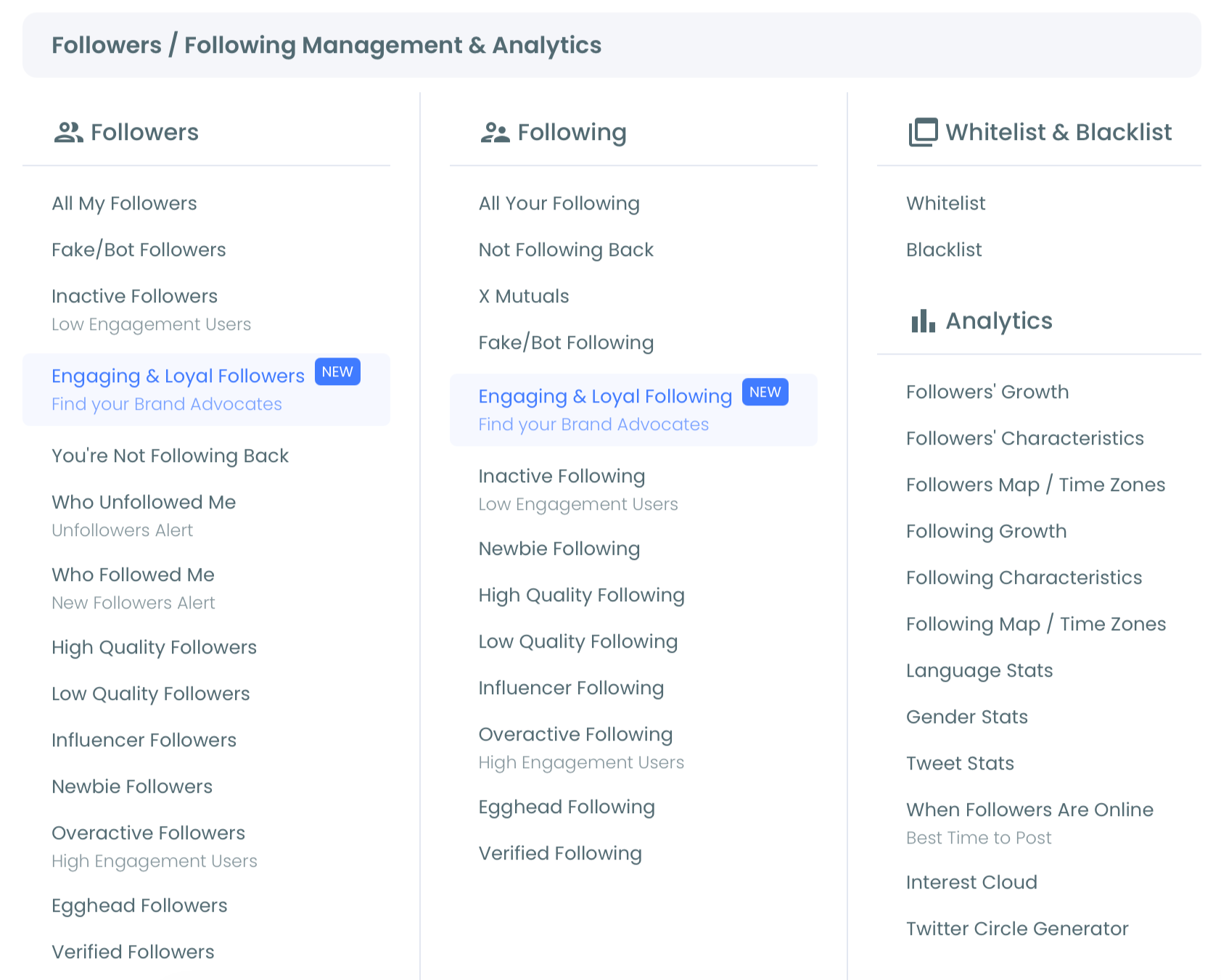
- Select Engaging & Loyal Followers to trigger the run. A preparation screen tracks four stages: fetching your posts, fetching the retweeters of each post, removing duplicates and inauthentic accounts, and finalizing the list. Circleboom notifies you when the results are ready, usually after one to three hours.
Rank the results and decide where to cut
- Sort the Times Retweeted column descending so the followers who retweeted you most often sit at the top of the table.
- Narrow the table with Filter Options when you want a specific slice. The panel carries Verification Status, Follower Quality, Find in Bio & Name, follower and following counts, Join Date, Language, and Location. An Active Filters bar shows exactly which combination is live before you select a single row.
Act on the ranked segment
- Select the rows you want and open Add to List, a dropdown offering Twitter List, Add to Mass Block List, Whitelist, and Blacklist.
- Export the selection as CSV from the Export button in the top right. The remaining token balance is printed inside the button label, so the cost is visible before you click.
That order holds up because each stage narrows what the next one touches. The ranking has to exist before you can choose a cut-off, and the cut-off has to exist before the export means anything.
Quick recap:
- Connect the account and let the run finish.
- Sort by Times Retweeted.
- Filter down to the slice you actually want.
- Select, then add to a List or export.
What makes a follower a top engager on Twitter
A top engager is defined by a repeat count, not by a single interaction. The Times Retweeted number shows how many of your posts one follower has retweeted. A follower sitting at 8 chose to put your content in front of their own audience on eight separate occasions.
A follower at 1 did it once and may never do it again.
That gap is the whole reason the ranking is worth building. Anyone can open a single post and read its retweeter list. Nobody can hold thirty of those lists in their head and work out which accounts appear on twelve of them. Circleboom's what are engaging and loyal followers on Twitter explainer covers the same definition from the audience side.
The list is also shaped by what gets stripped out before you ever see it. Four exclusions run automatically:
- Repeat appearances across posts collapse into one row carrying a count.
- Accounts flagged as fake or spam drop out.
- Accounts currently suspended or locked by X drop out.
- Anyone who retweeted you without following you drops out.
That last exclusion is the one people miss. Engaging & Loyal Followers is a followers view, so a stranger who retweeted you six times never appears in it. When you need every account behind a specific post, follower or not, Export Retweeters is the tool built for that job instead.
How this differs from your other follower segments
Circleboom also classifies every follower as an Active and High Engagement, Moderate, or Inactive user, and that column appears in this same table. It measures something else entirely. The engagement classification describes how busy the follower is on X in general, not how often they have touched your content.
A follower can be Active and High Engagement while having retweeted you exactly zero times.
Times Retweeted is the single figure here that belongs to your account rather than to theirs, which is why it is the one worth ranking on. Every other column describes an account in isolation: how many followers it has, how often it posts, how old it is. Rank on those and you learn who is big. Rank on the retweet count and you learn who shows up.
That is also why a top engager list rarely looks like a list of your most impressive followers. The accounts at the top are often small, often unverified, and often people you have never replied to.
Where to draw the cut-off line
The distribution decides the threshold, not a rule of thumb. The top engagers on Twitter table sorts on any column, so read the retweet count first.
Some accounts will show a figure in the double digits. A wider band sits at two or three, and a long tail sits at one.
Cut where the number stops falling steeply.
Say the drop from the top row to row fifty runs 14 down to 5, and rows fifty to four hundred all read 2 or 1. Your real segment is the first fifty rows. Everything after that is a one-off.
Two practical notes on that cut. Anything at a count of 1 is closer to a coincidence than a relationship, so it belongs in a broader nurture group rather than an advocate group.
A small segment is a feature, not a failure: a list of forty accounts you can actually reply to beats a list of four hundred you will ignore.
Filter after you cut, never before. Applying Follower Quality or Location filters first hides rows from the sort and quietly changes where the drop-off looks like it lands.
Why X gives you no ranked view of this
X shows who retweeted a given post and stops there. No screen adds those lists together, no column counts repeat appearances, and no export carries the combined result out of the platform.
The gap is structural rather than an oversight. X is organized around posts, while this question is about people measured across posts.
Manual reconstruction fails on arithmetic alone. Thirty posts at an average of forty retweeters each is 1,200 rows to deduplicate by hand before any counting starts, and that is a light month for most accounts.
Open Engaging & Loyal Followers instead of spending an afternoon on the spreadsheet. For a preview of what the segment tends to look like, your most engaging followers on Twitter walks through a finished list.
What to do with the ranked list
The report is only worth the processing time if something downstream consumes it. Four destinations cover almost every real use.
Add the top rows to a dedicated list on X
Select the highest-count rows, open Add to List, and choose Twitter List to push them into an existing list or create a new one with those accounts as founding members.
X allows up to 1,000 lists per account and 5,000 accounts per list, the ceiling documented on X's own Help with Lists page. There is no practical limit here. Circleboom's Twitter List Manager handles the ongoing membership work.
Whitelist the segment before any cleanup
Whitelisting marks an account as protected and excludes it from bulk actions across the whole platform. Run it on your top engagers first, because these are exactly the accounts a quality filter is most likely to catch by mistake.
A loyal follower with 90 followers and no profile photo looks like noise to a filter and looks like a supporter to you.
Export the segment for use outside Circleboom
Export downloads the selected accounts as a CSV carrying ProfileId, Username, Name, Location, tweet and follower and following counts, the Bio text, the account creation date, and a verification type. The ranking itself is a table property, not a CSV column, so select in ranked order before exporting or the file arrives without the sort that made it useful.
Start with your most engaged Twitter followers, then move the file into a CRM or an Export Twitter Accounts workflow.
Feed the list into a paid campaign
Circleboom's own recommendation block above the results table points at low-budget X Ads aimed at these accounts, on the logic that people who already retweeted you are the cheapest audience you will ever reach. The exported CSV is the source file for that audience.
Circleboom runs all of this as an official X Enterprise Developer company, so the retweeter data behind the ranking arrives through sanctioned API access rather than page scraping. Your account never carries the suspension risk that unofficial tools create.
The same segment gets used for outreach in find your brand advocates on X.
How often should you rerun the report?
Once a quarter suits most accounts, plus one extra run after any campaign that produced unusual retweet volume. The results are a snapshot taken at processing time rather than a live feed, so a follower who started retweeting you last week will not appear until the next run finishes.
The results page keeps a date picker beside its header, and every earlier run stays reachable from it. Comparing two of them shows how the segment moved: who entered the ranking, who climbed it, and who stopped retweeting entirely.
One limit shapes the cadence. The analysis reaches back over the 3,200 posts you published most recently, so followers who carried your content years ago fall outside the window and will not register as loyal now.
Accounts that post heavily hit that ceiling faster, which argues for running the report more often rather than less. If you are also tracking the denominator, what is a good engagement rate on Twitter gives you the benchmark this ranking sits inside.
What you do Monday
The objection that comes back most often is that a one-to-three-hour processing wait feels expensive for what sounds like an analytics report.
It is not an analytics report.
It is a shortlist of the people already doing your distribution for free, and the only cost of skipping it is that you keep treating them like everyone else in your follower count.
Start the run before anything else on Monday and let it finish while you work. Spend twenty minutes that afternoon on the output: sort, whitelist the top tier, add them to a List, export a copy for the file.
→ Pull your top engagers on Twitter
Questions about following back and the pace it runs at
Can I follow my top engagers back in bulk?
Yes. Select the rows and use the Follow button above the table. Follows are paced at 50 per 15-minute window and capped at 400 in a day, and Circleboom picks the queue back up the next morning once that ceiling is hit.
Does the export consume tokens even if I only select a few accounts?
Yes. Every export spends tokens, and the size of the draw follows the number of accounts in the selection. Circleboom prints the balance you have left on the Export button itself, so read that number before committing to a large selection.
Why is a follower who replies to me constantly missing from the list?
The ranking is built from retweeters. Circleboom collects the accounts that retweeted each of your posts, so replies and likes alone will not place someone in this segment no matter how often they appear in your mentions.