
A live conversation on X pays out only while it is live. The accounts posting about a launch, an outage, or a conference hashtag stay reachable for a few hours, sometimes a day or two, and then the thread cools and those same people are strangers again. Real-time keyword monitoring is what stops that window from closing while you are still scrolling.
What real-time keyword monitoring on X gives you.A live collection of public tweets matching your keyword, gathered from a start date you set.A deduplicated list of the accounts that wrote them, with follower counts and activity signals.Filters that cut noise before collection, plus a CSV export after.
Circleboom collects live tweets on X from your chosen start date and pulls out the accounts behind them through official API access. Start here: monitor tweets by keyword.
Why native X search leaves you with nothing to act on
The search box on X is built for reading, not for keeping. It answers the question you typed at the second you typed it, and then it moves on with the feed. Refresh an hour later and the same query returns a different screen, because the ranking has shifted and the earlier posts sit under newer ones.
Nothing about that session was designed to end in a file.
The cost shows up later. You remember that three or four accounts said something useful during a launch week, but you cannot name them, and the search results have already shifted underneath you.
Reading happened. Nothing accumulated.
Volume makes it worse. An active keyword during a busy moment produces more posts than a person can read, let alone sort by quality, so the good accounts sit buried between reply chains and link drops. Manual monitoring fails at exactly the moment the keyword starts to matter.
A structured approach flips the order: filter first, collect second, read third. That is what it takes to watch live tweets by keyword instead of watching them go by.
If your interest is narrower than a whole topic, brand-name coverage has its own path. Circleboom's track Twitter mentions page covers the case where the keyword is your own handle or product name.
Broader keyword and tag coverage sits one step out from that, and the walkthrough on keyword and hashtag tracker is a reasonable next read once you know which words you care about.
What Circleboom collects when you monitor a keyword in real time
Real-time Tweet Search returns two views of one collection: the tweets, and the accounts behind the tweets.
Circleboom gathers matching public posts on X from the start date you pick and deduplicates their authors into a second table you can act on.
The tweet view carries the post and its live counts:
- The post itself, with a link out to the original on X.
- Six engagement counts per post: impressions, likes, retweets, quotes, bookmarks, and replies.
- When it went out, down to the timestamp.
- Who wrote it: display name, username, and the location on their profile.
The profile view is where the workflow lives. Clicking "Display Profiles of this search" turns the tweet list into a set of unique accounts. Each author appears once no matter how many matching posts they wrote.
Every row carries follower count, following count, follow ratio, tweet count, join date, and an active or inactive classification.
One reading gives you the conversation. The other gives you the contact list.
Every row in that second table is actionable without leaving the page. Follow, unfollow, whitelist, blacklist, open the profile, add accounts to a Twitter List, or export the set as CSV.
Circleboom is listed on X's Enterprise customer directory, so the tweets and the account data both arrive through sanctioned access rather than a scraper. That is why the counts line up with what X itself reports. Your account stays inside the platform's rules while the collection runs.
That combination is what lets you track tweets by keyword as they are posted and still have something in hand a week later.
For a wider look at how search behaves as a discovery layer on the platform, the piece on Twitter search engine covers the same ground from the query side.
How to monitor tweets by keyword step by step
Watch keyword monitoring explained end to end:
The process, in order.
Open the live search and point it at your keyword
- Log in to Circleboom Twitter and connect the X account you want to work from.
- Open the Advanced X Search menu, which holds the tweet-level search features next to the account-level ones.
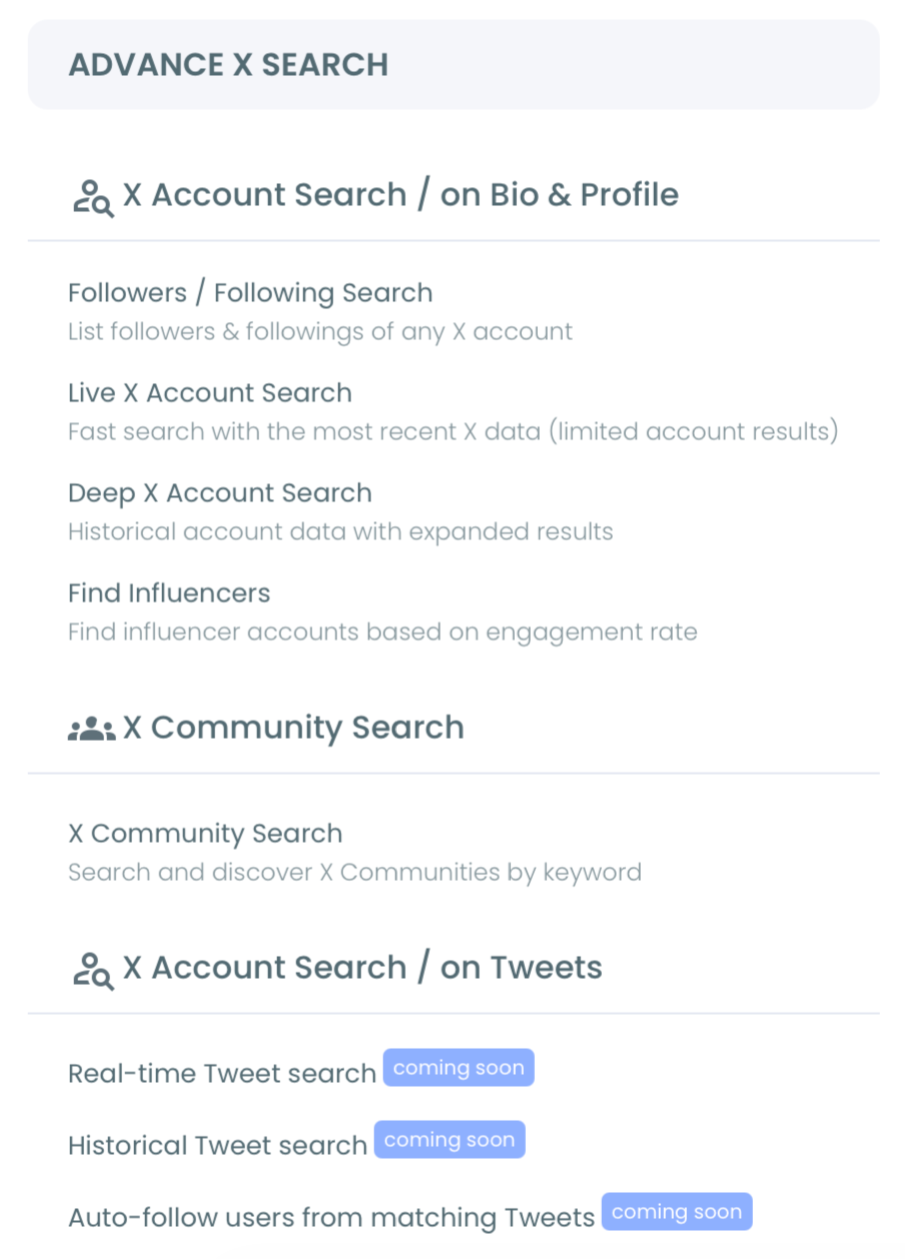
- Select Real-time Tweet Search, not Historical Tweet Search. Real-time collects forward from a date you choose; historical queries a past window.
Shape the collection, then work the accounts
- Describe the tweets you want in plain language, then open Filters and narrow the query. Keyword match type, exclude terms, language, replies, links, hashtags, cashtags, verified-only, media type, and engagement minimums are all there, and an Active Filters bar shows what is applied.
- Set the start date and the tweet count. Last 24 Hours, Last 7 Days, Last 30 Days, or a custom date anchors the collection, and the tweet count controls its size and the GetTweetTokens it consumes.
- Read the tweets, click "Display Profiles of this search," then act on the accounts by following selectively, adding them to a Twitter List, or exporting the set as CSV.
That ordering is what keeps the result usable.
Filtering before collection means you spend tokens on posts you want rather than posts you will scroll past. The start date decides which slice of the conversation belongs to you, and the profile view converts a stream of posts into a list with names on it.
Which filters keep a live keyword stream usable?
Filter before you collect.
A busy keyword produces volume faster than you can read it, and every unfiltered post you pull consumes tokens that a better-matched post could have used. Filters are what separate monitoring a keyword from drowning in it.
The filters that earn their place on a noisy live keyword:
- Engagement minimums, so a post nobody reacted to never reaches your result in the first place.
- Exclude terms, for the unrelated meanings your keyword happens to share with another topic.
- Language, so a globally used word stays inside the market you actually sell to.
- Replies and links toggles, which decide whether you want original commentary or the chain built around it.
- Verified-only, when a smaller and more accountable set is worth the accounts you give up.
Match type is the control most people leave on its default. Exact phrase, contains, and partial each read the same words differently, and the distance between them decides whether a run comes back as a tight readable set or as a flood you abandon halfway down.
The Twitter advanced search filters page lays out how each control behaves before you commit tokens to a run.
Operator thinking transfers directly from the native side. X documents its own X advanced search behavior, and the same instincts about phrases, exclusions, and account filters apply once you move the query into Circleboom.
For a deeper pass on query construction, how to use Twitter advanced search walks through the operator set in detail.
Mentioning your keyword is not the same as wanting to hear from you.
A person venting about the category may be perfectly loyal to someone else, and an account quoting your launch may be quoting it to argue with it.
Read the profile rows before you act on them in bulk, and hold Auto Follow back until the engagement and quality thresholds are in place, since it will keep following every qualifying account for as long as it runs.
When a live keyword beats a historical search
Pick real-time monitoring when the signal is being expressed right now and the window is short. Four situations make that call for you.
A competitor incident is the clearest one. An outage, a viral complaint, or a public dispute opens a stretch of hours or days when affected accounts are saying so out loud and an alternative reads as helpful rather than opportunistic.
Collect from the moment the incident starts and you have the participants; collect a month later and you have a transcript.
A launch or campaign is the second. Setting the start date to your announcement and running the collection on your campaign keywords shows which accounts pick the conversation up, who asks questions, and who carries it to an audience you do not already reach. That list is useful during the campaign in a way no post-campaign report can be.
Live events are the third. Conference hashtags and event keywords produce a short, dense burst of posting, and collecting from the event start date captures attendees, speakers, and outside commentary together while the shared experience still gives you something to open with.
Current buying signals are the fourth. "Looking for recommendations" posted this week means something that the same sentence posted last year does not, because the decision has not happened yet.
Measurement makes the case for scoping tightly. The read on how many people saw my hashtag is a useful companion when the keyword you are watching is a tag rather than a phrase.
The counter-case is real too.
A single noisy window is a bad foundation for a long-term conclusion, and comparing the live spike against a historical run is how you tell a genuine shift from an ordinary Tuesday.
How to keep the accounts once the conversation cools
Treat every live result as perishable.
Posts get deleted, edited, or made private within minutes, engagement counts move while you read, and a result left open in a browser tab is a result you will eventually lose.
Adding accounts to a list is the lightest way to hold a finding. The Twitter List Manager keeps the campaign, incident, or event in its own container. Nothing changes in your follower or following graph during a week when your feed is already loud.
Export is the durable version. Pull the profile view out as CSV and the accounts land somewhere a spreadsheet, a CRM, or a report can use them after the moment passes.
Export draws on the token balance separately from the search, so check what is left before a large pull.
Old collections stay available, which changes how you plan the next monitoring run.
Results sit under a search log and can be reopened without consuming GetTweetTokens a second time, so a keyword you ran during a launch week is still there when the next launch comes around. Two runs on the same keyword, months apart, tell you whether the volume you saw was a spike or a baseline.
Following is the move to spend last, because it is the one the other person actually notices. Save it for the accounts where the moment itself explains why you turned up. That is the same discipline behind live tweeting: presence inside the conversation beats a cold approach three weeks later.
Competitive moments deserve a second pass too. A live collection around a rival's incident pairs naturally with a slower read of analyze your competitor's Twitter account. One shows you the spike, the other shows you the pattern behind it.
What to do next
The gain here is not that you see more of X. It is that a session now ends in something with edges: a dated set of matching posts, a named list of the accounts that wrote them, and a file you can reopen next month and still understand.
A short checklist to run your first collection:
- Pick one keyword narrow enough to mean something, and one start date that matches the moment.
- Set exclude terms, language, and engagement minimums before you spend tokens.
- Collect, then read the tweet view sorted by impressions to see who is carrying the conversation.
- Switch to profiles, review the rows, and list or export the accounts worth keeping.
Keyword monitoring on X only pays out while the window is open, so set yours while the conversation is still worth joining.
→ Set up keyword monitoring on X
What to know before you start
Will protected or private accounts show up in my results?
No. Only publicly posted tweets from public accounts are collected, so protected, private, and restricted accounts stay out of both the tweet view and the profile view. Anything you see in the result is something anyone on X could have seen too.
Can I follow everyone posting about my keyword automatically?
Yes, through Auto Follow from matching keyword, which keeps searching live tweets with your keyword, start date, language, engagement, and account filters, then follows the accounts behind qualifying posts. Set those thresholds first, because an unfiltered live stream will pull in low-signal accounts at scale.
Follow actions are subject to X's own limits and Circleboom processes them gradually.
How far back can the start date go?
You can pick Last 24 Hours, Last 7 Days, Last 30 Days, or a custom date. A start date set far into the past effectively behaves like a historical query and returns a less current result set than you probably intended, which is a sign the topic belongs in Historical Tweet Search instead.