
You remove Twitter likes from a specific time period by loading your recent likes into Circleboom, setting the Date filter to the earliest and latest dates that matter to you, and unliking what the filter leaves on screen.
One detail decides whether that lands the way you expect: the date the filter reads is the date the post went up, not the day you tapped the heart.
Circleboom loads the most recent 3,200 posts you have liked on X into one filterable table, bounds them by publication date, and unlikes whatever stays ticked. Unliking is permanent, and the post you liked stays exactly where it was.
→ remove Twitter likes by date range
Which date the filter reads is where most dated cleanups quietly go sideways. That is the next section.
Two different dates hide inside one date range
"Everything I liked in 2022" and "everything from 2022 that I liked" are different sets of posts, and only one of them is what a date filter returns.
Your like history is ordered by when you liked. Circleboom keeps that order when it pulls the last 3,200 liked posts off X, newest like first.
The table it renders carries the post's own numbers, impressions, likes, retweets, quotes, bookmarks and replies, plus a single date column: Created At.
Created At is the post's birthday. It is not yours.
That gap produces three outcomes worth knowing before you set any dates:
- A 2019 thread you liked last month sits inside your recent-likes window, and a 2019 date filter will catch it.
- A post published in 2022 that you also liked in 2022 is caught cleanly by a 2022 filter.
- A brand-new post you liked during the stretch you want erased was published outside that stretch, so the filter skips it.
The first and third cases are the ones that bite. If the period you want off the record is a period of your behaviour, a date range built on publication dates is a strong first cut rather than a complete answer.
That is not a flaw in the filter. It is the only date X exposes on a liked post, and knowing which of the two questions you are asking turns a rough sweep into a precise one.
Reacting versus digging
Take a composite case, purely as illustration.
Someone spends a bad autumn arguing under political posts, most of them published that same autumn, and wants the whole stretch gone. A date range across those three months catches nearly all of it, because live argument happens on fresh posts.
Now the opposite shape. Someone spends a research month liking old explainer threads from 2018 and 2019. A date range across that research month returns almost nothing, because the posts themselves are seven years old.
Same screen, same filter, two completely different hit rates. The only variable is whether the reader was reacting to new material or digging through old material.
That is the thing to settle before you type any dates. Were you reacting, or were you digging?
What your last 3,200 likes actually reach on X
The window is measured in likes, not in months.
Circleboom loads your most recent 3,200 liked posts from your X account through the platform's own API, and anything past that count needs the archive route instead.
How much calendar time 3,200 likes buys you depends entirely on your habit.
Purely as arithmetic: five likes a day works out to roughly 640 days of coverage, while forty a day covers closer to eighty.
Heavy likers have a short reachable horizon; light likers can reach back years.
Nothing warns you when a period falls outside that horizon. The screen simply shows the likes it has.
Read the total count at the top of the page first, then scroll to the oldest row and check its date. Within a few seconds you will know whether the period you came for is loaded at all.
The same date-bounded logic exists on the posting side, and Circleboom's walkthrough on how to delete tweets by date covers that version against your own timeline.
Ready to clear a period of Twitter likes rather than the whole history? The filter panel is where that decision gets made.
What to pair with the dates in the filter panel
The Date boxes rarely work alone. The same panel carries Post Type, Language, Media presence, an Exclude Some Tweets control, and Min/Max ranges for retweets, likes, replies, quotes, bookmarks and impressions.
Two pairings do most of the work on a dated pass.
- Date plus Post Type separates the replies you liked from the standalone posts you liked, which matters when the regret is specific to argument threads.
- Date plus a Min/Max engagement range isolates the viral posts inside the window, the ones most likely to still be circulating with your name attached in the liked-by list.
Everything you do not filter stays selected, so each filter you add is a subtraction from what is about to be removed.
Add the dates, then add one more control, then stop. Three stacked filters on a 3,200-row list usually means an empty result and a confusing second attempt.
Why the surgical version beats the full reset
Removing every like is one click and no thinking. It also takes out the reading list, the reference threads, the posts you saved because you meant to come back to them.
A dated pass keeps that material. You give up one stretch of engagement history and keep everything on either side of it, which matters if you treat likes as informal bookmarks.
Circleboom is one of the companies on X's official Enterprise developers list, which is what makes a scoped pass exact rather than approximate.
The Created At value on every row is X's own record of when that post was published, read from the platform instead of inferred from a rendered profile page.
The window you set is the window that gets cleared.
That is the practical difference between a scoped cleanup and a scorched one.
Most people who arrive wanting the second want the first once they price it. Circleboom reached roughly the same conclusion on the posting side, in its look at what to delete and what to keep.
Once you know which date you mean, the mechanics are short. The flow below runs from a logged-out browser to a bounded, reviewed, permanent removal. It is where you remove Twitter likes from a specific period in practice.
How to remove Twitter likes from a specific period with Circleboom
Date filter, on screen: the Earliest and Latest boxes that scope a Circleboom delete run to a single window.
https://www.youtube.com/watch?v=sRl1DYsR_tg
To remove likes from one stretch of time, load your recent like history, bound it with the Date filter, confirm what survived the filter, and only then run the removal. The six steps below split into three phases, and the order is deliberate: nothing irreversible happens until the last one.
Load the like history first
- Log in to Circleboom Twitter and connect the X account whose likes you want to clean.

- Open the Essential Toolbox menu and pick the Delete Likes tools, which is where Delete My Last Likes sits.
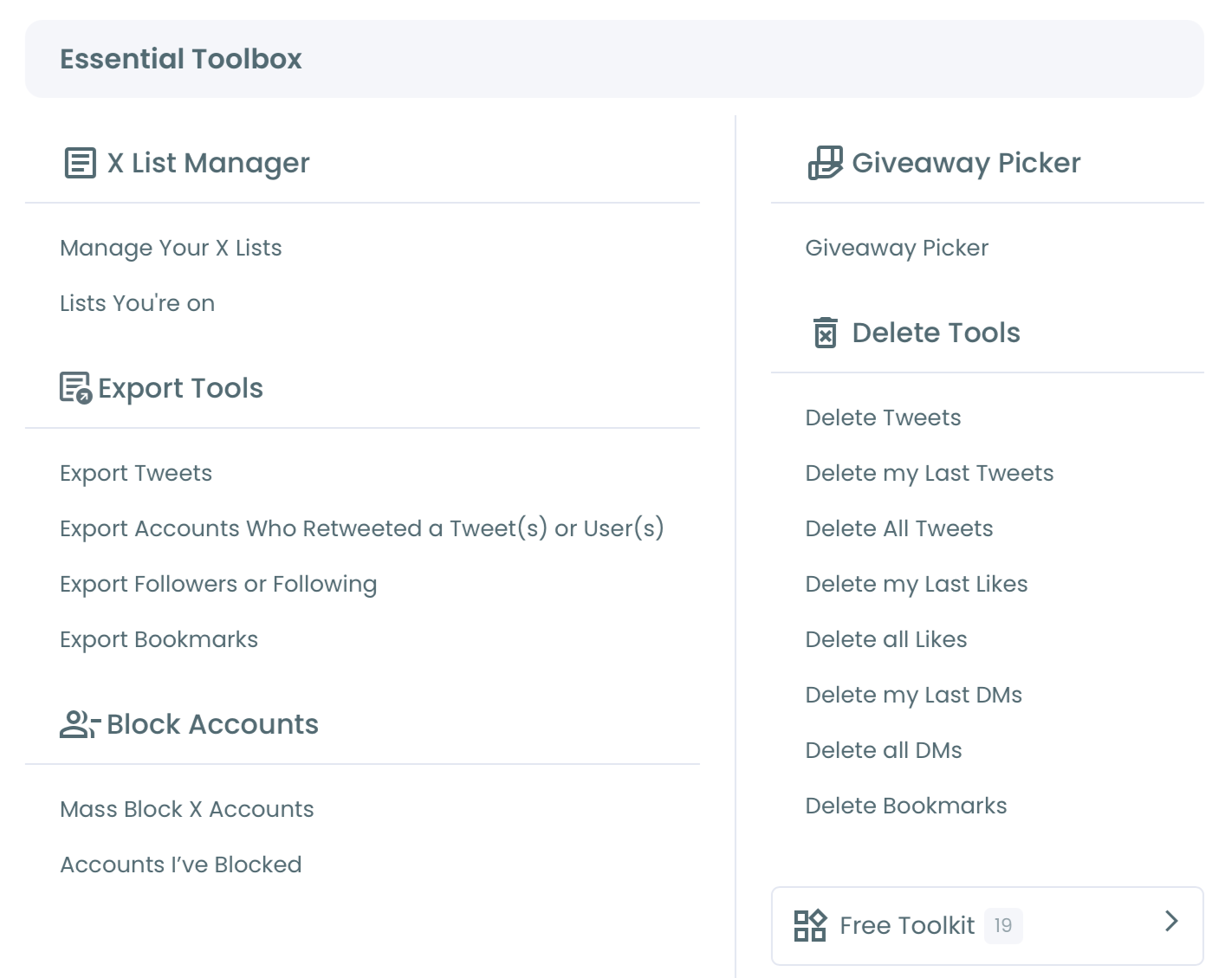
- Let the page finish loading your likes and read the total count at the top. That number tells you how much of your history is in play before you filter anything.
Bound the window before you touch a button
- Click Filter Options and set the Date filter, Earliest and Latest, to the two ends of the period you want gone. Add Post Type in the same panel if you only want replies, or only original posts, inside that window.
- Read the rows that survived the filter. Each row keeps its external link, so you can open a post on X and confirm you are looking at the right stretch before anything happens.
Confirm the selection, then unlike
- Check the Delete Selected count, then run it. Every loaded like starts pre-selected, so the count is the honest picture of what is about to come off, and the removal only touches what is still ticked.
The sequence earns its shape. A filter cannot narrow a list that has not loaded, the date bounds have to exist before any button means anything, and the selection check sits between the filter and the one action nobody can reverse.
Skip the count and you are trusting a filter you never read.
The sequence in one line: load, bound, verify, remove.
What happens to the posts you unlike?
The post itself is untouched. Removing a like takes your engagement signal off it and decrements the like count by one; the author's post, its replies and everyone else's likes carry on exactly as before.
On your side, the change shows up as a gap in your engagement record where that period used to be. Nothing announces it.
Worth saying plainly, because people expect otherwise: unliking is not a takedown. The content you reacted to remains published, searchable and visible to everyone.
What changes is the association between your account and that content, which is the only part of the arrangement you ever controlled in the first place.
Reversal is the part to take seriously. Unliking through the X API is permanent, and Circleboom has no restore button once a batch has processed.
Export the list to CSV before the run if the period holds anything you might want to find again. Readers working from a phone get the same panel: Circleboom's notes on how to delete likes on iPhone cover the mobile-browser version of the identical flow.
Where this leaves your X account
You end up with a like history that has one stretch removed and everything else intact.
The bookmark-style likes from before and after the window survive. The profile carries no visible mark where the period used to be.
The engagement signal you sent during that stretch is gone from the platform's record of your account, and the posts themselves carry on without you attached to them.
That is what scoping by date buys over clearing the lot.
If the period you care about sits past the 3,200-like window, the escalation is the archive route, and X sets out how to download your X archive on its own help pages.
Delete Old Tweets by Year is the same pattern on the posting side, and likes have their own archive-based equivalent for history that deep.
One last check before you commit: read the count, then unlike everything in that window.
Date-bound cleanup questions people send us
Does the date filter go by when I liked the post or when the post went up?
By when the post went up. Created At is the only date column the liked-posts table carries, so a date range selects on publication date while the list itself is ordered by your like activity. Set the range against the posts you remember, not the days you remember.
Can I reach a period that is older than my last 3,200 likes?
Not through this screen. Delete My Last Likes covers the most recent 3,200 liked posts on X, and anything older needs the archive-upload route instead. Check the total count on the page before you plan a run against an older stretch.
Can I save a copy of the likes before they come off?
Yes. The likes list exports to CSV from the same screen before you delete anything, which is worth doing when the period contains reference material. The same table also powers My Tweets on the posting side, so the export behaves the way you would expect if you have used that one.
How long does a big date-bounded unlike run take?
Longer than you would guess, because X rate limits how fast unlike calls can be submitted and Circleboom paces the batch to stay inside them. Leave the browser open until the run reports finished. Anyone comparing this against a wider sweep can look at how Circleboom handles deleting old tweets before a certain time, which runs on the same pacing logic.