
How many of the accounts you follow on X could you describe without opening their profile? Most people manage thirty or forty before the names stop meaning anything.
Everything past that is an unlabelled row, and a Twitter following audit is the pass that puts a label on every one of them before anyone decides whether something has to change.
By hand: open profiles one tab at a time, lose the thread around row sixty, and finish with an impression instead of a number. With Circleboom: every account you follow on X loads into one sortable table with tweet count, join date, follow ratio, and engagement tier already computed through official API access.
→ Twitter following audit
The output of the pass is a report, not an unfollow queue.
What a Twitter following audit counts
An audit answers one question: what is this list made of?
X does not answer it. The native following list is a scroll of avatars and bios, ordered by nothing you chose, with no totals anywhere on the screen.
You can read it for an hour and still not know how many of the accounts you follow have posted anything this year.
Circleboom pulls your full following list from X and rebuilds it as a table of computed values. Every row carries total tweets, account age from the join date, following count, follower count, follower-to-following ratio, and an engagement tier of high, medium, or low.
Those values are the measurements. The audit is the act of reading them together.
Most people arrive here from the other direction, having already decided something is wrong. You can audit the accounts you follow on X without holding that opinion first, and the numbers usually redraw it.
Why the report is the deliverable
Cleanup articles treat the following list as a queue of mistakes waiting to be removed. An audit treats it as a population waiting to be described.
The difference shows up in what you walk away with. A cleanup leaves you with a smaller number and no record of what the old number contained.
An audit leaves you with a description of both, which is the only version you can compare against later.
That matters because the composition drifts slowly. Accounts you followed for a project go quiet. A creator you followed for one topic starts posting about another.
None of that announces itself, and none of it is visible in a count of how many people you follow.
Reading the list by attribute rather than by name is also how you find the accounts worth protecting. The strongest sources in a following list often look ordinary on metrics: low follower counts, few posts, no verification badge. Sorting by Influencer Followers and Friends style reach signals shows you the opposite end of the same list.
What sits in the export file
Here is the part most audit write-ups skip: the export is not a screenshot of the table. It is a structured record with sixteen fields per account, and four of those fields are quality booleans.
| Field group | Columns | |---|---| | Identity | ProfileId, Username, Name, Location, Bio | | Scale | CountTweets, CountFriends, CountFollowers | | Status | IsProtected, IsVerified, Verified_Type, CreatedAt | | Quality flags | IsEgghead, IsFake, IsInactive, IsOveractive |
The four flags in the last row are what turn an opinion into a count.
IsEgghead marks an account with no profile photo. IsFake, IsInactive, and IsOveractive carry Circleboom's own classification of the account's behaviour.
Each is true or false per row, which means a spreadsheet formula can tell you exactly how many of the accounts you follow fall into each bucket.
Your following list becomes a countable classification the moment those booleans land in a file.
Circleboom computes those flags across the whole following list on X, so the composition arrives as numbers rather than an impression. Run the same export three months later and the two files diff cleanly, because the column names do not move.
If you would rather work in a sheet than in the table, export Twitter followers to a spreadsheet covers the same file format from the follower side.
The three counts worth writing down
Not every column deserves a line in the report. Three of them carry most of the signal on a following list.
Silent accounts. Sort by Tweets ascending and read where the low tail ends. Accounts with almost no posts are not always dead, but the size of that block tells you how much of your feed capacity is producing nothing.
Age spread. Sort by Joined and look for clusters. A tight group of accounts created within weeks of each other, sitting inside a list you built over years, is the signature of an old follow-for-follow phase rather than of anything you picked deliberately.
Ratio floor. Sort by Follow Ratio ascending. Accounts following thousands while being followed by a handful land at the bottom, and their share of the total is the closest single number to a spam estimate you can get without reading bios.
Write those three counts down with the list total beside them and you have a report. Everything else in the table is detail the export will hold for you.
The same three readings work on the other half of the account, where Twitter Audience Insights reports the equivalent split for the people following you.
How to run a Twitter following audit, step by step
Export step on video: the token balance, the field list, and the file that lands on your desktop.
https://www.youtube.com/watch?v=gOXfzG3jVz4
Three phases, eight steps, and no destructive action anywhere in the sequence.
Load the whole following list before measuring anything
- Log in to Circleboom Twitter and connect the X account you want to audit with official OAuth.

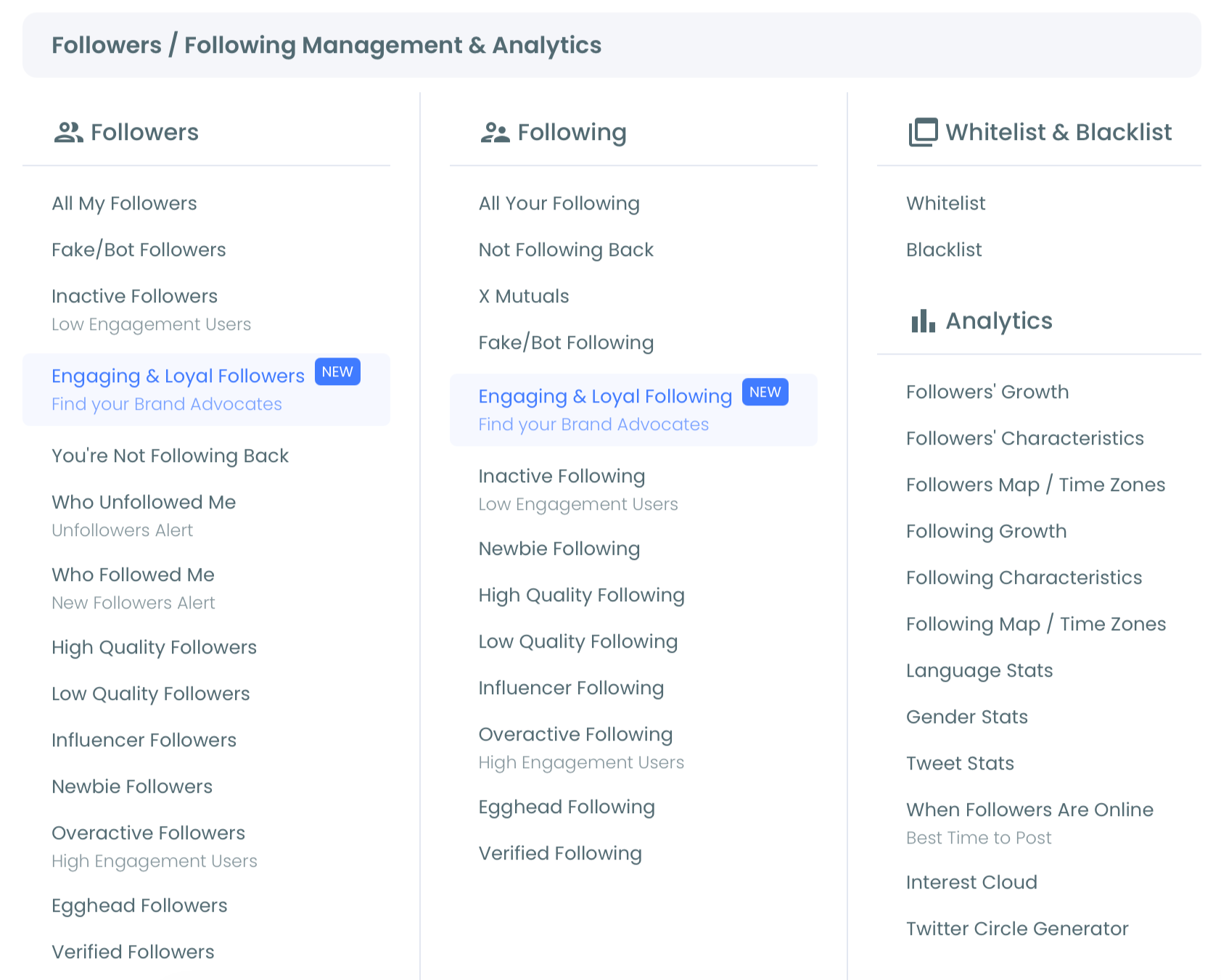
- Open the Follower & Following menu and pick the All My Following view, which is the unfiltered version of the list with no segment pre-applied.
- Wait for the table to finish loading so the totals reflect your entire following list rather than a partial page.
Read the list one column at a time
- Click a column header once to sort ascending, then again to sort descending. Tweets, Joined, Following, Followers, Follow Ratio, and the engagement column all sort, and each sort answers a different question about the population.
- Note the shape of each sort before moving on. Where the tail of very low tweet counts ends, where the join dates cluster, and how far the follow ratio drops at the bottom are the three readings that describe most following lists.
- Open Filter Options and count one segment at a time. Every active filter applies as an AND condition, so stacking four of them at once gives you a small number that describes almost nothing. One filter, one count, then clear it.
Turn the reading into a file
- Select the rows you want on record. Each row has its own checkbox, and the master checkbox at the top selects only the accounts on the page currently in front of you, not the full filtered set behind it.
- Click Export and check the remaining token balance shown on the button before the download starts. The CSV arrives with all sixteen columns whether you exported forty rows or four thousand.
Every step in that order is a measurement, and measurements have to be taken in a fixed sequence to stay comparable.
The full load fixes the denominator, the column reads give you the distribution, and the export freezes both into a file the next audit can be measured against.
Sort before filtering and you keep the census. Filter first and you only ever measure the segment you already suspected was there.
Is a following audit safe to run on your X account?
Yes, because nothing in the sequence above changes a single relationship.
Sorting, filtering, and exporting are read operations. No follow state is touched, no account is notified, and nothing appears on your profile. The whole pass is closer to opening a bank statement than to spending money.
Circleboom is an official X Enterprise Developer company, which is why the audit returns the whole following list rather than the truncated slice standard API access hands back.
A partial list produces a wrong denominator, and a wrong denominator makes every percentage in your report meaningless.
The only step with platform limits attached is the one you may never take.
If you do decide to remove accounts later, X processes 50 unfollows per 15 minutes and up to 800 per day, and Circleboom recommends staying near 100 to 150 per session. X publishes its own account-data guidance in the X archive download instructions if you want a second copy of your data straight from the platform.
What changes once you have the numbers
The first thing that usually changes is the assumption you walked in with.
People expect the problem to be bots. More often the report shows a large block of accounts that are real, alive, and no longer relevant, plus a small block of genuine spam that felt much bigger because it was loud.
Those two findings lead to completely different next steps.
A Twitter following audit also settles arguments you have been having with yourself. The feeling that your timeline is worse than it used to be is either supported by the numbers or it is not, and both answers are useful.
The second change is that decisions get cheaper. Once you know that a specific number of the accounts you follow have not posted in a year, deciding what to do about them takes a minute instead of an evening.
The third is comparability. A dated CSV from today makes next quarter's version readable at a glance, in the same way that Twitter friends demographics only becomes useful once you have two of them side by side.
If the report does point at a cleanup, run a Twitter following audit first anyway. The removal then happens on evidence you already collected rather than on the mood you were in when you opened the app.
Your audit checklist
Five items, in the order they actually happen:
- Load the full following list and confirm the totals before touching a control.
- Sort by tweet count, join date, and follow ratio, and write down what each one shows.
- Count one filtered segment at a time instead of stacking filters.
- Export the CSV and date the filename so the next audit has something to compare against.
- Decide about removals afterwards, in a separate sitting, if at all.
The accounts worth protecting are usually the ones you spot during step two. The follower-side version of that segment is covered in list and export your high quality followers and friends on Twitter.
→ Start a following audit on your X account
Questions that come up once the CSV is open
How long does a following audit take on a list of a few thousand accounts?
The table loads in one pass and the sorting is instant, so the reading is the slow part rather than the tool. Most people finish the three sorts and the export inside twenty minutes on a list of two to five thousand accounts. A repeat audit is faster still, because you already know which three numbers you are looking for.
Does exporting my following list cost anything?
Export runs on a token balance shown next to the Export button, and each operation consumes tokens based on how many accounts you exported. The balance restores on your Circleboom plan cycle, so a quarterly audit costs far less than a habit of exporting every filtered view you open.
Can I audit the following list of an account that is not mine?
Yes, for public accounts. Circleboom can retrieve and export any public X account's following list with the same enriched columns, which is how competitor and prospect research usually starts. Private and protected accounts are not accessible.
Do I have to unfollow anyone after the audit?
No. The audit finishes at the report, and plenty of people run one, learn that their list is healthier than they feared, and change nothing at all. Removal is a separate decision taken later. For the record-keeping step that belongs before any of it, see how to download your following list on Twitter.