
The average person with a social account is active on 6.75 platforms every month. Your X posts reach one of them.
That gap is the entire problem. You write something that lands, it does fine with your X followers, and the part of your audience that lives on Instagram or LinkedIn never sees it.
The idea did not fail. The idea never travelled.
What you get from this walkthrough.The five platforms a tweet can land on natively, without a screenshot.The character ceiling that quietly decides how you draft the tweet.The exact sequence that publishes one post to all of them at once.
Circleboom cross-posts your tweets to Instagram, Facebook, LinkedIn, Threads and Bluesky from a single scheduled X post, using official X Enterprise APIs. Start here when you want to share tweets outside Twitter.
Why copying a tweet link rarely earns anything off X
A copied X link is the weakest way to move a post off the platform, because it asks a reader to leave the app they are already in.
X documents the mechanics clearly enough: every post carries its own URL, and the share menu hands it to you in one tap. X's help pages cover how to link to a post by URL in detail.
The mechanics work fine. The distribution does not.
Instagram is where the route breaks hardest. Links in captions are not clickable, so a pasted X URL sits in the caption as dead text that nobody can follow.
Circleboom converts the tweet into a styled visual card and publishes it to your connected Instagram account instead, which is why the X post arrives as native content rather than an orphaned string.
That same conversion logic drives Tweet to Instagram, which handles layout and theme before anything reaches your feed.
LinkedIn is friendlier to links but punishes them anyway. An outbound URL in the body of a LinkedIn update competes with LinkedIn's own retention goals, and an update whose entire payload is a link elsewhere reads as a redirect rather than a contribution.
The stronger move is to republish the text natively, which is exactly what a proper cross-post does. Our walkthrough on how to post a tweet on LinkedIn breaks down the formatting differences that matter there.
→ share one tweet across five platforms
The character ceiling that decides how you draft the tweet
Every destination platform has a hard character limit, and the tightest one in your set governs the draft.
This is the piece almost nobody plans for, because on X alone the only number that matters is 280.
| Platform | Character limit per post |
|---|---|
| X (standard) | 280 |
| X (Premium / Premium+) | 4,000 / 25,000 |
| 3,000 | |
| Instagram caption | 2,200 |
| Threads | 500 |
| Bluesky | 300 |
| 63,206 |
Your real draft limit is the shortest ceiling in your destination set, not X's.
If Bluesky is switched on, 300 characters is your working budget, and a 4,000-character Premium post will not fit.
Circleboom flags character-limit violations per platform before submission, so the problem shows up while you are still drafting rather than as a silent failure at publish time.
You can also edit the text per platform, which means the long version goes to LinkedIn while a compressed version goes to Bluesky.
What the ceiling looks like on a real draft
Run the arithmetic once and the constraint stops feeling arbitrary. Take a 900-character LinkedIn-shaped observation with three sentences of setup and one conclusion.
On LinkedIn it fits with room to spare. On Instagram's 2,200-character caption ceiling it fits. On Threads at 500 it needs the setup cut in half. On Bluesky at 300 it survives only as the conclusion.
That is not four edits. That is one decision made at draft time about which sentence is load-bearing, followed by three trims that take under a minute each.
Writing for the tightest ceiling changes the shape of the post itself. Short declaratives travel. Long dependent clauses do not.
The habit of drafting a tweet that already fits a 300-character floor makes every downstream version cleaner, and it removes the editing round that usually kills cross-posting somewhere around the second week.
If your destination is visual, the same discipline governs the card text, covered in our walkthrough on how to post a tweet on Instagram professionally.
What Circleboom does when you share tweets outside Twitter
Cross Posting lives inside the X Post Planner and turns a single compose action into simultaneous publication across every connected platform.
You write once, pick your destinations in the Schedule modal, and Circleboom pushes the post to X and to each toggled network at the same scheduled moment.
Five destinations are supported: Instagram, Facebook, LinkedIn, Threads and Bluesky. Each needs a connected account before it can be selected, and one account per platform can be chosen per post.
The pencil icon next to any enabled destination swaps the connected account; the remove icon drops that platform from this specific post without disconnecting it permanently.
Circleboom is an official X Enterprise Developer company, which is why the X side of every cross-post is published through sanctioned access rather than a browser workaround. Your account is never asked to do anything X has not authorized.
Everything you schedule this way lands in one Outbox record covering all destinations, so a week of cross-posts is a single queue rather than five dashboards you have to reconcile by memory. That single view is what makes the workflow survivable past the first month, because the failure mode of manual multi-platform posting is rarely effort.
It is losing track of what already went where.
→ share tweets outside Twitter
How to share tweets outside Twitter, step by step
Full walkthrough: the Schedule modal toggles that send one tweet to Instagram, Facebook, LinkedIn, Bluesky and Threads in the same publish action.
https://www.youtube.com/watch?v=OJEoAvvTcvs
The flow runs in three phases: connect, compose, confirm.
Connect the destination accounts once
- Log in to Circleboom Twitter and authorize your X account.
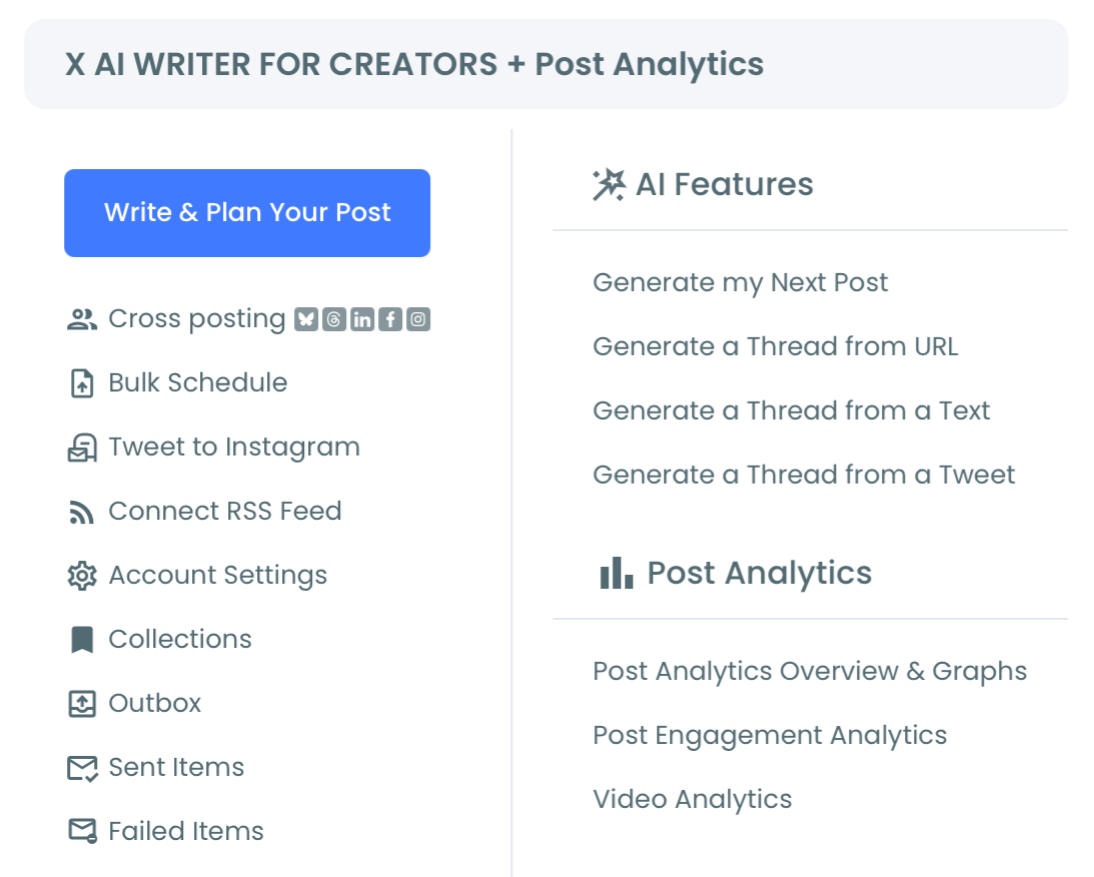
- Open the X Post Planner menu, where every publishing and cross-posting control lives.
- Authorize Instagram, Facebook, LinkedIn, Threads or Bluesky in the connections panel, one account per network.
Compose the post against the tightest limit
- Write the post in the editor and check the length against your shortest active destination.
- Edit the per-platform text wherever the wording, hashtags or mentions need to change for that network.
Confirm the destinations and schedule
- Click SCHEDULE, toggle each destination on in the Cross post on section, then confirm the time.
That order matters because connection is the only irreversible dependency. A platform that is not authenticated at publish time fails silently, so proving the connections first and drafting second means the character check and the destination check never collide with an expired token.
Quick recap:
- Connect each destination account once.
- Draft against the shortest character ceiling in the set.
- Adjust the per-platform text where it needs to differ.
- Toggle destinations in the Schedule modal and confirm.
Stories are a separate surface worth planning for, since a vertical card behaves differently from a feed post. Our guide on how to cross-post tweets to Instagram Stories covers that format specifically.
When simultaneous publishing beats extra reach on X
Reach is the obvious argument for cross-posting. Timing is the better one, and it applies hardest to launches.
A product announcement that goes live on X at nine and reaches LinkedIn at eleven has a two-hour window where half your audience is reading commentary about news they have not been told. Anyone who follows you in both places sees the gap. Journalists and partners who monitor several of your channels see it too, and the impression is not that you are busy.
The impression is that the announcement was an afterthought everywhere except X.
Every destination in a single cross-post shares one publish time.
That constraint reads like a limitation until you are the one coordinating an announcement, at which point it becomes the entire point: there is no window, because there is only one moment.
The same logic covers scheduled campaign beats, event reminders, deadline notices and anything where a stale version of the message on one network contradicts the current version on another. Coordination is a distribution problem long before it is a copywriting problem.
This is also the argument that persuades people who dislike cross-posting on principle. The objection is usually that identical text everywhere reads lazy, and for evergreen commentary that objection has weight.
For time-bound announcements it does not, because the value of the message is tied to when it arrives rather than to how differently it was phrased on each network.
Announcements want synchronisation. Essays want adaptation. Knowing which one you are publishing decides whether you toggle every destination or only two.
Does cross-posting the same text hurt your reach?
No. Search engines apply duplicate-content logic to indexed web pages, not to social posts distributed across separate networks with separate audiences and separate ranking systems. Instagram's feed does not know or care what your LinkedIn feed showed an hour earlier.
The reason cross-posting sometimes underperforms is different, and it is about fit rather than duplication. A post built on X-native shorthand, reply context or platform-specific hashtag behaviour will read as an import when it lands somewhere else. That is a content judgment, not a penalty.
The test that decides whether a tweet should travel
The practical test is whether the post still makes sense to someone who has never opened X. Strip the @handles, strip the reply chain, strip the running joke your timeline has been on for three days.
If what remains still carries the idea, it travels. If what remains is a fragment, that post belongs on X only, and skipping the cross-post is the correct call rather than a missed opportunity.
A steady share of any active account's posts will fail that test, and that is healthy. An account that cross-posts everything is not distributing, it is broadcasting, and the destination audiences notice the difference quickly.
The audience math still favours distribution. DataReportal's Digital 2026 global overview puts the average adult social user on almost seven platforms a month, and there is very little overlap in when they check each one.
Publishing to one network is a decision to reach a fraction of the people who already follow you somewhere.
Facebook is worth handling deliberately here, because its native tweet-sharing integration was retired years ago and the copy-link habit stuck around. Our walkthrough on how to post a tweet on Facebook covers the current path.
Pick your route before you schedule
If you post text-first content and want the same idea on LinkedIn, Threads and Bluesky, cross-posting with per-platform edits is the whole answer, and the character ceiling is your only real constraint.
If Instagram is in the set, treat it as a conversion problem rather than a distribution problem. The text has to become a card before it becomes a post.
If you are managing several brands at once, the destination list multiplies faster than the content does, and Circleboom Publish handles that surface with manage multiple social media accounts.
And if you are still copying links into other apps by hand, the fix takes one afternoon of setup and then never asks for your attention again.
The connections persist, the toggles remember nothing you have to re-teach them, and the only recurring decision is which destinations belong on this particular post.
That is the shape of a distribution habit that survives a busy quarter. Not more effort spread across more platforms, but one publishing action that already knows where the content is supposed to go.
→ distribute your tweets beyond X
Frequently asked questions
What happens if my tweet is too long for one of the destinations?
Circleboom flags the character-limit violation for that specific platform before the post can be scheduled, and you shorten the text in that platform's own editor. The other destinations keep the original wording.
Can I schedule the same post to go out at different times on each platform?
No. Every destination in a single cross-post shares one scheduled publish time, and per-platform time offsets are not supported inside one post. Schedule separate posts when you need staggered timing.
Do X polls and threads survive the trip to other platforms?
Polls do not, because they are an X-native interactive format with no equivalent on the destination networks. Threads survive as content but not as structure: each tweet in the thread publishes as an individual post on LinkedIn, Facebook, Instagram and Bluesky.
Do I need a paid plan on the destination platforms?
No. Cross-posting uses the standard publishing permissions of a connected account on each network, so a normal Instagram, Facebook, LinkedIn, Threads or Bluesky account is enough. The only paid-tier variable is on X itself, where Premium raises your own character ceiling.