
To sort your Twitter following by tweet count, load your full following list into a tool that reads the tweet-count field from X and rank every account by total posts. That single sort exposes both extremes of your feed at once: the accounts with zero or near-zero tweets that add nothing, and the hyperactive accounts posting hundreds of times a day that bury everyone else.
Native X gives you a following count and a scrolling list. It never tells you how much each of those accounts actually posts, which is the one number that decides whether a follow helps your timeline or clutters it.
Sorting your following by tweet count ranks the accounts you follow from most to least active, surfacing dead-weight dormant follows and feed-flooding overposters in one view. Circleboom pulls your complete following list from X as an official X Enterprise Developer and makes the Tweet Count column sortable in both directions. Start with a sort of your Twitter following by tweet count.
→ rank who you follow by post volume
Below: the exact sort, both directions, and how to read the results. ..
Why Tweet Count Is the Follow Metric Nobody Checks
Your following count hides a silent share. A number like 1,400 following sounds like 1,400 sources feeding your timeline, but a real chunk of that list has gone quiet, and another chunk never stops.
Neither group behaves like the account you thought you followed.
Tweet count separates the two. Read it against account age and you learn something the follower count can't tell you:
- An account years old with 40 total tweets never really posted.
- An account with 90,000 tweets and a two-year age posts more than a human reasonably can.
- An account with a healthy tweet count that stopped six months ago went quiet after being active.
That third case is the one manual browsing always misses. The account looks legitimate, the profile is complete, the old tweets are good.
Only the tweet count against the join date reveals it stopped contributing. Cleaning your following by tweet count is less about deleting bad accounts and more about matching your feed to accounts that are actually posting right now.
There is a platform reason to care too. X caps follow actions once you pass 5,000 accounts, tightening based on your follower-to-following ratio, per the platform's own follow limit and ratio rules.
A following list padded with dormant accounts spends that ceiling on follows that give nothing back. The fastest way to see the damage is to audit the accounts you follow by activity before you decide anything.
What Sorting Twitter Following by Tweet Count Actually Solves
Sorting by tweet count answers a question X refuses to: which of the accounts I follow are pulling their weight? Circleboom turns your following list into a structured table on X where the Tweet Count column ranks every account you follow by total posts, all pulled through authorized, policy-compliant data access rather than scraping.
The value is directional. Sort ascending and the bottom of your list fills with the lowest-tweet accounts, the dormant and barely-there follows.
Sort descending and the top fills with the highest-volume accounts, the ones flooding your timeline.
Same column, two problems, one pass.
This is different from unfollowing by follow ratio, which targets accounts that follow thousands but have few followers. Tweet count targets posting behavior instead: it does not care how popular an account is, only how much it posts.
A verified 500,000-follower account that hasn't tweeted in a year is dead weight in your feed regardless of its ratio, and only a tweet-count sort catches it.
If your instinct is to rank by reach instead, compare the two approaches with how to sort Twitter followers by popularity. Activity beats audience size for feed quality.
You can also run the same audit on your quality tiers. Once you spot the pattern, Circleboom's low-quality followers and friends breakdown layers activity signals on top of the raw count so a quiet-but-valuable source doesn't get grouped with genuine noise.
When you are ready to act, you can rank your following by activity and work the two ends of the list in a single sitting.
How to Sort Your Twitter Following by Tweet Count
Load your following list, open the Tweet Count column, and sort it once each way. The whole audit is a login, a menu, a sort, and a review.
Circleboom does the data pull through official X Enterprise Developer access, so nothing here scrapes X or risks your account.
Connect your account and load your following
- Log in to Circleboom Twitter and connect your X account with official OAuth.

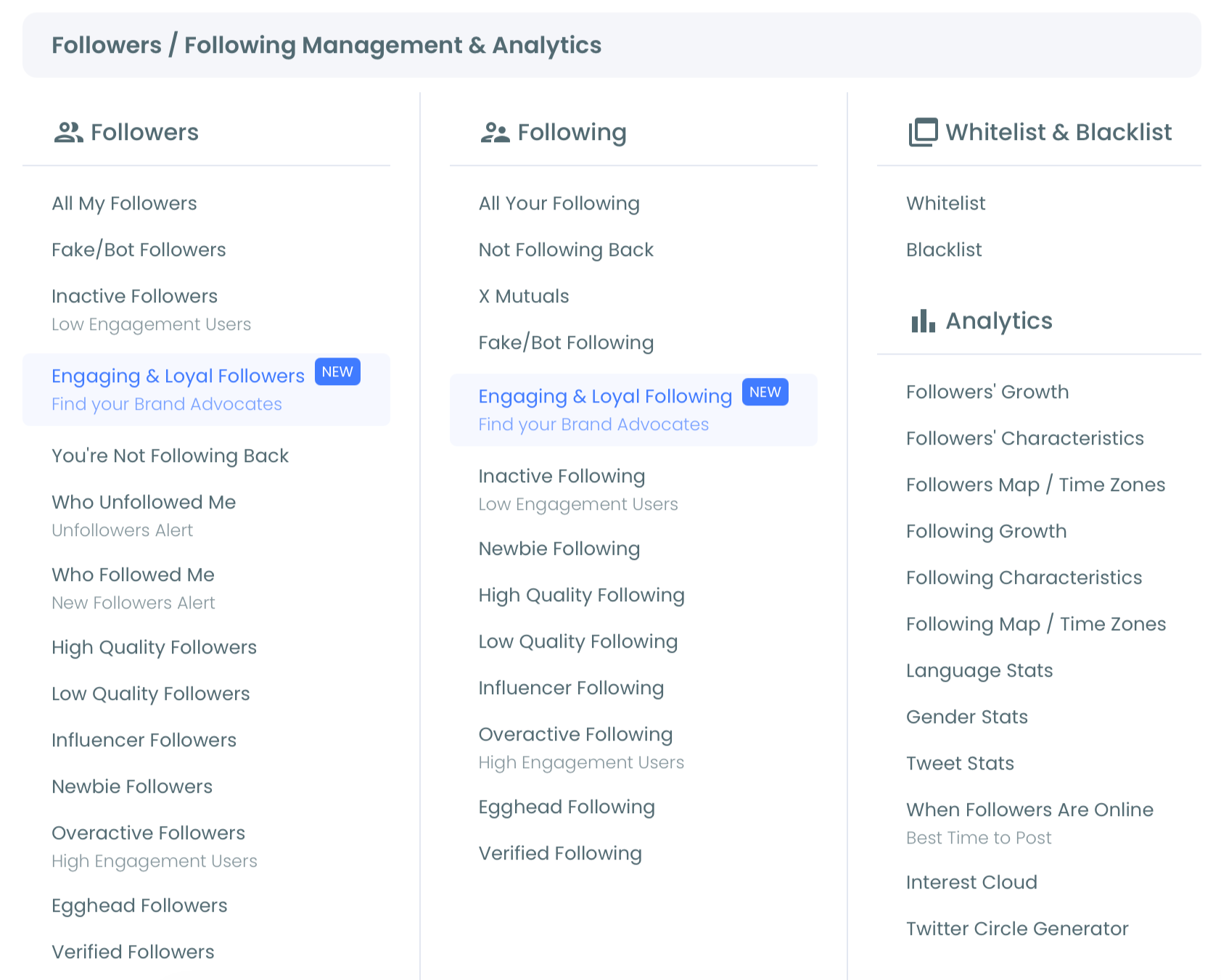
- Open the Follower and Following management menu and select All My Following.
- Let the full following list load into the table, one row per account, with the Tweets column visible alongside Joined, Followers, and Follow Ratio.
Sort the Tweet Count column both directions
- Click the Tweets column header to sort ascending and read the bottom of your list, where the dormant, near-zero-tweet accounts collect.
- Click the Tweets header again to sort descending and read the top, where the highest-volume overposters sit, then cross-check each against Joined so you can tell a never-active account from one that recently went quiet.
- Select the accounts that no longer earn a slot with the row checkboxes, whitelist any quiet-but-valuable source first so it survives cleanup, then unfollow the rest gradually.
That order works because the sort does the finding and you do the judging. Ascending surfaces the silent accounts, descending surfaces the loud ones, and the join-date cross-check stops you from cutting a good source that simply posts rarely.
Whitelisting before you act is what keeps a slow-posting client or archive account off the removal list.
See it live: the Tweet Count sort ranking a full following list from most to least active in one view.
What You Get After the Audit
A following list sorted by tweet count leaves you with a feed that matches reality. The accounts still in your following are the ones actually posting, so your timeline concentrates on live signal instead of a mix of ghosts and firehoses.
The compounding gain is control over your own attention. Cut the overposters and a handful of accounts stop dominating what you see; cut the dormant ones and your following count starts to mean what it says.
Want to keep a few high-volume accounts without letting them flood you? Move them into a list instead of unfollowing, so their posts live in a dedicated tab.
That is where how lists work on Twitter becomes the natural companion to a tweet-count cleanup.
You can rerun this any time your feed feels off. Because the data is pulled fresh from X on each run by a verified Enterprise partner of X, the tweet counts are current, not a stale snapshot.
A quarterly pass keeps the list honest.
Readers who want to confirm the raw view first can start from a plain look at who you follow on X before layering the sort on top. And if your list looks incomplete before you even sort it, why your followers and followings may not show in your list explains what to check first.
Objection: Isn't a Low Tweet Count Just a New Account?
The most common hesitation is real: some low-count accounts are simply new, and unfollowing a promising newcomer is a mistake. This is exactly why the join-date cross-check sits inside the workflow.
A low tweet count on a two-week-old account means "just started." The same count on a five-year-old account means "never posted." The number only tells the full story next to the age. The sorted table shows both columns side by side, so you never judge one without the other.
Curating who you follow by activity is one of the cleanest ways to fix a noisy timeline without touching your content or your posting schedule. If your feed has felt like scrolling past strangers and getting drowned by a loud few, the fix is not more following, it is knowing how much the accounts you already follow actually post.
→ Sort your Twitter following by tweet count
Common Questions About Sorting Your Following
Does sorting by tweet count unfollow anyone automatically?
No. Sorting only ranks and shows your following list by post volume. Unfollowing is a separate, deliberate step you take after reviewing the sorted accounts, and you can whitelist anyone you want to keep before acting so nothing valuable gets removed by mistake.
Can I tell a dormant account from one that just posts rarely?
Yes, by reading tweet count against join date and last activity together. A low count on an old account signals a never-active follow, while a low count on a new account signals a recent join.
Sorting on X with Circleboom keeps both fields visible, and its engaging followers and following view adds a recency layer so a slow-but-live source is not mistaken for dead weight.