
Watching a competitor's follower count is easy. Understanding their growth is not, because X shows you a single number with no history attached. You note "12,400 followers" today, and tomorrow that figure is meaningless because you have nothing to compare it against.
Real competitive intelligence is not the count; it is the change. Whether a rival is gaining steadily, spiking around a campaign, or quietly losing ground tells you far more than the raw total ever could.
To see that change, you have to capture the count over time and compute the difference. A tracking tool does exactly that, turning a static number into a dated growth curve you can actually read.
Circleboom tracks a competitor's follower growth by taking dated snapshots of any public account at regular intervals, then computing the difference so you see how their audience changes day by day. It reads only public data through official API access.
→ track competitor Twitter follower growth
Below: why the count alone is useless, and how dated tracking turns it into intelligence.
Why a Follower Count Tells You Nothing on Its Own
A follower count is a snapshot, and a snapshot has no direction. Without yesterday's number, today's number cannot tell you whether a competitor is rising or falling, which is the only thing that matters competitively.
X makes this worse by storing no history at all. There is no daily changelog, no growth chart for accounts you do not own, and no notification when a rival gains or loses followers.
The moment the day turns over, the figure you noted loses its context entirely. This is the same wall people hit before they set up a proper Twitter follower tracker, and the answer from X alone is no.
The only fix is comparison across time, which means capturing the count repeatedly and measuring the delta. That is what it takes to track competitor Twitter follower growth instead of guessing from a number that resets its meaning daily.
How Tracking Turns Count Into a Growth Curve
Circleboom's account-tracking feature automates the comparison. It takes dated snapshots of a target public account at scheduled intervals, computes the difference between consecutive snapshots, and plots the result as a growth chart with additions and losses over time.
The output is direction, not just magnitude. A bar chart shows new followers as gains and lost followers as drops, day by day, so you can see whether a rival's growth is steady, spiky, or stalling.
Because Circleboom is an official X Enterprise Developer company, it reads this through sanctioned access using only public data, which keeps the monitoring compliant. It is the same approach behind the best social media monitoring tools, applied to follower growth specifically.
Video walkthrough: how follower tracking captures every new follower on an account over time.
How to Track a Competitor's Twitter Follower Growth (Step by Step)
Here is the flow, start to finish.
- Log in to Circleboom Twitter and connect your X account with official OAuth.
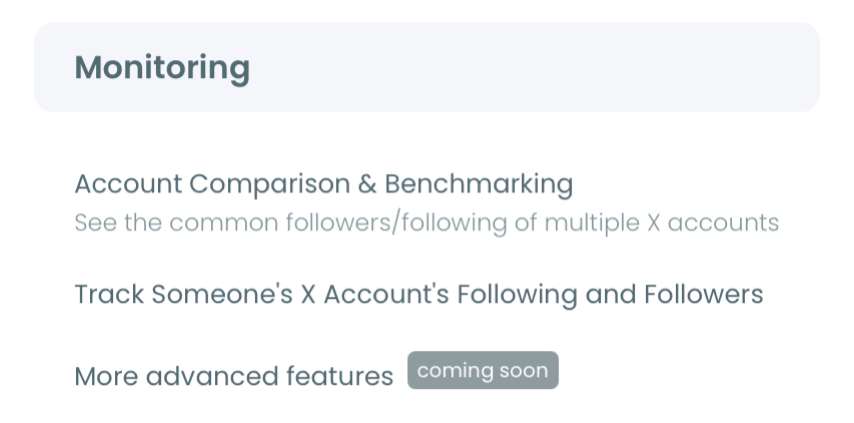
- Open the Monitoring menu and start a new tracking setup for the competitor's handle.
- Enter the username and choose Followers, then set the rule to track recent follower changes.
- Open the dashboard over time to read the dated growth chart, with optional daily or weekly email alerts.
That order works because tracking is forward-looking: you set the competitor, the snapshots accumulate, and the dashboard builds the growth curve X never gives you. Each tracked account consumes tracking tokens, since ongoing snapshots take resources.
Read Velocity, Not Just Direction
The growth curve is more than up or down; its shape is the real signal. Two competitors can both be growing while telling completely different stories.
Steady, gradual growth suggests durable content and a healthy audience. Sharp spikes suggest campaigns, viral moments, or paid pushes that may not sustain.
Sudden drops can mean a controversy, a bot purge, or a strategy that backfired. Reading the velocity, how fast and how smoothly the line moves, tells you whether a rival's momentum is real or borrowed.
This is the kind of insight that separates tracking where followers came from from simply counting them.
The dated view also lets you connect spikes to events. When a competitor's line jumps, you can line it up against their content, a launch, or a news moment and learn what actually moved their audience.
That is intelligence you can apply to your own strategy.
Don't Stop at the Number, Look at Who
Follower growth has a hidden second layer most people miss: not just how many followers a competitor gained, but who those followers are. The composition matters as much as the count.
If a rival's new followers are mostly low-quality or bot-like accounts, their impressive growth number is hollow. If their new followers are exactly the engaged, on-topic accounts you are also targeting, that is a competitive threat worth a response.
The tracking dashboard shows each new follower with full profile data, so you can judge quality, not just quantity. Watching that with a proper follower tracker turns a vanity metric into a real read on a competitor's audience.
For a fuller picture, pair growth tracking with deeper competitor analysis, which adds context about overlap and positioning beyond the raw growth line.
Turn the Data Into a Competitive Routine
A single look at a competitor's growth curve is interesting; a routine is what produces an edge. The accounts that get real value from this check it on a rhythm and act on what they see.
The practical habit is to track your core competitive set, the three to five accounts you actually compete with, and review their curves weekly. Over a few weeks, patterns emerge that no single snapshot reveals: which rival grows consistently, which one only spikes around paid pushes, which one is quietly stalling.
That pattern is the intelligence, and it compounds the longer tracking runs. It is the same discipline serious operators apply when they track an account's activity daily to catch moves early.
The dated record also makes your reporting concrete. Instead of telling a client or team "our competitor seems to be growing," you can show the actual curve, the velocity, and the quality of who is joining.
That shifts the conversation from impression to evidence, which is where strategy decisions should start. Understanding why an account suddenly gains new followers is far easier when you can see the dated spike that triggered the question.
The goal is not to obsess over a rival's number. It is to read their trajectory clearly enough that your own moves are informed by what is actually working in your space, rather than by guesswork.
The Bottom Line
You cannot track a competitor's follower growth from X alone, because the platform stores the current count and discards the history. The workaround is dated tracking: capture the count over time, compute the change, and read the curve.
Set it on a rival's public account, let the snapshots accumulate, and a meaningless number becomes a dated growth story, complete with who is actually joining their audience.
→ Start tracking competitor follower growth
Common Questions About Tracking Competitor Growth
Can I see a competitor's growth from before I started tracking?
No. Tracking captures change only from setup forward. It builds a dated growth history going forward and cannot reconstruct follower counts from before the first snapshot.
Will the competitor know I'm tracking them?
No. Tracking uses only public data through the official API. Nothing is posted or sent, and X does not notify an account that it is being monitored.
Does it work on any competitor's account?
Only public ones. A protected account's follower data is not publicly visible, so tracking can only be set up for public profiles, which most brand and competitor accounts are.
How often is the growth data updated?
On a schedule, not in real time. Tracking takes periodic snapshots, so the growth chart updates at each check, with daily or weekly email alerts available when new activity is detected.
Can I track more than one competitor at once?
Yes. You can set up tracking on multiple competitor accounts, with each tracked account consuming tracking tokens, which is common for monitoring a whole competitive set.