
Replying is the cheapest growth channel on X and the easiest one to waste. A reply that reads like a template gets scrolled past, and a reply under a dead thread gets read by nobody, so most of the effort people put into replying produces no measurable return at all.
The fix is not writing faster. It is running every reply through the same three checks before it ships.
What this walkthrough gives you.A reply workflow that starts from live engagement data rather than from scrolling.The three quality gates that separate a reply people click from one they ignore.The exact Circleboom sequence from trending card to scheduled reply on X.
Circleboom generates AI replies to trending X posts through approved API access and schedules them alongside your original content in the same workspace. Start with the Twitter comment generator.
What a generic X reply actually costs you
The cost of a bad reply is not zero, which is the part most volume advice skips. Every reply you publish is a small advertisement for your account, and a bland one teaches the reader that your name is not worth clicking.
Three patterns get filtered out by readers almost instantly:
- Agreement with no addition, which reads as a bid for attention rather than a contribution.
- Restating the original post in different words, which adds nothing to the thread.
- Generic praise, which is the single most recognisable signature of automated replying.
Free comment generators produce all three by default, because they are working from the source post alone and have no idea what you know.
The output is grammatically fine and strategically empty.
There is a compounding version of this cost that rarely gets counted. Readers who scroll past your name twice stop registering it entirely, so a run of bland replies makes the good one you write next month less likely to land.
Your name is a signal that accumulates value or loses it with every reply you publish. Volume without judgement spends that signal down, and a Twitter comment generator pointed at the wrong threads simply spends it faster.
A reply's job is to make one stranger curious enough to click your name. Nothing else in the thread matters to your follower count.
That is why the useful version of this tooling is a pipeline rather than a text box that produces sentences. It picks the thread, drafts against it, and then forces an edit before publishing.
Circleboom builds that pipeline into the X Post Planner, pairing trending X posts with AI drafts that wait for your edit. You can write X replies with AI and still keep every published line recognisably yours.
The three quality gates every reply should pass
Gate one is the thread. Before any writing happens, the source post has to have a live, growing audience, because reply reach comes from the conversation rather than from your own follower count.
Views climbing alongside replies is the signal; a big view count over a thread nobody is adding to is not.
Gate two is the addition. Your reply has to contain something the existing replies do not: a number, a counterexample, a specific tool setting, a consequence nobody mentioned.
If you cannot name what you are adding, the reply fails this gate no matter how well written it is.
Gate two has a fast version that costs about twenty seconds. Open the thread, read the top five visible replies, and write down the one thing none of them said.
If that note is a real sentence, you have a reply worth generating. If it is a shrug, the thread is saturated and the next candidate on your shortlist is a better use of the same minute.
Gate three is the voice. The reply has to sound like a person with a point of view, which is where most AI output falls down and where the writing-style controls on a Twitter comment generator earn their place.
Skip gate one and nobody reads you. Skip gate two and nobody remembers you. Skip gate three and nobody believes you.
The gates are ordered deliberately. Gate one is the cheapest to check and eliminates the most candidates, so running it first saves the writing effort for threads that can actually pay it back.
Accounts starting from a small base benefit most from that discipline, and grow an X audience from 0 to 10,000 covers the wider strategy around it.
Check whether replies are even open before you write
A reply you cannot publish is the most avoidable waste in this whole workflow, and it happens more often than people expect. X lets any author restrict who may reply to a post, limiting the thread to accounts they follow or to accounts they mentioned.
The controls are documented in X's own reference on conversations, and authors can change the setting after publishing as well as before. A thread that was open when you started drafting can be closed by the time you finish.
Two habits remove nearly all of this friction:
- Open the source post on X and confirm the reply box is available before you generate anything.
- Keep a second candidate from your shortlist ready, so a closed thread costs you seconds rather than the whole session.
A closed thread is not a dead end either. The AI quote generator writes the same commentary as a quote post, which publishes to your own timeline with the original attached.
The author still gets notified, so the point lands somewhere a reply could not have reached.
The background on reply restrictions is covered in limit replies to your tweets on Twitter. Seeing the setting from the author's side makes the workaround obvious.
How to use a Twitter comment generator safely, step by step
The process, in order.
Set the topics that decide what you see
- Open Circleboom Twitter and link the X account you plan to grow.
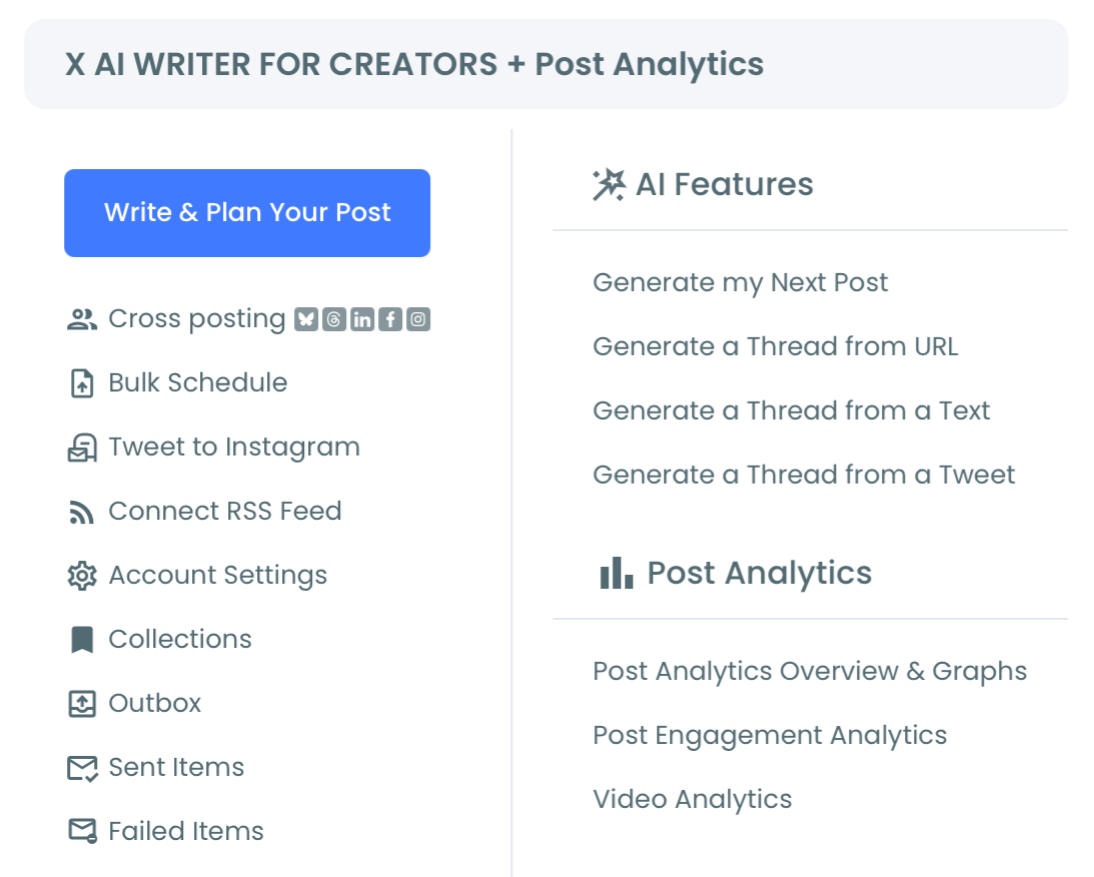
- Open the X Post Planner workspace and review the content interest topics saved on your account, since those topics decide which trending posts the feed shows you.
Shortlist the conversations worth entering
- Compare views against replies on each trending card and shortlist only the posts where both numbers are still climbing, which is gate one applied in about thirty seconds.
- Open your top candidate on X and read the existing replies, then decide what you can add that is not already there, which is gate two settled before a single word is generated.
Generate, refine, and schedule
- Hover the card, select AI Reply, and choose a writing style, using My Style when you want the reply to match your own posting voice and a structural style when the thread calls for a specific shape.
- Refine the draft with the "Describe and improve tweet" field, add the specific detail you identified in step four, then schedule or publish the reply from the same panel.
That ordering is what makes the workflow hold up under repetition. Selection sets the ceiling on how many people can see the reply, the addition decides whether they finish reading it, and the voice pass decides whether they click your name.
Reshuffle those moves and each one wastes the work of the ones behind it.
Quick recap:
- Connect the account and set your interest topics.
- Shortlist posts where views and replies are both rising.
- Name your addition before you generate anything.
- Refine the draft and schedule it from the same panel.
Watch it run: the refinement pass that turns a competent first draft into a reply worth clicking on.
https://www.youtube.com/watch?v=-YYzw9S6JnQ
Why approved X data access decides the quality of your shortlist
The engagement figures your whole shortlist depends on are only useful if they are accurate. Circleboom is one of the companies on X's official Enterprise developers list. The trending feed and the tweet-history analysis behind My Style both run through approved access rather than scraped page data.
Accuracy is not a compliance footnote here, it is the input to gate one. A shortlist built from estimated numbers sends you into threads that looked busy and were not, which is exactly the failure the gates exist to prevent.
Two operational limits follow from that same design, and both are worth knowing before you build a habit around the tool:
- Nothing publishes on its own, so every generated reply waits for an explicit publish, queue, or schedule action from you.
- Generated posts must fit the character limit on your account, which is 280 for standard accounts, 4,000 for Premium, and 25,000 for Premium Plus.
If you cross-post the same text elsewhere from the schedule step, each destination enforces its own ceiling. Threads stops at 500 characters, Bluesky at 300, and LinkedIn at 3,000, so anything longer needs shortening in that platform's editor before it will schedule.
What you get back from a gated X reply workflow
The most immediate return is a shorter path from finding a conversation to being in it. Reply windows close quickly, and a workflow that never leaves the planner produces more published replies per session than one that moves text between tabs.
Running the Twitter comment generator inside the same workspace as your scheduled posts is what removes those tab-switches. The time saved goes straight back into the editing pass, which is where it earns something.
The second return is a profile worth landing on. Because the same trending feed also produces rewrites and quotes, the account fills with original posts rather than becoming a wall of responses to other people.
For the posts that start a conversation instead of joining one, generate your next tweet works from a topic rather than from a source post.
The third return is knowledge you can use everywhere else. Reading engagement figures every morning shows you which formats are working in your subject area right now, and that signal improves posts you were going to write anyway.
Pulling the same lesson from your own history is covered in what to tweet based on past analytics.
There is a fourth effect that only appears after a few weeks, and it is the real reason the gates are worth their friction. A profile whose replies are consistently useful starts getting recognised by the same handful of regulars in a niche, and recognition from regulars is what converts a single visit into a follow.
Volume without gates buys the opposite kind of familiarity, the kind readers learn to skip.
Which reply path fits your X account?
Pick the route that matches where you are right now rather than running all three at once.
- If your account is under a few thousand followers, lead with replies. Reply reach depends on the source post, not on your follower count, so this is the one channel where being small costs you nothing.
- If you already have an engaged audience, lead with quotes and rewrites. Your own timeline distribution is worth more than borrowed thread traffic, and quotes notify the original author as a bonus.
- If your niche is unclear or your feed keeps showing irrelevant posts, fix the interest topics first. Everything downstream depends on them, and find people with the same interests as you on X is a good starting point for narrowing them.
Whichever route you take, keep the three gates in place. They cost seconds each and they are the difference between replying as a growth channel and replying as a hobby.
→ Set up the AI reply generator for X
Reader questions
How many replies should I publish per day?
Three to five well-chosen replies outperform twenty scattered ones, because reply reach is set by the source post's live audience rather than by your effort. Once you are filtering by engagement data, additional volume mostly adds time without adding readers.
Will people be able to tell the reply was AI-generated?
Only if you publish the first draft. Generated replies are drafts by design, and the editing pass, where you add a specific detail from your own experience, is what removes the machine signature. The writing-style selector handles tone; the detail handles credibility.
What happens if I reply to a post that already peaked?
Your reply gets published but lands near the bottom of a thread nobody is still reading, so it produces almost no profile visits. This is why the view-versus-reply comparison sits at the start of the workflow rather than at the end.
Can I schedule replies for later instead of publishing immediately?
Yes, replies can be scheduled from the same panel where they are generated. Timing is a trade-off, though, since a scheduled reply arriving hours later enters a colder thread, so scheduling suits evergreen conversations more than breaking ones.
Should I reply from my main account or from a separate one?
Your main account, in almost every case. A reply is only worth writing if a curious reader can click through to a timeline that makes sense to them, and a fresh side account gives them nothing to land on. If your main account posts about something else entirely, fix the interest topics and the posting mix first rather than splitting your attention across two profiles.
Does using a comment generator put my X account at risk?
Not when the tool reads X through approved access and publishes nothing without your action, which is how this workflow is built. The risk sits with tools that scrape data or post unattended, since both behaviours fall outside the platform's rules and put the account you are growing in jeopardy.