
Most creators and brands have a gut feeling about their audience's gender split, usually based on the topic they cover rather than anything they have actually checked. X gives you no way to check it even if you wanted to. There is no gender field, no demographic dashboard, nothing that tells you anything about who is actually following you beyond a name and a profile photo you would have to interpret yourself, one account at a time.
That assumption is testable. It does not have to stay a gut feeling.
Circleboom's Gender Stats analyzes the public profile signals across both your followers and the accounts you follow, and presents the estimated male and female split for each as a single side-by-side dashboard.
→ find out if your Twitter audience is mostly male or female
Why X gives you zero demographic data
X has no gender field anywhere in its profile structure. There is no setting, no declared category, nothing in the API that tells you anything about the demographic composition of an account beyond whatever the display name or bio text happens to imply. Finding accurate demographic signals about your followers on the native platform means opening individual profiles and making your own judgment call, repeated for every account in a list that may run into the thousands.
That absence is not a minor gap. Gender composition shapes how content gets framed, which examples land, and whether a brand partnership makes sense for the audience an account has actually built, not the audience it assumes it has built. Understanding your network's demographic makeup is a real input into content and partnership decisions, and X gives you nothing to work with directly.
The result is that most assumptions about audience composition go unchecked indefinitely, simply because checking manually at any meaningful scale was never realistic.
How the estimate actually works
Gender Stats produces an estimate, not a declared fact, and understanding how that estimate is built matters before acting on it.
- Display names provide the primary signal. Where a name carries a strong gender association, that association feeds into the estimate.
- Bio text and pronouns add a second signal. Accounts that declare pronouns or include gender-related language in their bio contribute that information to the classification.
- Explicit profile fields are used where present. Any other publicly visible gender indicator on the profile is factored in if available.
- Accounts with insufficient signal are excluded. Gender-neutral names with no pronoun declaration and ambiguous bio text do not get forced into a category; they are left out of the distribution entirely.
- Non-binary and undisclosed identities are not represented as separate categories in the current output. The estimate works within a male/female framework based on available signals, which means it cannot capture every actual identity in your audience.
The output is a population-level percentage, not a label on any individual account. Treat it as directional evidence about the audience as a whole, not a verdict on any specific follower.
How to check if your Twitter audience is mostly male or female
Because Circleboom is an official X Enterprise Developer, both your follower list and following list are retrieved through sanctioned Enterprise API access before the demographic analysis runs.

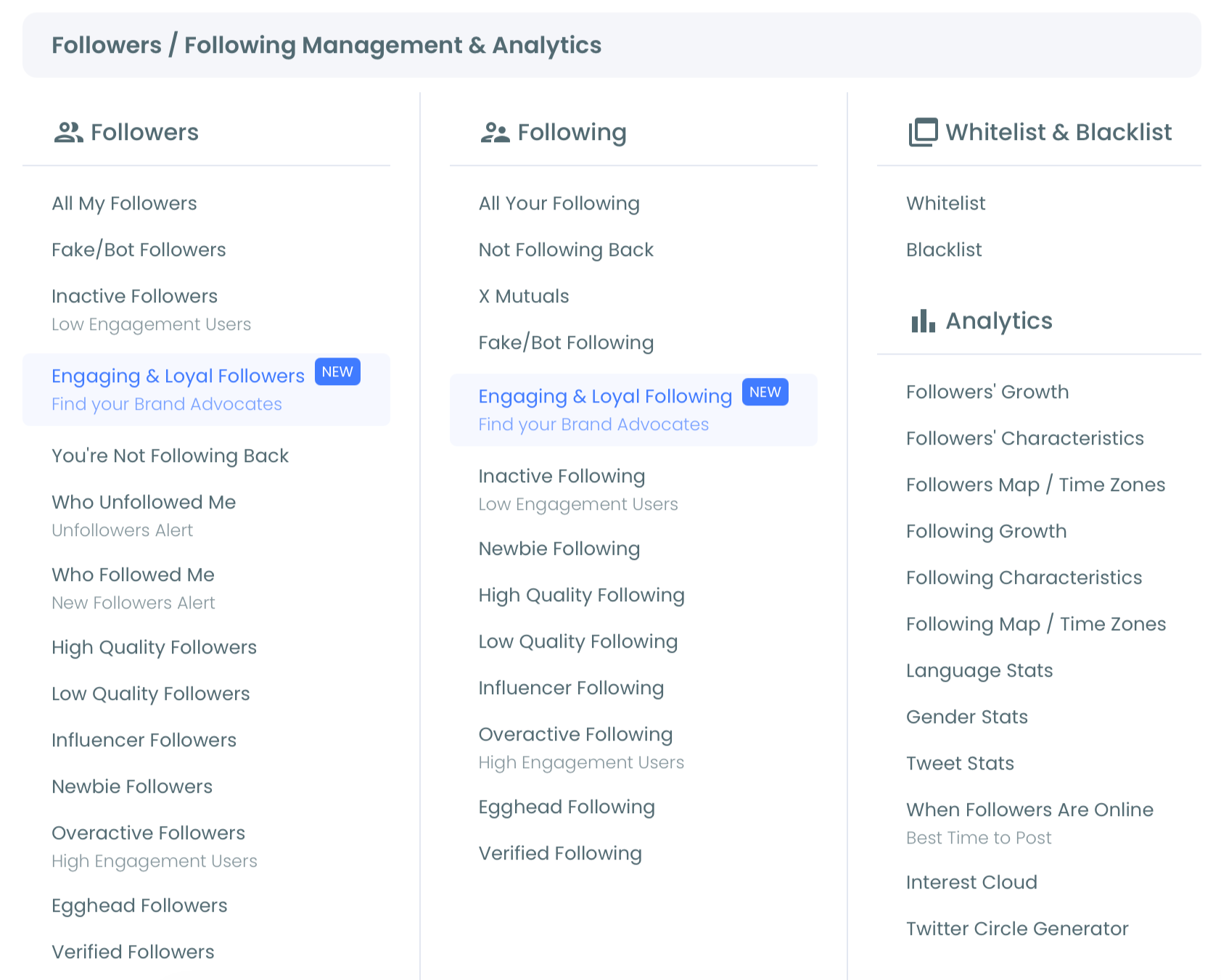
1. Connect your account and open Gender Stats: Log in to Circleboom Twitter and authorize your account through OAuth. Navigate to Gender Stats inside the Analytics section. The dashboard loads as a single view titled "Gender Stats: Followers vs. Following," with no tabs to switch between.
2. Read the followers panel: The left side of the dashboard shows the estimated male and female split among your followers, displayed as proportionally sized gender symbols so the balance is visible at a glance.
3. Compare it to the following panel: The right side shows the same breakdown for the accounts you follow. A significant difference between who follows you and who you follow can signal a mismatch between your built network and your actual audience.
4. Export the dashboard if you need it for reporting: Use the three-dot menu in the top right to export the complete side-by-side view as PNG, JPG, or PDF. Both panels are captured in a single export, with no need to save them separately.
That sequence gives you an actual number to compare against whatever assumption you walked in with, in less time than it would take to manually review even a small sample of your follower list.
What knowing the real split changes
Once the actual composition is visible, content and campaign decisions stop resting on an assumption that was never verified. If a content angle is built around resonating with one demographic, comparing that intent against the real follower composition tells you immediately whether the content is reaching the audience it was designed for or whether something is misaligned.
This number also has direct value in partnership conversations. Brand and sponsorship evaluations commonly ask about audience demographic composition, and a real, aggregate gender breakdown is a more credible answer than an estimate offered from memory. Combining it with language composition data builds a fuller picture for any media kit or audience report that needs more than one dimension.
Rechecking after a campaign aimed at a different demographic segment also shows whether the campaign actually moved the composition or whether it just generated activity without shifting who the audience actually is.
X never built the demographic layer at all
Most platforms eventually build some version of an audience insights panel. X never did, at least not in any form accessible to a regular account. Gender, age, location-based demographics, none of it is exposed natively in any aggregate, reportable form. What exists is raw profile text that a human would have to interpret manually, one account at a time, to extract anything resembling a demographic picture.
That gap is consistent with how thin X's own self-knowledge tools are for any account trying to understand who it has actually reached. The platform tells you how many people follow you. It tells you almost nothing about who they actually are in aggregate.
The mistake to avoid
The most common mistake is treating the percentages as identity labels on individual followers rather than as an aggregate estimate. The dashboard tells you something true about the population as a whole; it does not and cannot tell you the gender of any specific follower with certainty. Avoid drawing conclusions about, or acting differently toward, any single account based on this data.
The second mistake is using gender composition alone as a complete audience picture or a standalone targeting signal. Gender Stats answers one dimension of a larger question. Combining it with language, location, and interest data before making a content or partnership decision produces a far more reliable picture than any single demographic data point taken in isolation.
Common questions
How accurate is the gender estimate?
It is an inference based on publicly available signals, not a declared data point from X, since the platform has no gender field. Accounts with ambiguous or gender-neutral names and no pronoun declarations may be excluded from the distribution entirely rather than guessed at. Treat the result as directional, not exact.
Does this show me the gender of individual followers?
No. The output is an aggregate percentage breakdown across your entire follower base and following list, not a label applied to any specific account. The dashboard is built for population-level insight, not individual identification.
Can I compare my followers against the accounts I follow?
Yes. The dashboard shows both distributions side by side in a single view, no tabs required, making it straightforward to compare who follows you against who you have chosen to follow.
What about non-binary or undisclosed accounts?
The current output works within a male/female framework based on available signals, and non-binary or undisclosed identities are not represented as a separate category. This is a real limitation of the estimate, not a judgment about those accounts, and it is worth keeping in mind when interpreting the results.
Your next move
Whatever assumption you have about your audience's gender split is either correct or it isn't, and the only way to know is to check. Pull up the dashboard, compare followers against following, and use the real number instead of the guess the next time it actually matters. Check it, compare it, use it.
→ find out if your Twitter audience is mostly male or female