An egg avatar is not evidence. Neither is a low tweet count, a recent join date, or a lopsided follow ratio. Each of those describes plenty of real people, and a cleanup built on any one of them removes customers.
No single red flag identifies a fake follower. Composite signals do, and the difference decides whether a cleanup removes bots or removes customers. Circleboom classifies suspicious X followers across activity, follow ratio, account age, and profile completeness through official X Enterprise APIs, then presents them as a reviewable list rather than a verdict.
→ remove red flag accounts from Twitter followers
The list is a starting point for review, not a delete queue.
Why single signals produce false positives
Every commonly cited red flag has a large, legitimate population behind it.
No profile photo describes bots and also describes people who signed up to read rather than post, which is most of the platform's actual user base.
Low tweet count describes bots and also describes lurkers, who make up the substantial majority of accounts on any social platform and are perfectly real.
Recent join date describes bots and also describes anyone who joined recently, including people who joined specifically because they found you.
Lopsided follow ratio describes bots and also describes new accounts, casual users, and anyone who follows a lot of people without posting much.
Used alone, each of these flags a population that is mostly real. That is the entire reason naive bot cleanups do damage: they are run on one signal, they remove thousands of accounts, and a meaningful share of those accounts were people.
A red flag is a question, not an answer. Several red flags on the same account is an answer.
The detection logic underneath this is covered in how do you check if someone's Twitter followers are fake or real.
How composite scoring changes the result
Circleboom does not flag on a single dimension. An account with a low tweet count alone is not classified as suspicious. An account with a low tweet count, a follow ratio under 0.05, no profile photo, a very recent creation date, and an inactive engagement classification is.
The signals evaluated together:
- Activity relative to account age, since three years and five posts reads differently from one month and five posts.
- Follow ratio, where following thousands with almost no followers is a strong automated-behavior pattern.
- Posting distribution, because both total silence and burst-then-silence match known bot shapes.
- Profile completeness, covering missing photo, missing bio, and auto-generated-looking usernames.
The more signals that align, the higher the confidence. That is what keeps the false-positive rate manageable while still catching the accounts that matter.
Account age deserves a specific note, because it is the signal people weight most and should weight least on its own. A five-year-old account following 2,000 people is unremarkable. An account created yesterday following 2,000 people is not, and the difference is entirely in the combination rather than in either fact alone.
For the scale of the problem on a typical account, how many of my X followers are bots gives a realistic sense of proportion.
Why inauthentic followers actually cost you
The damage is arithmetic rather than reputational, and it is worth being precise about.
Engagement rate is engagements divided by impressions, and your follower count feeds the reach side of that calculation. Every inauthentic follower inflates the denominator while contributing nothing to the numerator, because it will never like, reply, or repost anything.
An account with 10,000 followers where 3,000 are inauthentic is not a 10,000-follower account with a bot problem. It is a 7,000-follower account whose metrics are being measured against 10,000, which makes every post look worse than it performed.
The knock-on effects compound:
- Your engagement rate reads lower than your real performance.
- Analytics mislead you about which content worked.
- Anyone evaluating the account for a partnership sees the same distorted ratio.
None of that is about looking bad. It is about making decisions from numbers with a known distortion in them, which is why the cleanup is worth doing carefully rather than dramatically.
That arithmetic is the honest reason to check your X followers for bots rather than an aesthetic one. You are correcting a denominator, not tidying a list.
The quality view one step up is also useful here. Circleboom's Twitter follower checker grades the audience as a whole rather than isolating the flagged segment.
The wider account-health context sits in Twitter X follower manager, which covers the analyze-and-clean loop end to end.
How to remove red flag accounts from Twitter followers
To remove red flag accounts from your Twitter followers, open the Fake/Bot Followers view under the Follower and Following menu. Sort the flagged list by follow ratio to triage the strongest cases, whitelist anyone you recognize, then remove only the accounts you actually reviewed. Detection precedes action, and the list is candidates rather than confirmations.
Six actions, with review sitting between detection and removal.
Load the flagged segment
- Log in to Circleboom Twitter and connect the X account you are auditing.

- Open the Follower and Following menu and select the Fake/Bot Followers view to load the flagged segment.
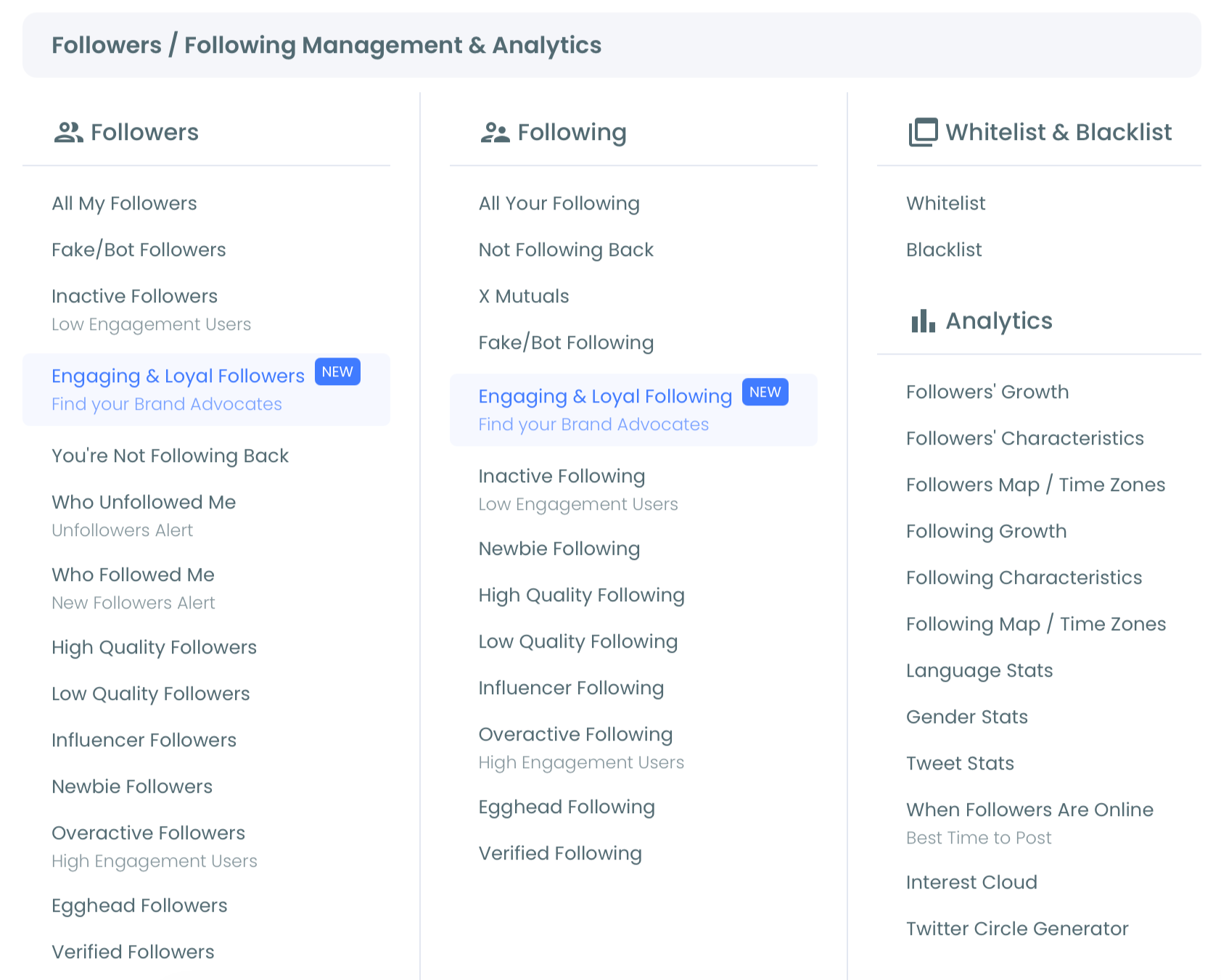
- Read the header count showing how many of your total followers were flagged. That proportion is itself a finding, and an unusually high one often points to a specific event rather than gradual accumulation.
Review before removing
- Sort by follow ratio, ascending, to put the most clearly automated accounts at the top. Work down from there rather than acting on the whole table.
- Open profiles for anything borderline and whitelist accounts you recognize. A whitelisted account stays protected across other Circleboom features, so the judgment is recorded once.
- Select the reviewed accounts and remove them, keeping the operation to a segment you have actually looked at rather than the full flagged list.
That order matters because the classification is deliberately a candidate list. Sorting by the strongest signal first means your attention goes where confidence is highest, whitelisting captures your knowledge before a bulk action can override it, and removing only what you reviewed is what keeps a cleanup from becoming a purge.
One mechanical point worth knowing before you start: Remove Follower and Mass Remove Follower are processed through the Circleboom Chrome extension, because X's API does not support removing a follower. The extension has to be installed and the browser session has to stay open while the queue processes.
Video walkthrough: how a flagged follower segment is sorted, reviewed, and reduced to a confirmed removal set.
→ clean up suspicious X followers
Where the red flags came from matters
Two accounts with identical flagged percentages can have completely different problems, and the difference is visible in the join dates.
Sort the flagged segment by account age and look at the distribution. If the suspicious accounts cluster tightly around a few dates, you were targeted. A follow-bot campaign runs in bursts, so its output shares a creation window, and that clustering is the signature.
If the join dates spread evenly across years, you have accumulation rather than an attack. Bots find accounts gradually through hashtags, replies, and follower lists of similar accounts, and the result builds slowly without any single event behind it.
Why the distinction changes what you do
The two situations call for opposite responses.
Accumulation is a maintenance problem. Clean it periodically, expect it to return at a predictable rate, and do not treat it as a sign anything went wrong. It is the ordinary cost of having reach.
Targeting is an event. A burst of inauthentic follows often arrives after something specific: a post that travelled unusually far, a mention by a large account, or an appearance in a list that bot operators scrape. Cleaning it once is usually enough, because the campaign that produced it has already finished.
There is a third pattern worth recognizing, which is a steady inflow that started recently and has not stopped. That points at something ongoing rather than historical, and cleaning it repeatedly without addressing the inflow is work you will keep repeating.
Check the timestamps before deciding the cadence. An account cleaned monthly when quarterly would do is spending attention on maintenance that the arithmetic does not justify.
The join-date distribution tells you whether this is weather or an event.
The underlying mechanics of how these accounts find you are covered in bots keep following me on Twitter.
Remove, block, or leave them alone
Removal is not the only option and frequently not the right one.
Removing a follower severs the relationship without blocking. The account can follow you again, which matters for follow-bot campaigns that simply re-follow after a cleanup.
Blocking is heavier and permanent until reversed. It suits accounts that are actively hostile rather than merely inauthentic, and it is worth reserving for that.
Leaving them is a legitimate choice for a low-volume problem. A few hundred bots on a large account move the engagement rate very little, and the cleanup costs more attention than the distortion does.
The decision usually turns on proportion. Under a few percent, the arithmetic barely moves and the cleanup is mostly cosmetic. Above ten percent, your metrics are genuinely misleading you and the effort pays for itself.
The blocking question specifically is worked through in should I block fake Twitter X followers, which lands on a more selective answer than most people expect.
What the classification cannot know
Circleboom is an official X Enterprise Developer company, so follower data is retrieved through authorized API access and the classification runs on publicly available signals. Those signals have limits worth stating plainly.
The model sees behavior, not intent. A dormant account belonging to a real person looks much like an abandoned bot, because the observable signals are nearly identical and nothing in the public data distinguishes them.
Sophisticated fake accounts also defeat signal-based detection by design. An account with a photo, a bio, a plausible posting history, and a normal follow ratio will not be flagged, because it does not look unusual on any measured dimension.
So the honest framing is that this catches the obvious and misses the careful, which is still most of the volume. X's own platform rules on authenticity cover the behavior the platform itself acts against.
Two habits keep a cleanup safe:
- Whitelist aggressively, since a protected real account costs nothing and a removed customer costs something.
- Re-run periodically rather than exhaustively, because follow-bot campaigns arrive in waves.
If bots keep reappearing after a clean pass, the cause is ongoing rather than historical. How to stop bots from following you on X Twitter addresses the inflow rather than the backlog.
Judge on the combination, act on the review
Removing red flag accounts from Twitter followers works when the flags are read together and fails when any one of them is treated as proof. Sort by the strongest signal, review the borderline cases, whitelist what you recognize, and remove only what you looked at.
Then check the proportion again in a few months rather than treating it as finished.
→ review flagged followers on X
Questions about red flag followers
Is an account without a profile photo a bot?
Not on its own. Plenty of real accounts never set one, so a missing photo only carries weight alongside other signals like a lopsided follow ratio and a very recent join date.
How many fake followers are normal?
A small percentage is typical for any account with reach. The cleanup becomes worth the effort somewhere above roughly ten percent, where the engagement-rate distortion turns material.
Does removing a follower notify them?
No. Removal severs the relationship silently, and the account is free to follow you again afterwards.
Why do I need a Chrome extension to remove followers?
X's API does not support removing a follower, so Circleboom processes those operations through its extension with your browser session open.
Will a cleanup improve my reach?
Indirectly. Removing inauthentic followers corrects the denominator in your engagement rate, so your metrics start reflecting what your content actually did.