
A Twitter follow check answers one blunt question: which of the accounts you follow don't follow you back? X keeps that gap invisible. It sits inside your following list until you go looking for it. Here is the short answer, then the full method.
A Twitter follow check is the fastest way to see which accounts you follow don't follow you back. Circleboom runs the Twitter follow check for you on X, comparing your following and follower lists through the official X API and returning every one-way follow with the engagement score, follow ratio, and account age you need to decide who stays.
→ See who doesn't follow you back
What a Twitter follow check actually tells you
A follow check reads two lists side by side: the accounts you follow, and the accounts that follow you. The interesting part is the difference.
Every account that appears in your following list but not in your follower list is a one-way follow, and that set is what a Twitter follow check returns.
This is the outbound view of your network. It is the mirror of the followers-you-ignore question, except it points the other direction: you extended the follow, and the account declined to return it.
Some of those one-way follows are deliberate. Most people also carry a long tail of follows they forgot about.
Our post on the Twitter follow check walks through the same idea from the follower's point of view. The point of running the check is not to unfollow everyone on the list.
It is to see the list at all, because until you do, every one of those accounts is a guess.
Why X makes a follow check so hard
X gives you no non-followers filter. There is no button that shows the accounts you follow who don't follow you back, and there is no sort that separates mutuals from one-way follows.
The only native method is manual: open a profile in your following list, look for the small "Follows you" badge under the display name, note whether it is there, close the tab, and repeat.
That works for a following list of twenty. It falls apart at a few hundred, and it is impossible at a few thousand.
You cannot hold the results in your head, the badge is easy to miss, and X paginates the list so you lose your place. Circleboom's own breakdown of how to know who's not following you back covers why the manual route never scales.
If you want the answer for a real account, run a Twitter follow check instead of checking profiles one at a time.
How Circleboom checks both lists at once
Circleboom pulls your full following list and your full follower list through the official X API, then compares them on the server. Accounts that are in the first list and missing from the second are isolated as one-way follows and returned as a single table.
No profile-hopping, no manual note-taking.
Each account on that table arrives enriched. You see the engagement classification (Active, Moderate, or Inactive), the follow ratio, the tweet count, and the account age next to every row, so the list is not just names but a set of decisions.
Because Circleboom is an official X Enterprise Developer, the whole comparison and every follow action run inside X's own rules and rate limits. That is what keeps a large cleanup from putting your account at risk.
Circleboom's Twitter follower checker uses the same two-list comparison under the hood. You can check every account that doesn't follow back and read it top to bottom in one screen.
Watch a follow check run on a live X account, from list to unfollow:
How to run a Twitter follow check in Circleboom
- Log in to Circleboom and connect the X account you want to check.

- Open the Follower/Following menu from the left side of the dashboard.
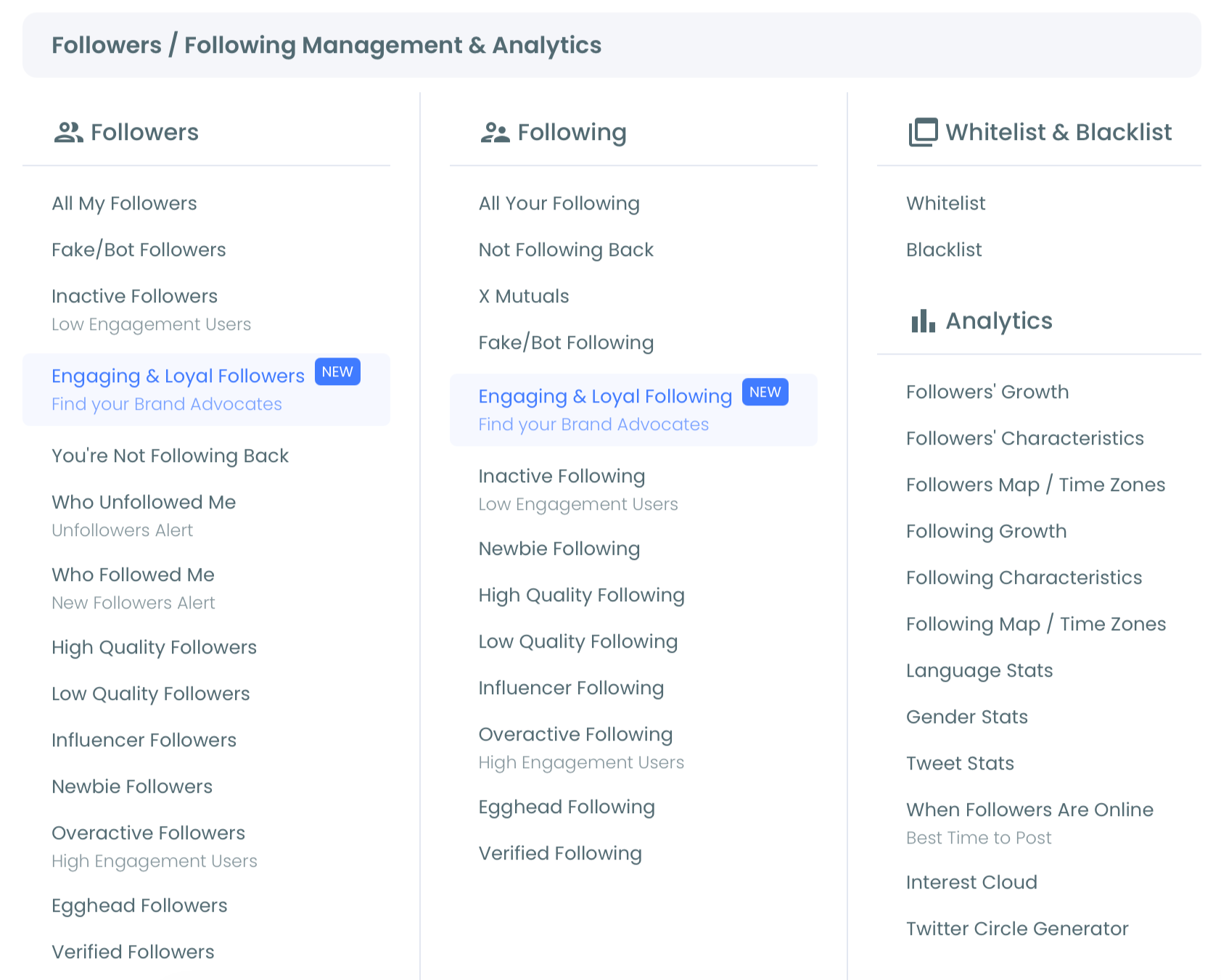
- Select Not Following Back to load every account you follow that doesn't follow you back.
- Filter by engagement and follow ratio, whitelist the accounts you follow on purpose, then unfollow the rest in batches.
Running the check this way means you review the list before you touch it, so the accounts you keep are kept on purpose and the ones you drop had the weakest claim on your follow.
Reading the list: keep, list, or unfollow
The follow check gives you names plus signals, and the signals are where the decision lives. Sort the table by follow ratio to push the most lopsided accounts to the top: profiles that follow thousands and are followed by almost no one are usually the residue of old growth tactics, not sources you chose.
Engagement classification does the rest of the sorting. An account marked Inactive that also never followed you back and posts nothing you read is a clean unfollow.
An account marked Active that publishes useful posts might be worth keeping even without the follow-back. You have three moves per row, not one: unfollow it, add it to a Twitter List so it leaves your main feed but stays reachable, or whitelist it so no future cleanup ever touches it.
Circleboom's Twitter follower checker returns the same enriched view if you want to start from a search instead of your own list.
One-way follows worth keeping
Not every non-follower is dead weight. A journalist you read never follows back.
A competitor you monitor will not follow you on purpose. A public figure with two million followers is not going to reciprocate, and a large industry publication may not follow anyone at all.
These are intentional one-way follows, and follow-back status is the wrong test for them.
The mistake is treating reciprocity as the only measure of value.
A low-quality account that follows you back is not automatically worth keeping, and a high-value source that ignores you is not automatically worth dropping.
Before any bulk action, whitelist the accounts you follow for information: news outlets, analysts, customers, prospects, and the handful of creators whose posts you actually open. Whitelisting protects them from this cleanup and every cleanup after it, so you never lose a good source to a fast unfollow.
The residue you can safely trim
The accounts worth removing usually share a profile. They came from a follow-for-follow campaign, a mass-follow phase, or a stretch of less selective following, and they never returned the follow because there was never a real connection.
On the follow check they cluster in the same corner: Inactive engagement, a very low follow ratio, few tweets, and nothing in the bio you care about.
Stack those signals before you act. One weak signal is thin evidence; a missing profile photo alone means little.
Three or four weak signals together, non-reciprocal plus inactive plus irrelevant plus low ratio, make a strong case for unfollowing. Circleboom's rundown of the best Twitter follow-back checker tools compares how different tools score this residue.
Filter the follow check down to that segment, review it once, and clear it in a single pass.
Common mistakes when you trim non-followers
A follow check is only as good as the decisions you make from it, and a few errors show up again and again.
The first mistake is unfollowing the whole list at once. Non-reciprocal does not mean worthless, and a bulk unfollow with no filter will cut the journalist you read, the customer you track, and the competitor you were watching on purpose.
Filter first, review second, act third.
The second mistake is judging accounts on a single signal. A missing avatar, a low follower count, or one quiet week each mean little on their own.
Wait for two or three weak signals to line up before you count an account as residue worth removing.
The third mistake is skipping the whitelist. If you unfollow without protecting your key sources first, the next cleanup you run in any other feature can catch them, because the whitelist is what carries protection forward across the whole tool.
Mark the accounts you never want to lose before you touch anything.
The last mistake is going too fast. Unfollowing hundreds of accounts in a few minutes is exactly the pattern X's automated systems are built to catch.
Stay near 100 to 150 at a time, let the queue pace the remainder, and even a large cleanup stays quiet and safe.
What your follow ratio signals to visitors
Your follow ratio is public math. Anyone who lands on your profile sees how many accounts you follow against how many follow you, and a following count far above your follower count reads as an account that follows indiscriminately.
It is a small signal, but it shapes the split-second decision a new visitor makes about whether to follow you.
Trimming non-reciprocal follows is the cleanest way to correct that ratio, because removing accounts that never followed you back has the clearest justification of any following-list change. You are not cutting relationships; you are cutting follows that were never returned.
Circleboom's Twitter follower audit view pairs the ratio with the underlying accounts so the number and the names live in the same place. Improve the ratio by removing the residue, and keep the sources that earn their spot.
How often to run a follow check
Run one after any event that adds follows in bulk. A follow-for-follow campaign, a rapid network-building push, or a stretch where you followed back everyone who arrived all leave a residue of accounts that never reciprocated.
Checking soon after means you review that residue while you still remember why you followed each account.
Outside of campaigns, a regular pass keeps the list honest. Networks drift: interests change, accounts go quiet, and follows you made for a project that ended just sit there.
Whatever cadence you settle on, the platform limits stay the same. Circleboom processes 50 unfollows per 15-minute window and up to 800 per day, and it recommends staying well under that, around 100 to 150 at a time, so X's automated systems never flag the activity.
When you hit the daily ceiling, the queue resumes the next day on its own.
Turn your following list into a two-way network
A Twitter follow check turns a blind spot into a decision. Instead of guessing which of your follows are one-sided, you get the full list with the engagement, ratio, and age signals attached, and you choose account by account: keep, list, or unfollow.
The mutuals stay, the intentional sources stay, and the leftover residue from old campaigns goes.
That is the whole value of checking before you cut. You end with a following list you can defend, a ratio that reads well to visitors, and a feed built from accounts you chose.
Read the list first, act second.
→ Open your Not Following Back list
Frequently asked questions
Does a Twitter follow check show who unfollowed me?
Not on its own. A follow check shows accounts that don't follow you back right now, whether they never followed you or unfollowed you later.
To see who unfollowed you specifically, use Circleboom's dedicated Who Unfollowed Me tracking, which watches for followers who drop off over time.
Is it safe to unfollow non-followers in bulk?
Yes, when it is paced. Circleboom runs unfollows through the official X API at 50 per 15-minute window and up to 800 per day, and it queues the rest automatically, so you stay inside the platform's limits instead of triggering them.
Whitelist the accounts you want to keep before you start.
Will people be notified when I unfollow them?
No. X does not send a notification when you unfollow an account, and the account will not see an alert.
They would only notice if they checked their own follower list and looked for you, which is exactly the manual work a follow check saves you from doing.