
Enter a market on a hunch about where a rival's audience lives and you pay twice: once for localized content that nobody there sees, and again when the plan is questioned and you have no source to show. Twitter follower locations for a competitor appear on no profile page, so the hunch usually goes unchallenged. A dated, country-by-country comparison is the cheaper way to be wrong early.
What this guide covers.Which accounts qualify for a country comparison before you spend a run on them.The seven steps from opening the tool to reading the country panel.How to compare a named country without overreading it.
Circleboom compares where the followers of up to 5 X accounts are located, country by country, through the official X Enterprise API. Start with Twitter follower locations.
What a hunch about a rival's Twitter audience costs
A hunch about a rival's audience costs the most at the moments when money is about to move. Three decisions lean on it:
- Opening a new market, language or region.
- Adding an account to a media plan or a sponsorship.
- Shortlisting a creator whose audience has to sit in your target market.
In each case the visible number is a follower count, and a follower count has no geography. An account can be large and still have most of its audience somewhere you do not sell.
The mistake I see most often is checking a rival one follower at a time. You can analyze an account's Twitter followers that way and learn a lot about individuals, but a handful of profiles is not a country split.
The underlying obstacle is the data itself. A location on X is text that a person typed, and turning typed text into countries is real work. X's own enterprise documentation describes a Profile Geo enrichment whose job is to normalize profile locations into structured geography.
That is the scale of the problem a spreadsheet user takes on by hand, once per account.
The shorter path is to compare a competitor's Twitter audience by country in a report that applies one method to every account in the set.
What the X competitor report compares, country by country
Circleboom's X Competitor Analysis & Benchmark Report tool compares up to 5 X accounts in one dated report and repeats every panel for each account. With Circleboom, you can put your own account in the first slot and add up to 4 competitors, or fill all 5 slots with other accounts.
The country comparison is one panel in the Audience Demographics & Geography part of the report. It is called Geographic distribution, and it presents each account twice: as a stacked bar and as a table row holding the same percentages.
The panel names four countries and groups everything else:
- The four largest countries for the accounts in that report.
- One Other bucket for all remaining countries.
Because Circleboom is a verified X Enterprise developer, the follower records behind those bars are retrieved through X's official API. For a number that will be quoted in a market plan, a documented source is part of the result.
The same section also holds panels for time zones, languages and gender. They answer different questions, and this guide stays with countries.
How the panel lays out follower locations
The two layouts do different jobs. The bars show the shape of each audience at a glance, so an account that leans heavily on one country stands out before you read a single figure. The table gives the exact percentage for each named country, which is what you copy into a plan.
One more property makes the comparison fair. Your own account is treated as one column among the others. As a result, Twitter follower locations for you and for each rival are calculated the same way on the same date.
Which competitors belong in a Twitter country comparison
Direct peers belong in the comparison, because the accounts you choose define what a gap in Twitter follower locations means. A gap against an account that serves a different market is a curiosity, and a gap against a true peer is a finding.
Screen each candidate on more than its industry:
- The market it targets.
- The language it publishes in.
- Its scale relative to yours.
- Its publishing purpose and business model.
Publishing purpose is the criterion people skip. A regional support account and a global, entertainment-led brand account can share a sector and still gather audiences for unrelated reasons, so their country mixes will differ for reasons unrelated to you.
Keep category leaders in a separate mental column. They are worth studying for how they built a following abroad, but their totals are not targets for an account a fraction of their size.
For a country question, 3 or 4 peers next to your own account is a workable set. That keeps the set small enough to read row by row, and close enough in kind that a difference between rows means something.
Which X accounts can be compared: check eligibility before the run
Not every competitor can go into a comparison, so the eligibility check comes before the run and not after it. Three rules decide whether a set of accounts will work.
Have these confirmed for every handle on your list:
- The account is public. Private accounts cannot be analyzed.
- The account has no more than 3,000,000 followers. An account above that threshold cannot be added, and the rule covers your own account too.
- The set holds 5 accounts or fewer in total, with or without your own.
Check the three rules against your shortlist first, because one ineligible rival changes which accounts end up in the report.
That matters more for Twitter follower locations than for any other part of the report. The four named countries are chosen from the data of the accounts in the set. Replace a very large rival with a smaller one and the legend itself may change.
So the shortlist is not a formality. If your biggest competitor is over the follower threshold, decide now which eligible account stands in for it, and keep that choice for later runs.
Plan the slots as well. Competitor Tokens are charged per competitor per report, and your own account never uses one, so including yourself adds a row without adding to the token count.
A stable set pays off the second time you run it. The country list is built from the data, which means a named country can be compared across two reports only when it appears by name in both.
How to compare Twitter follower locations for competitor accounts
The process has seven steps in three phases: set up the accounts, start the run, then read the panel.
Open the report and enter the accounts
- Open Circleboom Twitter and connect your X account.
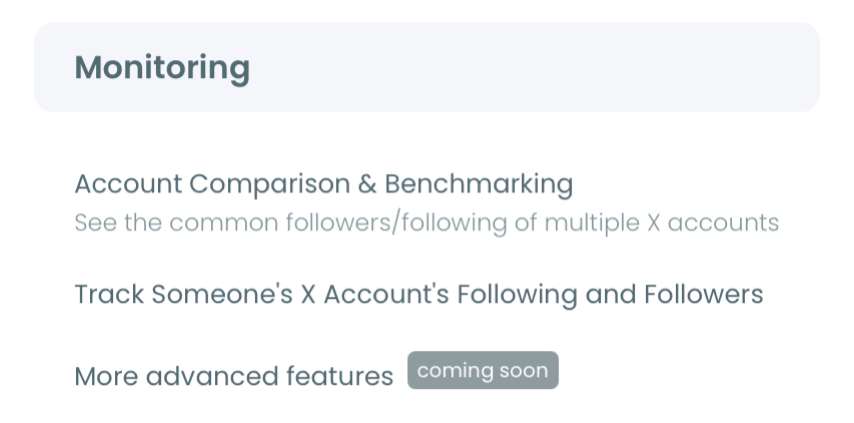
- Go to the Monitoring menu and select the first item, the full benchmarking report of X accounts.
- Enter each handle under Account Handles. Use one @ field per account and press the + button to add a slot. The counter next to the heading shows how many of the 5 slots are in use.
Choose the schedule and start the analysis
- Select how often the report should run. Just this once gives one report with today's data. Keep it up to date every month adds an automatic monthly report, with a MONTHS selector and a day-of-month selector.
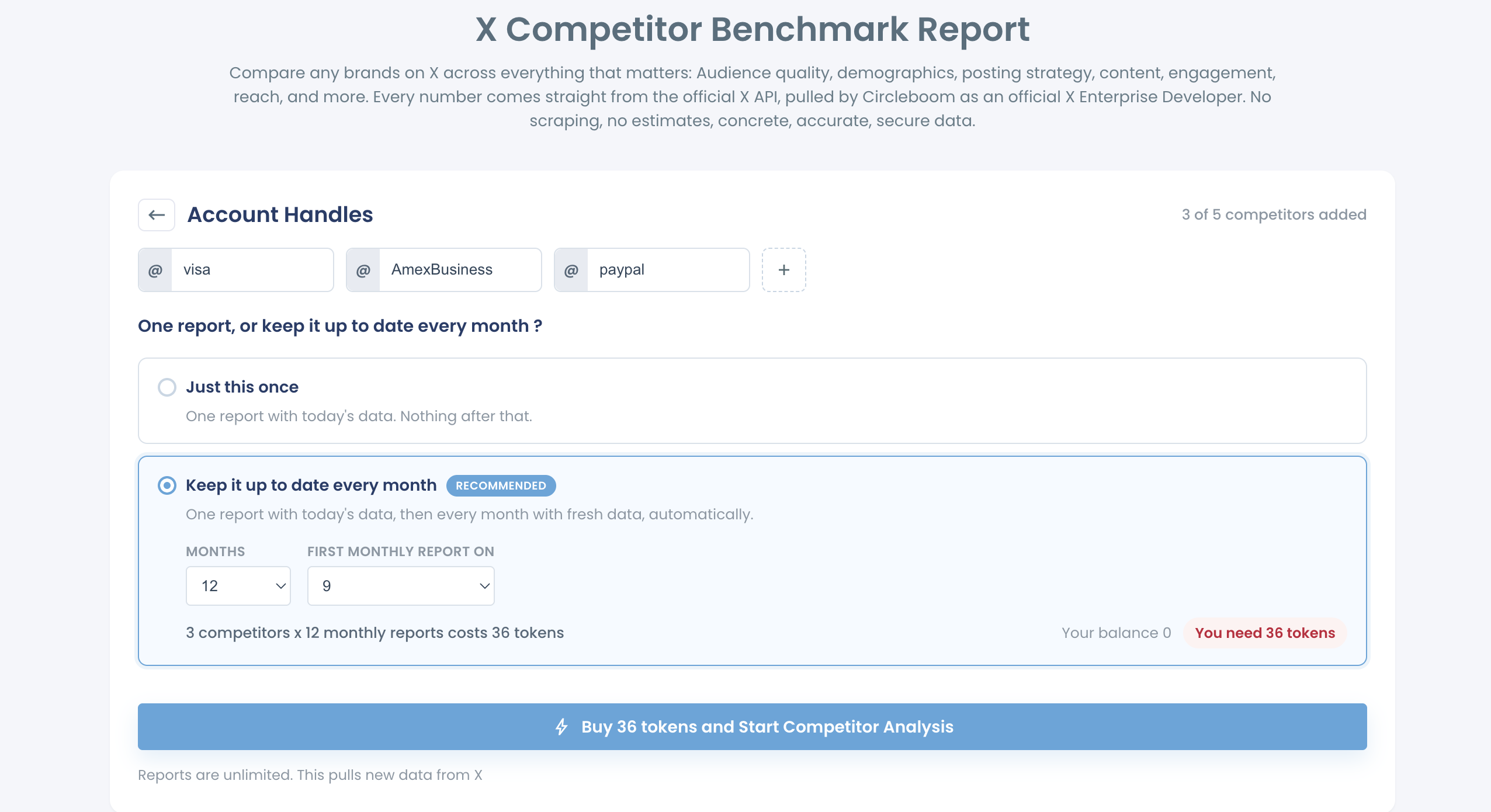
- Click Start Competitor Analysis. The screen states the token cost against your balance before the run begins.
Read the country panel in the finished report
- Open the report with View report and go to Geographic distribution. The panel is in the Audience Demographics & Geography section. Leave its toggle on Followers, since the Following setting describes the accounts each brand follows.
- Read one named country at a time across all rows. Note where a rival's share is clearly larger than yours and whether you sell there. Compare a named country across two reports only when it appears in both.
This sequence puts every decision that can't be undone, meaning the accounts and the schedule, before the run, and leaves interpretation for the end. Reading the panel last also means every row was produced by the same pull.
The finished report stays available under Your saved analysis, where each card lists its handles and its run date. You can return to the same panel later without starting a new run.
With the panel in front of you, the next decision is what a difference between two rows is worth.
How to judge a country gap between you and a rival on X
A country gap in Twitter follower locations tells you that a rival's audience is more represented in that country than yours is. It indicates representation, not purchasing intent, and the report states it that way.
Use three checks before a gap becomes a plan:
- Fit: the country is one of your intended markets, or could become one.
- Pattern: the rival's mix does not match its home market, which usually means the audience was built on purpose.
- Peer value: the rival is a direct peer in that market, not only a larger name in the category.
The third check prevents a common misreading. A bigger account whose audience sits in a different market can be a useful reference for the category and still be the wrong benchmark for you.
Geography also comes first when the question is whether to work with an account. An audience in the wrong market ends that conversation whatever its quality, so read the country row before you look at engagement.
An example gap and what it does not prove
Take an illustrative case, not a measured one: a rival's row reads 18% for a country where your own row reads 3%. That spread says the rival is present there and you are close to absent.
The spread does not say customers in that country are waiting. Presence in a market and demand in a market are separate facts, and only the first is on the chart.
Whether a region deserves a plan at all is a wider question than one panel can answer. A separate article covers Twitter geolocation maps for your business.
Turn the gap into something the next report can check
A gap in Twitter follower locations is a reason to try something, never the result of trying. Publish region-relevant content for that country, keep the same set of accounts, and let the monthly schedule produce the next dated report.
Then read the same named country again. If it still appears by name in both reports, you are comparing like with like, and a change in your own row is worth a conversation.
For the planning side of that work, see Tweet Mapper for strategic social media planning.
Who are the influential accounts in that country on Twitter?
The influential accounts in a country are found with a search, not with the benchmark report. The report has no influencer drill-down, and its follower locations panel shows shares without names.
Circleboom's Find Twitter Influencers covers this step. It searches high-reach accounts by keyword, and its filters include a free-text location field, so a niche term plus a place returns candidates in that market.
Each candidate comes with the signals you need for a first judgment:
- Follower and following counts.
- An engagement classification.
- Verification status.
- The location on the profile.
Read fit before reach. An account with a modest following whose topic and place both match your test will usually teach you more than a large account that matches neither closely.
A look at the search itself: finding the most influential people on a subject with Find Twitter Influencers.
Widen the search and save the shortlist
Keep the limits of the location filter in mind. It reads what people typed into their profiles, so a search for the country's name misses everyone who wrote only a city. Run the main cities as searches of their own.
If you want ordinary accounts in the country and not only the high-reach ones, you can search by location on Twitter with the same niche keyword.
When the shortlist is ready, save it outside the search. You can export Twitter accounts to a file and review them with whoever owns the market.
Do that review before anyone follows or contacts an account. Someone who knows the market will spot a mismatch that no filter catches.
A checklist for acting on Twitter follower locations
Acting on the first chart is the step to skip. Twitter follower locations are a starting observation, and the items below keep them in proportion.
- Confirm every account on the shortlist is public and under the follower threshold before the run.
- Keep the same set of accounts for repeat runs, and note any swap.
- Read the Followers view, one named country across all rows.
- Quote a change over time only for a country named in both reports.
- Publish for a country first, and read the next dated report before budgeting for it.
Each item is small, and together they turn a hunch into something a colleague can check.
→ Start your Twitter follower locations comparison
What people ask after reading a rival's country breakdown
Can't I export a competitor's followers and sort the location column myself?
You can, and the file is useful for other jobs, but sorting will not give you countries. The location column holds whatever each person typed, so one country appears under many spellings, and you would have to repeat the cleanup for every account. The do-it-yourself route is described in how to analyze someone's Twitter followers.
Where can I see my own followers' locations in more detail than one row?
Circleboom's Followers' Map / Time Zones feature shows your own X followers by country and region on a map. It is based on the location followers entered in their profiles, so followers without a location that can be resolved are left out of the percentages.