
Most sales teams hunt for leads on X by scrolling a feed and hoping something relevant floats past.
The buying signals are already there, posted in public, often minutes old.
What X does not give you is a way to collect those posts into a working list of accounts you can act on before the moment passes.
What a Twitter lead generation search gives you.Live public tweets matching your keywords from a start date you choose.The deduplicated list of accounts behind those tweets.Filters for language, engagement counts, verification, and media type.
Circleboom collects live tweets on X from your chosen start date and extracts the accounts that posted them through official API access, so you work from a profile list instead of a feed.
→ Twitter lead generation search
Why live X conversations beat a static prospect list
A live tweet tells you what someone wants right now. A follower list tells you who once clicked follow.
That difference decides whether outreach lands.
Someone asking for scheduling tool recommendations this morning is in a decision window that closes within days. The same account, found three months later in a bio search, has already picked something.
This is the gap a Twitter lead generation search fills. You define the language a prospect uses when they are ready to buy, then collect every public post that matches it from the moment you start watching.
Circleboom's real-time Twitter lead search turns that stream into an account list with follower counts, join dates, and activity classifications attached.
Teams that already run structured prospecting on X tend to arrive here after trying the manual route. For the wider view of the channel, how to use Twitter for B2B marketing covers the positioning work that sits upstream of any search.
What counts as a buying signal in a live tweet
Buying signals on X are unglamorous and easy to spot once you know the shapes they take.
The four that convert most often:
- Someone asking their followers for a tool or vendor recommendation.
- Someone complaining publicly about a competitor's outage, pricing change, or support.
- Someone announcing a role change, a new budget, or a new project.
- Someone comparing two named options out loud and asking which is better.
Each of those is a sentence, not a demographic. That is why keyword collection works better than audience targeting for early-stage prospecting: you are matching language, not guessing at profile attributes.
X's own advanced search operators will find those sentences one query at a time in the web interface. What they will not do is hold the results, deduplicate the authors, or let you act on the list.
That is the practical difference between searching and prospecting, and it is covered further in the breakdown of more targeted X account search.
How to run a Twitter lead generation search, step by step
Watch the live search flow end to end: the walkthrough below shows keyword setup, start-date selection, and the pivot from tweets to accounts.
The process runs in three phases: connect and open the search, narrow the stream, then work the accounts it returns.
Connect your X account and open the live search
- Log in to Circleboom Twitter and connect the X account you prospect from.
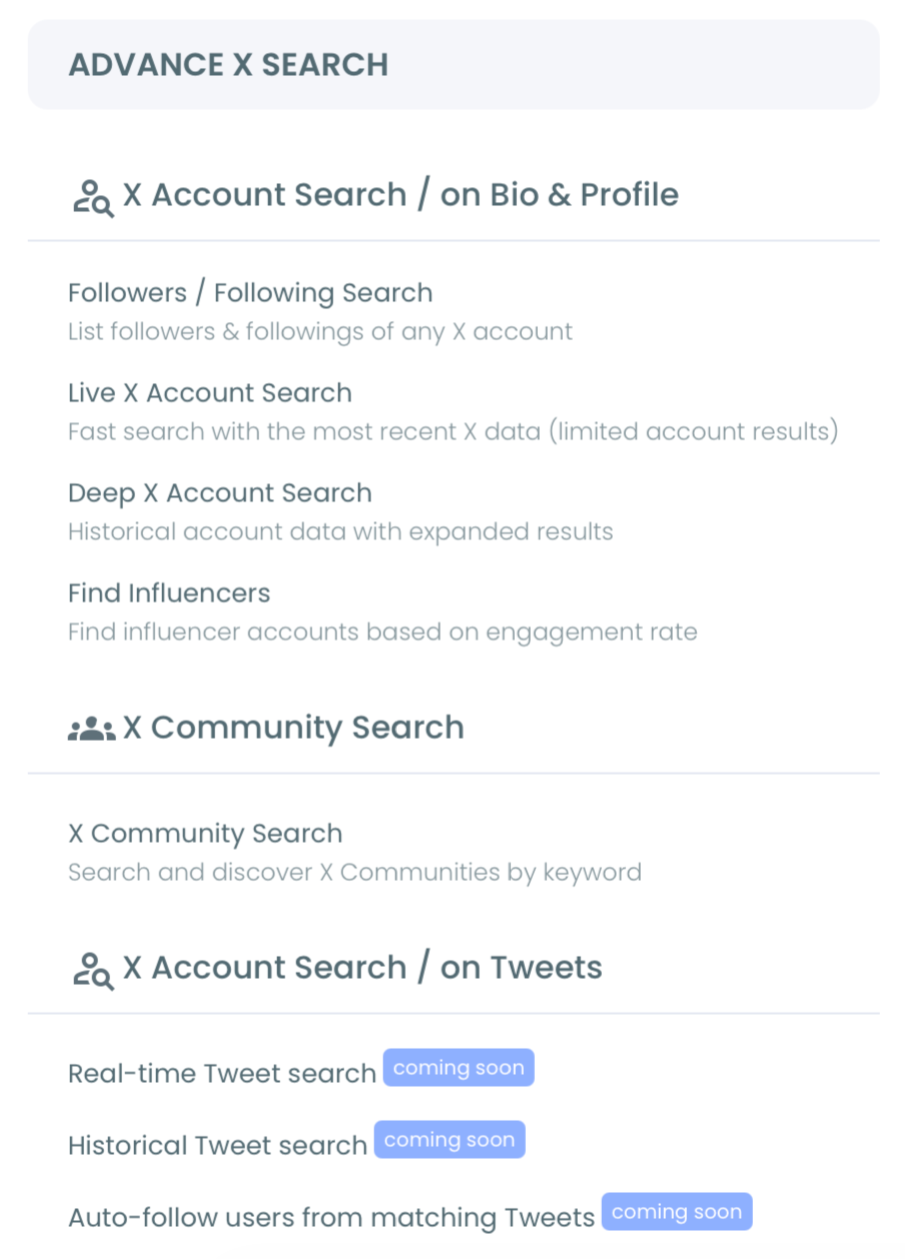
- From the Advanced X Search menu, launch Real-time Tweet Search.
- Describe the tweets you want in plain language. The interface accepts a normal sentence, then suggests refined search variations you can accept or edit before running anything.
Narrow the stream before you collect
- Open Filters and write the match rules. Everything deciding what survives is grouped here: the keywords themselves, how loosely they match, terms to throw out, language, and toggles for replies, links, hashtags, cashtags, verification, and media type. A bar above the results names whichever ones are live.
- Set engagement minimums so a viral keyword does not flood your result set with one-line replies. Minimum and maximum engagement filters are part of the same panel.
- Pick where collection begins. Presets run from the last 24 hours out to the last 30 days, with a custom date for anything else, and the run accumulates from that point onward instead of interrogating a closed archive.
- Set the tweet ceiling for the run. You are sizing the haul of posts here, not the roster of authors it resolves into, so a broad keyword deserves a generous number.
Work the accounts while the signal is live
- Review the tweet results table. Impressions, likes, retweets, quotes, bookmarks, replies, and the creation timestamp sit beside each post so you can judge whether the conversation has weight.
- Click "Display Profiles of this search" to pivot from posts to the deduplicated account list, where each author appears once regardless of how many matching tweets they wrote.
- Follow, whitelist, add to a list, or export the accounts you want to work. Bulk actions apply to every checkbox-selected row, and export downloads the set as CSV.
The sequence earns its keep by making every stage cheaper than the one before it.
Filters and engagement minimums shrink the collection before tokens are spent, the start date keeps the signal current, and the profile view hands you accounts rather than posts, which is what lead generation actually runs on.
How to build the keyword set your lead generation search runs on
The keyword set decides the quality of everything downstream. Filters can only remove noise that a bad query invited in.
Build the set from the words your prospects use, not the words your marketing uses. A team selling social media scheduling should watch for "scheduling tool," "posting schedule," and named competitors, not "social media management platform."
Category language belongs on your website. Prospect language belongs in the search.
Three passes usually get a set to production quality:
- Write ten phrases straight from real sales calls or support tickets.
- Add the competitor names your prospects mention when they are frustrated.
- Add exclusion terms for the hobbyist and job-hunting uses of the same words.
That last pass matters more than it looks.
"Looking for a scheduler" pulls in people building one, people teaching one, and people hiring for one, and exclusion terms are the cheapest way to keep those out before tokens are spent.
Test the set on a short window before committing to a long one.
A 24-hour collection on a modest tweet count tells you whether the phrasing is right, and adjusting after that costs almost nothing compared to discovering the problem in a 30-day result set.
Bio-level searching is a useful companion here. Live tweets tell you what someone needs today; profile text tells you what they do all year.
The notes on search for keywords in Twitter profiles cover that second layer.
Once the set holds up, set it running here: find X leads from live tweets.
What to do with the accounts a lead generation search returns
An exported list is not a campaign.
The accounts need sorting before anyone gets a reply or a message.
Sort them into three buckets:
- Accounts with a live, specific complaint go into an immediate-reply group and get a public response while the thread is still active.
- Accounts showing early research behavior go into a watch list.
- Accounts that matched on a keyword but show no intent get dropped.
The drop bucket is usually the largest, and that is a healthy sign rather than a failed search. A keyword net catches journalists, students, competitors, and people using the phrase idiomatically.
Removing them by hand on the first pass teaches you which exclusion terms to add before the next run, so each cycle produces a cleaner list than the one before it.
Follower counts and follow ratios in the profile view speed that triage up.
An account with a plausible ratio, a real join date, and recent activity is worth a reply. An account created last month with a five-figure following count is not, and the column layout makes that call in a glance rather than a click-through.
Circleboom's Twitter List Manager is where the second bucket belongs, because a list keeps the account visible without changing your follow graph. The bulk Add to List control inside the search results writes straight to it.
For the accounts you want to keep watching over weeks rather than hours, pairing the live search with a monitoring routine helps. The comparison of apps that monitor Twitter activity explains where continuous tracking earns its keep against one-off collection.
Where a live lead search beats a historical one
Timing is the whole argument.
Historical search answers "who has ever said this." Live search answers "who is saying this now."
For lead generation the second question is usually the one worth paying for, because a stated need decays fast.
A competitor outage creates a window measured in hours. A conference hashtag stays useful for the length of the event. A budget announcement is worth a reply the same week.
Speed also changes what you can say.
Replying to a live complaint reads as attentive; replying to a three-week-old one reads as surveillance. The same account, the same message, and a completely different reception.
There is one case where the historical view wins: checking whether a live spike is genuinely new or part of a recurring seasonal pattern.
Running both and comparing tells you whether you found a moment or a trend.
The keyword layer sits underneath both. Circleboom's Twitter keyword and hashtag tracker is the tuning surface when you are still choosing which phrases to watch.
Native results are shaped by ranking rules that have nothing to do with your pipeline, which the primer on Twitter search engine behavior unpacks in detail.
Limits worth knowing before you run a big search
Three constraints shape how you plan a lead generation search on X.
Collection consumes GetTweetTokens in proportion to the number of tweets gathered, and export consumes tokens separately from the search itself.
If the balance runs out mid-collection, the search stops there and the partial results are still saved and accessible, so nothing is lost.
Live data is also volatile.
Tweets can be deleted, edited, or made private within minutes, and only public posts from public accounts are returned. Engagement counts reflect the moment of retrieval and keep moving after that.
The third constraint is judgment.
A keyword match does not prove intent, so review profiles before running bulk actions on them. That caution matters most with Auto Follow, which keeps following every matching account continuously. The reasoning behind that care is laid out in the Twitter auto-follow keyword-safe alternative.
Circleboom runs all of this as an official X Enterprise Developer, so the collection happens inside X's own rules rather than around them.
Nothing here depends on scraping, and your account is never asked to do anything the platform does not sanction.
Your next move
A lead generation search on X is worth running the week you set it up, not the quarter you plan it.
Work through this order:
- Write down the four sentences a ready-to-buy prospect actually types.
- Set a start date no further back than seven days for the first run.
- Add engagement minimums and language filters before collecting.
- Export the profile view and sort it into reply, watch, and drop.
- Re-run the same keywords weekly and compare the account overlap.
Circleboom keeps the whole loop in one place, from keyword to account list to export, and the accounts arrive with enough profile context to triage in a single pass.
→ Run your Twitter lead generation search
What to know before your first search
How far back should I set the start date for lead generation?
Seven days is a reasonable default for most B2B keywords, because it captures a full working week without diluting the result set. Push it to 24 hours during a competitor incident or a live event, when the accounts you want are posting inside a much shorter window.
Does collecting more tweets mean I get more accounts?
No. The tweet count controls collection size, not the number of unique authors extracted, and one prolific account can produce many matching posts. Set the collection number higher than the account count you are targeting.
Can I follow every account that matches my keyword automatically?
Yes, through Auto Follow from matching keyword, but set your engagement thresholds and quality filters first. Left wide open it will keep following every account that mentions the phrase, including low-signal ones.
What happens if a tweet is deleted after I collect it?
Your collected result stays in the search log, but the live post may no longer exist on X when you go to reply. Acting quickly on strong matches is the practical fix, since results are stored and can be revisited without re-spending tokens.