
What is the official method to delete all X posts in bulk? There isn't one inside X itself; the native delete-post documentation confirms the platform deletes posts one at a time, with no select-all or bulk option. The sanctioned path that fills the gap is Circleboom, listed in the official X Enterprise customer directory, with bulk deletion running through API-grade access.
No native bulk-delete inside X. Circleboom is the sanctioned third-party route, processing your archive plus the live tweet list, removing thousands of posts through sanctioned API endpoints with filters for date, keyword, engagement, and content type.
→ delete all X posts
The walkthrough below covers what counts as "official," why scraping tools fail this bar, and how the actual workflow runs.
Why X has no native bulk delete
X's product team has never built a bulk-delete control. The delete-posts help page lays out the per-post UX: hover the tweet, open the overflow menu, click Delete, confirm. There is no select-all, no checkbox grid, no batch operation anywhere in the native interface.
Two adjacent options exist but don't solve the problem. The native account deactivation flow wipes everything after a 30-day window, including the account itself; this is the "burn it down" option, not a cleanup option. The X Developer Platform exposes a single-tweet delete endpoint, but the endpoint operates one tweet at a time and requires developer registration most users won't bother with.
That leaves third-party tooling as the only realistic path. The definitive guide to deleting all tweets walks through what "official" means here: tools that operate within X's API terms and don't trigger account-suspension risk, versus tools that scrape or otherwise bypass the platform.
The platform's reasoning, never publicly stated, appears to be that bulk-delete tools sit close to abuse vectors X wants to limit (mass deletion as part of evidence destruction, mass deletion as part of harassment cleanup, regulatory data-retention concerns).
The compromise is allowing developer-partner tools to build the bulk-delete experience while X's API access serves as the gatekeeper for what's permissible. Circleboom operates inside that compromise.
What "official method" actually means
The phrase "official method" gets thrown around loosely in the deletion-tool space. The strict meaning, the one that matters for account safety, is operation through sanctioned API access. Circleboom is an official X Enterprise Developer company, which means every deletion request runs through Enterprise-grade endpoints, rate-limited by X itself, fully compliant with platform terms.

The best methods to delete tweets comparison covers the safety differential between sanctioned and unsanctioned approaches. The short version: sanctioned tools carry zero account-suspension risk because they operate inside the platform's developer agreement; unsanctioned tools carry meaningful risk because they violate X's terms by scraping or unauthorized access.
The delete tweets best tools overview compares the major options on the safety axis specifically. For users planning to use the workflow on an account they care about (which is most users), the official-method distinction matters.
How to delete all X posts (full workflow)
The workflow runs in two phases: API-based deletion for recent tweets, and archive-based deletion for older tweets.
Phase 1: API-based deletion (recent tweets)
- Log in to Circleboom Twitter and connect the X account using official OAuth.

- Open the Essential Toolbox menu and pick the Delete Tools sub-tool.
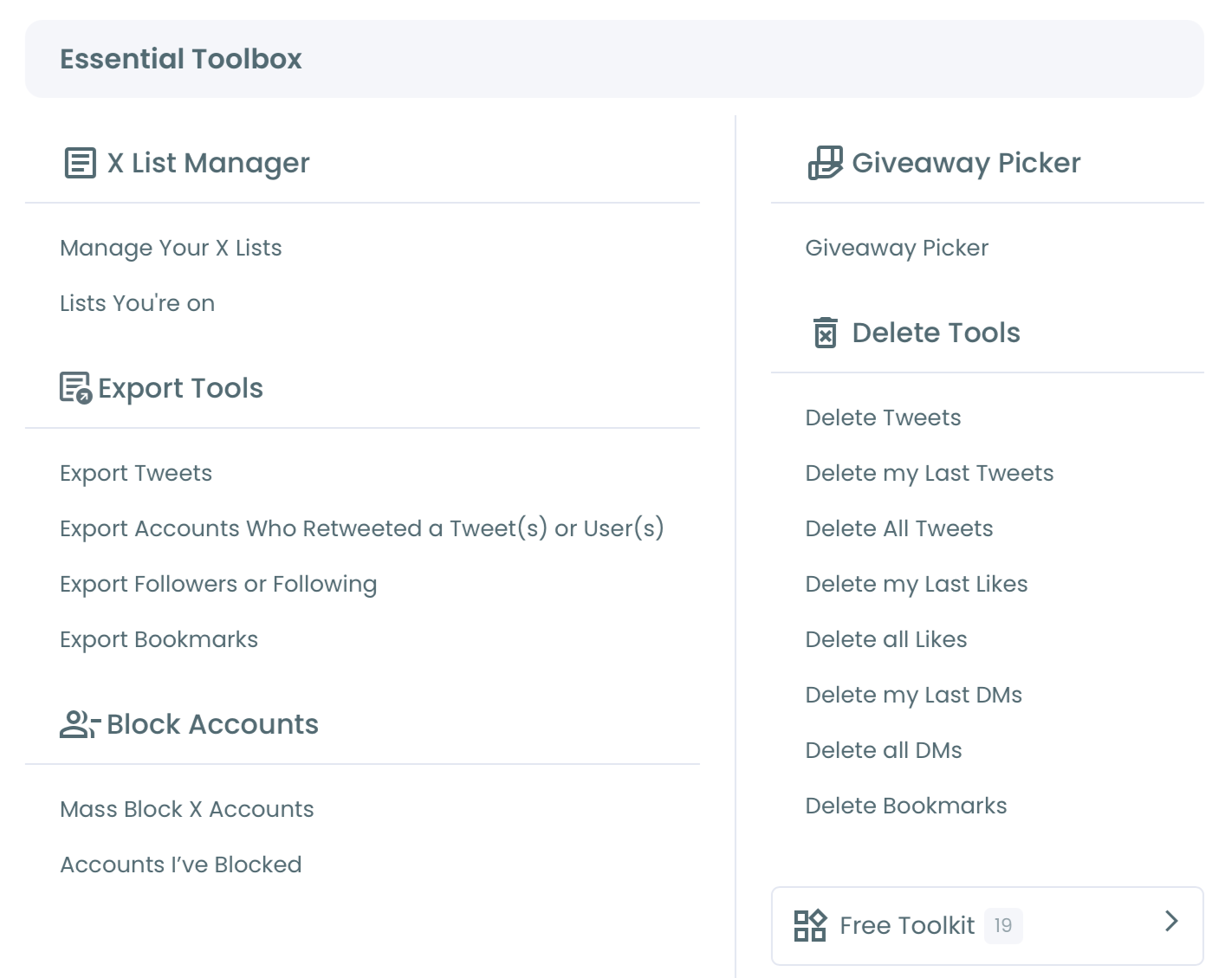
- Configure filters. Date range, keyword, engagement threshold, and content type (replies, retweets, media tweets, plain tweets) can stack. A common starting recipe: everything older than 6 months with fewer than 5 likes.
Phase 2: Archive-based deletion (older tweets)
- Request the X archive inside X (Settings → Your account → Download an archive of your data). The link arrives by email within 24 to 48 hours.
- Upload the archive to the bulk delete tweets workflow. The archive route lifts the 3,200-tweet API ceiling so older tweets become eligible for deletion.
- Apply filters and confirm. The same filter set works across the API and archive paths. Filters resolve before the delete action runs.
That sequence is what makes "delete all X posts" actually complete. The API path handles recent tweets quickly; the archive path handles the older tweets the API alone cannot reach. Skip the archive step and the deletion is bounded to the 3,200 most recent tweets, which is incomplete for any account with longer history.
Video walkthrough: the full bulk-deletion workflow from configuration to confirmation.
The filter set that actually matters
Five filter dimensions cover the common cleanup goals.
- Date Range, for clearing tweets older than a chosen date or inside a window.
- Keyword, for matching content inside tweet text. Hashtag-specific deletes work here too.
- Engagement threshold, for removing low-performing tweets while keeping high-engagement content.
- Content type, for handling replies, retweets, media tweets, and plain tweets independently.
- Stacked filters, where date AND keyword AND engagement combine into precise selection logic.
The delete tweets in bulk overview covers each filter dimension in depth. The right combination depends on the cleanup goal: privacy-driven cleanup, performance-driven cleanup, or full reset all draw on different filter recipes.
For account-wide cleanup that goes beyond tweets into media and replies, the Twitter archive cleanup hub groups the related tools (replies, media, bookmarks, likes) under one umbrella.
Is the official method safe?
Yes. Circleboom is listed in the X Enterprise customer directory, and every deletion request runs through sanctioned endpoints. The account-suspension risk that scraping tools carry does not apply here.
The narrower safety question: deletion is irreversible. Once tweets are removed through the API, the action is final on the account side. The filter preview is the safety control; reading it before confirming the deletion is the standard practice that prevents accidental over-deletion.
There's also a downstream consideration. Tweets you delete from your account don't disappear from third-party caches, Google's index immediately, or any screenshot anyone has already taken. The local cleanup is thorough; the broader internet retention is outside any tool's reach.
Action checklist
A short checklist to close the workflow.
- Decide your cleanup goal before opening the tool. "Delete all posts older than X" or "Delete posts under Y engagement" gives the filter set direction.
- Request the X archive while you plan. The 24 to 48 hour wait runs in parallel with the rest of the workflow.
- Run the API-based deletion on the recent tweets first. This handles 3,200 tweets per account fast.
- Upload the archive for the historical tail. This handles the older tweets the API alone cannot reach.
- Save a record of what was deleted. Circleboom exports the filter set used; archive that record in case you need to reference it later.
Common Questions About Deleting All X Posts
Can I delete all my X posts at once with X's own settings?
No. X provides per-post deletion only. The closest native option is account deactivation, which wipes everything after 30 days but also closes the account.
Will Circleboom delete my X account?
No. The Delete Tools workflow operates on tweets only. The account itself remains active throughout.
Is the deletion reversible?
No. Once tweets are removed through the API, the action is final. Run the filter preview before confirming, especially for large operations.
Does deletion remove tweets from Google search results?
Eventually. Google's index updates over time after the source content is gone; the lag is typically a few weeks. The cleanup is local first, then propagates.
Do I need X Premium for this?
No. Circleboom works on any X account that can connect via OAuth. Premium is not a prerequisite for the deletion workflow.