X does not offer a native button that deletes every Direct Message conversation at once. In the standard inbox, you remove conversations individually, and that distinction matters when an old inbox contains years of personal, customer, or sensitive exchanges.
Does X have a bulk delete DMs feature? No, not natively. Circleboom deletes selected DM history on X through an archive-based workflow using official X Enterprise APIs, including messages older than the usual API window.
→ Bulk delete DMs
The useful question is not only whether a bulk action exists, but what should be preserved before an irreversible cleanup.
The native X answer: conversations are removed one at a time
X lets an account owner delete a conversation from their own inbox, but its normal interface is designed around individual threads rather than a whole-inbox operation. X also explains that deleting a DM or conversation does not delete the other participant's copy. Its Direct Messages help guidance is the right place to check the platform's current behavior before taking action.
That native limit becomes real when an inbox has accumulated spam, old job discussions, personal history, support requests, and former client conversations. Opening every thread and choosing delete can be reasonable for a handful of chats. It is a poor control for a years-old inbox that needs a defined retention decision.
Circleboom gives X account owners an archive-based route for a full DM reset. Circleboom processes the account's own exported DM file and performs the selected deletion action on X using official X Enterprise APIs. That is different from asking for a password or pretending that another person's copy can be erased.
For a close look at the privacy boundary, read whether deleting a Twitter DM removes it completely. The answer is one-sided: you can control what remains in your inbox, not what another account has retained.
Why archive access changes the bulk-delete question
An archive is the account's historical export from X. Circleboom's Delete All DMs feature uses direct-messages.js from the archive's data folder, rather than the full ZIP file. That matters because a full inbox cleanup should not be constrained to only the most recently accessible messages.
The archive model also makes the scope visible before deletion. After upload, the tool displays the available DM count, preselects the uploaded DMs, and lets the account holder narrow the action by date, message text, media, URL, or protected accounts. A bulk action without a scope check is reckless; a bulk action with exclusions can support a real retention policy.
If your intent is a broader account cleanup, Delete All Tweets addresses public posts separately. DMs deserve their own decision because they may contain commitments, contact details, or private context that should be retained outside X before the inbox is cleared.
The answer to does X have a bulk delete DMs feature is therefore two-layered: X itself does not provide the bulk inbox button, while an archive-based management workflow can make a deliberate bulk cleanup possible on your side.
When a full DM reset is the right choice
A full deletion is most defensible when the account is changing hands, being repurposed, or being cleaned after a security concern. It can also make sense when an inbox has become a long-term storage location for material that should live in a controlled record system instead.
Do not treat it as ordinary tidying. A DM thread can hold an approval, a customer promise, an address, an invoice question, or context needed to resolve a future dispute. Before you remove all X DMs in bulk, decide what belongs in an export, a CRM, a support platform, or an internal archive.
There is a useful operational distinction here. Deleting inbox history can reduce what a future account administrator can access, but it is not a substitute for legal, compliance, or incident-response advice. If a record may be required, preserve it under the policy that applies to your organization before deleting anything.
People who only need to remove a few recent threads should not force a whole-inbox workflow. Deleting multiple Twitter DMs at once can help frame the difference between small cleanup and an archive-based reset.
How to use an archive-based bulk DM cleanup
To delete historical DMs in bulk, download your X archive, upload the specific DM data file, set the scope, and approve the deletion only after reviewing the count. The sequence below keeps the irreversible decision at the end rather than the beginning.
Prepare the account and its records
- Log in to Circleboom Twitter with the X account whose inbox you intend to manage.

- Download the account's X archive from X settings and keep a protected copy if important records may be needed later.
- Identify active legal, sales, support, hiring, or partnership threads that need to be preserved outside the X inbox.
This preparation phase prevents the common mistake of confusing a platform inbox with a proper records system. The archive is both the input for the cleanup and, if stored safely, the last local reference after deletion.
Open the DM deletion workspace
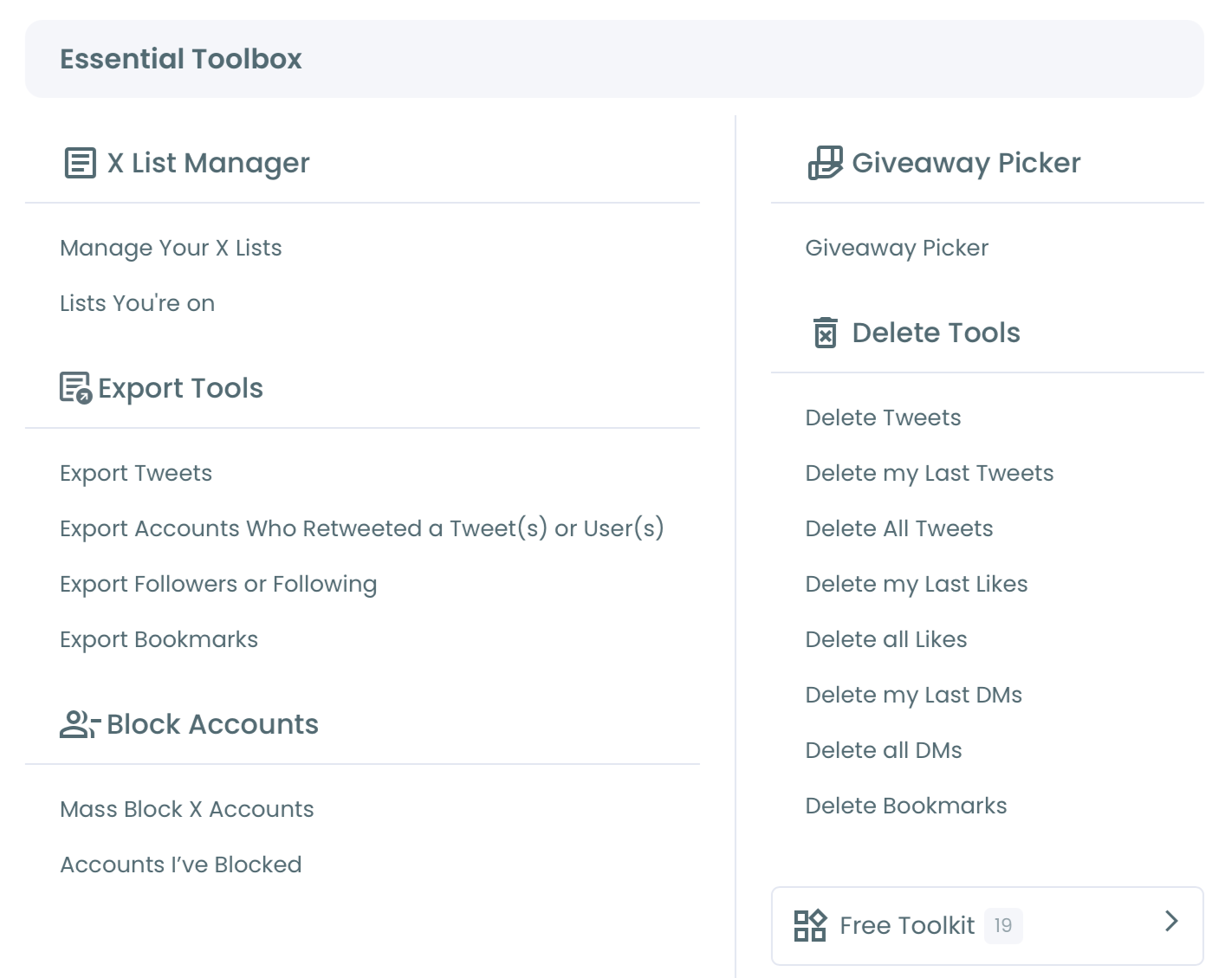
- Choose Essential Toolbox and open Delete All DMs in Circleboom.
- Locate
direct-messages.jsinside the archive'sdatafolder. Upload that file, not the whole archive ZIP. - Follow the page's preparation guidance before upload if the file exceeds 100MB.
Circleboom's upload screen processes the exported message history and shows how many DMs are available. This is the point to stop if the count does not match the account or the archive appears incomplete.
Narrow the deletion scope before approval
- Use a start and end date when the goal is an older-period cleanup rather than a full wipe.
- Use Any Keyword when a particular campaign, subject, or phrase needs attention.
- Protect key relationships with Exclude some accounts, which keeps those conversations out of the deletion set.
- Check the media and URL options when you are handling messages that carry shared files or links.
Filters turn a blunt request into a reviewable one. A team can, for example, keep the current customer cohort while clearing old messages, or preserve selected named accounts while removing the rest.
Review the count and confirm the permanent action
- Read the Approve & Delete panel and verify the number of DMs that match the selected criteria.
- Confirm that the visible date range and protected accounts match the plan.
- Select “Delete my DMs,” read the confirmation warning, and approve only when the scope is correct.
The confirmation exists because deletion is permanent. Circleboom automatically excludes already deleted items when the same archive file is uploaded for a later, different filter run, so a cautious staged cleanup is possible without improvising a new data source each time.
The workflow gives the account holder a controllable record-cleanup process: export, inspect, filter, approve. That order is what makes an archive-based bulk action safer than hurriedly deleting random threads from the native inbox.
What bulk DM deletion does not do
Bulk deletion removes the selected conversations from your side. It does not remove the recipient's or sender's copy, and it does not retrieve something already deleted. Those boundaries are part of X's service behavior, not a Circleboom setting.
For that reason, avoid claims that a tool can erase a conversation from both people. This explanation of deleting DMs from both sides is useful context for setting expectations with a team or client before a cleanup begins.
The feature also cannot decide which messages are business-critical. That is a human decision. A better practice is to create a short retention checklist: export key records, identify exclusions, document the date scope, and nominate the person who approves deletion.
If your concern is unwanted future contact rather than historical storage, consider how to block direct messages on Twitter alongside cleanup. Deleting old conversations does not by itself prevent new ones from arriving.
A better retention habit after the inbox is clean
The biggest improvement after a reset is not an empty inbox. It is setting a rule for what happens next. Move support cases to a ticketing tool, record commercial commitments where the team can find them, and decide how often a DM export is reviewed.
That habit matters for brand accounts especially. An X DM can feel informal to the sender, while the business may still be making a promise, handling a complaint, or receiving confidential information. Treating every message as disposable creates a different risk from retaining every message forever.
If bookmarks are also becoming an unmanaged archive, Delete All Bookmarks on X can keep that public-account housekeeping distinct from private-message decisions. Separate data types should have separate reasons for deletion.
A practical review checklist before you press delete
The final confirmation should be boring because the decisions were made earlier. Write the purpose of the cleanup in one sentence, such as “remove pre-2023 campaign messages while retaining current support threads.” That sentence gives the reviewer something concrete to compare with the filters and count on screen.
Check who can still access the X account. Shared passwords, dormant agency access, or former employees change the privacy context of an inbox even before any DM is deleted. Removing unnecessary access is usually a separate account-security action, but it should be considered at the same time as inbox hygiene.
Set a boundary for the archive copy too. A local export can be valuable for records, but it can also create another sensitive store if it sits unprotected on a laptop or shared drive. Keep it only in the approved location, limit access, and delete it according to the retention rule once its purpose is fulfilled.
For a staged cleanup, start with a narrow date range or a clear keyword group. Review the result in the live inbox, note whether exclusions behaved as expected, and only widen the filter after that check. This cautious pattern is especially useful for organizations where several people have handled the same account over time.
Keep the replacement contact route visible
Keep the customer-facing side of the change in view as well. If the inbox has been a route for support, put a visible contact method in the profile, automated reply, website, or pinned post before historical threads disappear. The purpose of cleanup is to reduce uncontrolled storage, not to make people unable to reach the account. A clear replacement channel also helps the next account owner manage messages consistently.
→ Plan an archive-based DM cleanup in Circleboom
Common questions about X bulk DM deletion
Does X have a bulk delete DMs feature in its app?
No. X's native DM interface is based on deleting individual conversations, not selecting and deleting an entire inbox in one action.
Can I delete old DMs beyond the usual recent window?
Yes, an archive-based workflow can cover historical DMs included in your X data export. Circleboom uses the direct-messages.js file from that export to process the full available history.
Will bulk deletion erase messages from the other person's inbox?
No. Deleting a DM conversation removes it from your side only. Other participants retain their own copy unless they delete it themselves.
Can I keep some conversations during a bulk cleanup?
Yes. Circleboom can filter by dates, keywords, media or URLs and exclude named accounts before the final deletion action.
Can deleted DMs be restored?
No. The feature warns that processed deletions are not recoverable, so preserve anything important before confirming the action.
Make the answer operational, not theoretical
X does not include a native bulk delete DMs feature. If you need to clean a historical inbox, the safe path is to preserve necessary records, use the archive file to inspect the real scope, protect exceptions, and approve deletion on your side with clear expectations about what remains elsewhere.
→ Check whether Circleboom's Delete All DMs workflow fits your cleanup plan