
The answer depends on what you mean by “see.” X may show a limited public profile or following preview while you are logged out, but it does not provide dependable, complete logged-out access to someone's following list.
Sometimes you can see a limited preview for a public account, but X may require a login, restrict scrolling, or show an incomplete list. You cannot rely on logged-out browsing for a complete record. To retrieve a public account's following list as a structured CSV, authenticate your own account and use Circleboom through official X Enterprise APIs. Protected accounts are not available for this export.
→ Export a public X account's following list
The distinction is between a limited preview and a structured, point-in-time export.
The key boundary is simple: public does not always mean fully accessible without a session, and viewing is not the same operation as exporting.
The logged-out visibility boundary on X
X controls what an unauthenticated visitor can load. A public profile may appear in a browser, and a visitor may sometimes reach a followers or following tab. That result is not a promise of complete access.
The visitor can encounter:
- a prompt to log in before the list opens;
- a short preview that stops loading;
- an order that is not useful for analysis;
- different behavior across browsers, regions, or sessions;
- no access to a protected account's relationship list.
A visible preview proves only that X rendered those visible rows. It does not prove that the full list is available.
X can change its public web experience without changing whether the underlying account is public. That makes a logged-out browser check useful for a quick glance, but weak for research, documentation, comparison, or outreach preparation.
If your goal is merely to recognize several accounts, try the public profile first. If you need completeness or a file you can sort, move from anonymous viewing to authenticated export.
Viewing, searching, and exporting are different tasks
Three actions often get compressed into one question. Each has a different access level and a different result.
| Task | Typical result | Reliable without logging in? |
|---|---|---|
| Glance at a public profile | Profile details and possibly a small relationship preview | Sometimes, but not consistently |
| Browse a following tab | A scrollable interface controlled by X | No dependable guarantee |
| Export a following list | A structured point-in-time CSV | No, authenticated access is required |
Someone asking can you see following list on X without logging in may need only the first task. A researcher asking for every username, account age, bio, or follower count actually needs the third.
That distinction also prevents a common mistake: counting the rows that happened to load and treating them as a complete dataset. A browser view has no completeness receipt. A CSV has a row count, fixed fields, and a retrieval time that can be documented.
For a closer look at the native interface, the Twitter following list viewer explains what a list view can and cannot tell you.
What public and protected account status changes
A public account allows its public profile information and relationships to be exposed according to X's interface and API rules. It does not force X to serve an unlimited logged-out page to every visitor.
A protected account has a stronger boundary. Its posts and relationship information are restricted, and Circleboom's export feature does not export protected accounts' follower or following lists. Authenticating your own account does not turn a protected third-party list into public data.
Logging in establishes who is making the request. It does not cancel another account's privacy setting.
The practical decision tree is:
- Check whether the target account is public.
- Decide whether a partial on-screen view is enough.
- If you need a structured working file, use an authenticated export for the public account.
- If the account is protected, respect the privacy boundary and do not expect an export.
X's help material on public and protected posts explains the platform-level difference. The interface a logged-out visitor sees can still vary within that larger rule.
Why X may show less than the account count
The number beside “Following” is a profile metric. The list rendered in a browser is an interface result. Those two objects do not have to expose the same amount of data to an unauthenticated visitor.
Web interfaces load rows in pages. They can stop requesting more rows when a login wall appears, when a session is rate-limited, or when X decides that anonymous browsing has reached its allowance. The displayed count can therefore be larger than the set you can inspect.
Ordering creates a second problem. Even when many accounts load, a native list is not a spreadsheet. You cannot reliably sort it by join date, follower count, tweet count, location, or quality flags.
The article about why followers and followings are not showing covers other reasons the visible interface may not match the number you expected.
Missing rows do not automatically mean those relationships disappeared. They may be outside the current interface result.
How to export a public following list with Circleboom
Use authenticated export when the required output is a structured research file rather than a passing browser view. Circleboom lets you enter the username of a public X account, confirm the profile, and export its following list as CSV.
Connect your own X account
- Log in to Circleboom Twitter and connect the X account you are authorized to use.
- Confirm that the correct profile is connected before starting the export.

Authentication is required because Circleboom retrieves supported data through X's official connection. Circleboom is listed in X's Enterprise customer directory.
Open the export tool
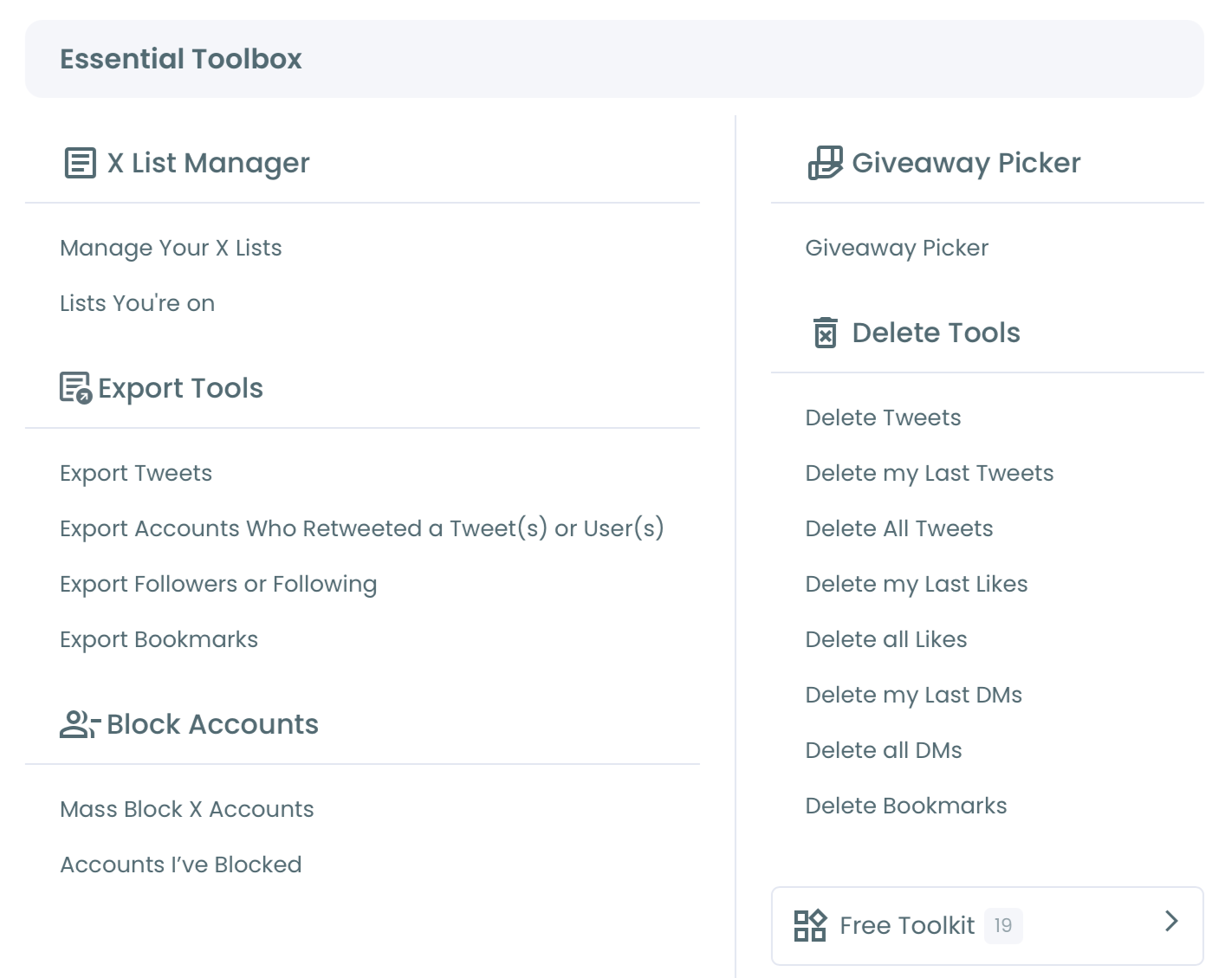
- Open Essential Toolbox from the Circleboom dashboard.
- Choose Export Followers or Following, then enter the public account's username.
Circleboom displays a profile preview with identifying details and account counts. Check the username, display name, bio, and profile metrics before spending export tokens.
Choose the right relationship
- Select Export Following rather than Export Followers.
- Review the remaining token balance and the target account before confirming.
- Start the export and download the generated CSV when it is ready.
The resulting file represents the relationships at retrieval time. Following lists change, so the file should carry a date in its filename if it will be compared later.
→ Create a dated following-list export
Protect and document the output
- Store the CSV where only the people who need it can access it.
- Record the source username, retrieval date, purpose, and any filters used.
- Refresh the file before making decisions that depend on current relationship status.
An export is a snapshot, not a live feed. A later follow or unfollow will not rewrite an existing CSV.
From public profile to usable file: watch how a following list becomes a structured export after authenticated access.
What the CSV gives you that a browser list does not
The export creates one row per retrieved account and can include profile and account fields such as:
- profile ID, username, display name, location, and bio;
- tweet count, follower count, and following count;
- protected and verification indicators;
- account creation timestamp;
- Circleboom quality signals for fake, inactive, egghead, or overactive patterns.
Those fields turn a visual list into an analysis surface. You can sort by account age, identify a geographic segment, compare follower counts, remove duplicates, or prepare a reviewed shortlist for a legitimate business workflow.
The guide to scraping a Twitter following list discusses why copying rendered profile cards is a poor substitute for a supported, structured export.
For a follower-side task, use the separate option to export a list of followers on Twitter. “Followers” means accounts that follow the target; “following” means accounts the target follows.
A completeness check before you use the data
Large accounts deserve extra caution. The number of rows returned can be affected by API retrieval windows and pagination, especially for accounts with very large relationship counts. Do not describe an export as complete until you inspect the actual output.
Use this check:
- Save the displayed following count before the export.
- Count data rows in the CSV, excluding the header.
- Note the retrieval time and any reported processing limitation.
- Explain any difference rather than silently treating the file as exhaustive.
Completeness is a property you verify, not a word you attach automatically.
This check is important when the output will support a report, market map, or comparison. A small mismatch may reflect relationship changes during retrieval. A large mismatch deserves investigation before conclusions are drawn.
Name the limits in the final report
The method belongs beside the findings. State that the source account was public, that Circleboom retrieved the file through X's supported API connection, and that the CSV records one moment rather than a permanent relationship map.
Also separate observations from interpretations. “The account followed 214 profiles with a location containing London” is a reproducible filter result. “The account is focused on the London market” is an interpretation that needs more evidence, such as bios, posts, and business context.
This wording discipline matters when another person will act on the report. A transparent limitation does not weaken useful work. It shows where the evidence ends and judgment begins.
For recurring analysis, retain the original file unchanged and work from a copy. That preserves the source snapshot while letting you add categories, exclusions, and review notes without losing the initial output.
→ Build a verifiable public following snapshot
Responsible uses for an exported following list
Public availability is not permission for careless handling. Relationship data can reveal professional interests, community ties, or research patterns even when each profile is public.
Good uses include:
- mapping credible voices in a specialist field;
- comparing a brand's public network across dates;
- preparing a deduplicated research list;
- documenting your own account before a cleanup;
- reviewing candidates before adding them to an X List.
Avoid publishing raw files, collecting more data than the task needs, or treating automated quality flags as proof about a person. Review context before outreach or action.
If the next step is organization, Circleboom's X List Manager provides a separate workspace for managing public or private lists. A private X List can help you monitor selected accounts without following them, but it does not make a protected account's data public.
The guide to creating a following list with accounts created before 2020 shows how account age can support a narrow, reviewable segment.
Choose access based on the job
Logged-out browsing is enough when your question is casual and a limited preview answers it. It is the wrong foundation for a task that requires every row, stable fields, sorting, or an audit trail.
Use the smallest access level that completes the job:
- preview a public profile for a quick identity check;
- log in to X when the native interface asks for a session;
- authenticate Circleboom when you need a supported CSV export;
- stop at the privacy boundary when the target is protected.
The answer to can you see following list on X without logging in is “sometimes partially, never dependably as a complete dataset.” A universal yes or no would miss the actual access boundary.
Questions about logged-out following-list access
Can I see every account someone follows without an X account?
No dependable method guarantees that. X may show a limited public preview, require a login, or stop loading additional rows, so the visible result should not be treated as the entire following list.
Can Circleboom export a protected account's following list?
No. Circleboom's export applies to public X accounts; authenticating your own account does not override a protected third party's privacy setting.
Do I need the target account's password to export its public following list?
No. You authenticate your own authorized X account in Circleboom, enter the public target username, confirm the profile preview, and select Export Following.
Is the exported following list live?
No. The CSV is a point-in-time snapshot. Refresh it when the task depends on current relationships, and label each file with its retrieval date.