
Most freelance prospecting on X fails on timing rather than on wording. Someone types "anyone know a good motion designer," four people answer inside the hour, and the work is spoken for two days before your search ever shows you the post.
You find freelance clients on Twitter by searching the sentence a person writes when they need help, then arriving while the reply thread is still short. Circleboom collects live public posts on X that match your hiring phrases from a start date you choose, then pulls the account behind each matching post into a list you can filter, save, or export.
→ find freelance clients on Twitter
The phrases are the easy half. The clock is the part most guides skip.
How to find freelance clients on Twitter, step by step
The flow below runs from an empty query box to a shortlist of accounts you can approach.
Point the search at live posts instead of the archive
- Log in to Circleboom Twitter, connecting the handle you plan to prospect from.
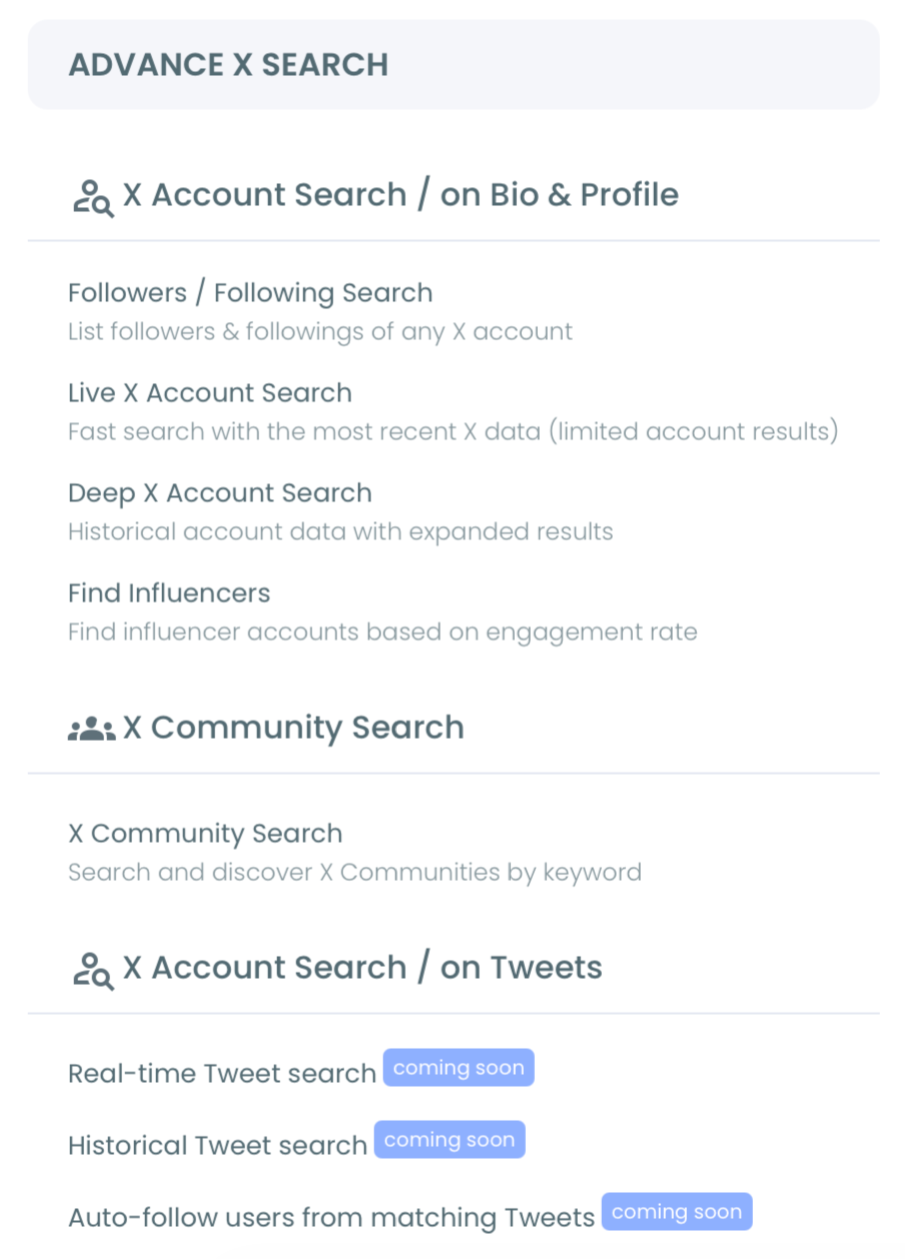
- Open Real-time Tweet Search. You will find it filed under the Advanced X Search menu, and it gathers matching posts from a date forward rather than querying a past window.
- Describe the search in plain language. The interface asks you to write what you are looking for in your own words, then offers refined variations you can accept or ignore.
Spend tokens only on posts from people who can hire you
- Set the start date to Last 24 Hours or Last 7 Days. Anything wider starts behaving like an archive query, which is the failure this whole approach exists to avoid.
- Add your exclusion terms in the Exclude field so job-board reposts, recruiter listings, and other freelancers advertising themselves drop out before collection begins.
- Decide the size of the collection. The figure you enter governs how many posts get gathered and what you spend, not the number of distinct people it yields.
End on a shortlist you can act on today
- Pivot to the profile view. The results page carries a control marked "Display Profiles of this search," and a prolific poster still occupies exactly one line behind it.
- Sort, shortlist, and act. Push the accounts worth pursuing onto an X List, or take the whole selection down as a CSV before the live conversation moves on.
Each stage in that order strips out a different kind of waste. The start date drops stale requests, the exclusions drop people who cannot hire you, and the profile view drops duplicate rows so one person gets judged once.
Shuffle the sequence and you pay tokens to read noise.
At a glance: connect, open the live search, write the phrase, date it, exclude, collect, pivot to accounts, save.
Screen recording: how a live keyword collection on X starts running from a chosen moment and keeps gathering as new posts appear.
https://www.youtube.com/watch?v=dZ4djvmOqTo
Why a hiring request goes stale faster than a complaint
A hiring request is a question with a closing date, and nobody announces the close.
Somebody venting about a bad tool is still venting a month later. Somebody asking for a recommendation gets three names in an afternoon and stops reading the thread.
The words look similar in a search box, but their useful lifespans are nothing alike, and that difference is what makes freelance prospecting on X harder than it looks in most guides.
X's own advanced search is built to move backward. Its date fields pull posts sent before a date, after a date, or inside a range.
The X help documentation on advanced search notes you can reach posts from any date since the first public post.
That reach is useful for research. It is the wrong shape for work that expires.
A backward query hands you the requests that already closed, sorted so the busiest ones come first.
Real-time Tweet Search runs the other way. You name a moment, and the collection accumulates from there.
What lands in front of you is the set of requests posted since you started paying attention. That shift matters most when your week is already full. Prospecting then runs quietly beside the social media accounts of over 20 clients you handle for other people.
Which start date matches which kind of work
Pick the start date from the shape of the work you sell, not from a habit.
Last 24 Hours suits small, fast jobs where the buyer wants a name today: a landing page fix, a thumbnail, a one-off edit. Those requests are answered and closed within a day, so a wider window mostly shows you decisions already made.
Last 7 Days suits retainer-shaped and project-shaped work. A person hiring a fractional marketer or a long-form writer takes several days to read replies, ask for samples, and pick, so a week-old post is often still live.
A custom range is for testing rather than working. Set one when you want to know whether a phrase produces anything at all in your niche before you commit to watching it.
A start date set too far back stops being a live search and starts behaving like a historical one. That is fine when you mean it, and quietly wasteful when you do not.
Which hiring phrases expire fastest
Hiring language is a small vocabulary, and almost none of it contains the word "freelancer."
People asking for help write short, plain, slightly apologetic sentences. What separates one phrase from another is not how it reads. It is how long it stays answerable after somebody posts it. Sorted by the window they leave you, shortest first:
- Same-day, because the poster has already decided to spend money: "DM me your rates," "send me a quote," "what would something like this cost."
- Unpredictable, because it closes the moment a name the poster trusts arrives: "anyone know a good," "who should I talk to about," "recommendations for someone who."
- Several days, because a stated hire takes longer to fill than a quote takes to send: "looking to hire," "need to bring someone in for," "taking on a contractor."
- A week or more, because the poster is scoping rather than buying: "anyone taking on work right now," "who has availability in the next few weeks."
That ordering is the argument for watching the rate phrasings hardest. Somebody asking what the work costs has moved past deciding and is now shopping, and shopping ends quickly.
Search the phrase, not the profession. A person hiring a copywriter rarely writes "copywriter."
Can a search tell you someone is ready to hire?
No. A search matches text, and wanting to hire somebody is not a property of text.
The collection hands you sentences that look like the sentences buyers write. Whether the person behind one of them has a budget, a brief, or second thoughts since Tuesday is nowhere in the result set, and no control in the panel puts it there.
Circleboom is blunt about this in its own docs. A keyword hit inside a live post proves nothing about whether its author wants what you sell, and every result set expects human review before a bulk action touches it.
So the inference is yours, drawn from one sentence a stranger typed. Make it on purpose rather than by default.
The phrase gets you a candidate. The account record and the post itself tell you whether the candidate is real, and no query decides that for you.
The flow that lets you find clients who are asking for freelance work gives you both views of one collection, never a verdict.
To sanity-check one person before writing to them, the same search family covers how to find someone on Twitter from a partial name or handle.
Recruiters, agencies, and rival freelancers all match your query
Most of the noise in a hiring search comes from three sources, and each needs a different exclusion.
Recruiters and job boards. They post the highest volume of hiring language on X and almost never want a freelancer. Their posts are formatted rather than written, they carry a link out to a listing, and they repeat.
Excluding link-carrying posts removes a large share of them in one move.
Agencies farming for a bench. These read like hiring requests but are collecting names for a roster they may never staff. The tell is the absence of a project: no deadline, no scope, no budget language, just an invitation to send a portfolio.
Other freelancers announcing availability. "Taking on new work" is written by both the buyer and the seller, which makes it the single most contaminated phrase in the category.
Pair it with an exclusion for portfolio and availability words, or drop it and rely on the referral and rate phrasings instead.
Size is the fourth trap, and the quietest one. A modest account that keeps asking for recommendations in your field deserves more attention than a large account that never buys anything.
That is the calculation behind deciding whether to hire Twitter influencers, run backward.
Sorting through this many strangers' posts is worth doing on sanctioned access. Circleboom is an official X Enterprise Developer company, so nothing you run here asks your account to carry the risk.
You can search X for freelance clients without putting your login anywhere unofficial.
What changes once the timing is handled
The number that improves is not how many prospects you find. It is how many of them still need you.
Say a phrase you watch produces 40 matching posts in a week. Under a backward query, most of those were posted before you looked, and a fair share are closed.
Under a forward collection dated to Monday morning, the same 40 arrive as they happen, and you are answering while the thread is short enough that a considered reply is still visible.
Same phrase, same volume, completely different hit rate.
A second effect takes longer to show up. Answering early, repeatedly, in the same niche builds the visible presence that makes the next referral ask land on you by name.
That compounding is the real return. It drives most durable ways to earn money from X as a creator: showing up in the right conversation before anyone else does.
Location narrows it further when your work has a regional component. A designer chasing local retainers can run the same phrases, then search Twitter by location to keep the shortlist inside one market.
The one variable you control
Every guide about freelance work on X gives you phrases. The phrases are public, and your competitors have the same ones.
What separates a reply that lands from a reply that arrives fourth is the moment you saw the post.
That is the one variable in this process you control. Set the start date, cut the recruiters out, and let the requests reach you while they are still questions rather than closed decisions.
Wondering whether a phrase is worth watching at all? Twitter historical data answers that in one pass, before you commit tokens to a standing search.
→ run a live search for freelance clients
Questions freelancers ask before the first client search
What happens if the client deletes the post before I reply?
A live post can vanish, get rewritten, or turn private within minutes of going up, so something captured during collection may already be gone from X when you open it. The account record stays in your profile view either way, so you can still look the person up, but treat a vanished post as a signal that the request was withdrawn rather than something to chase.
Does a bigger collection size mean more prospects?
Not reliably. The tweet count you pick governs how many posts arrive, while the number of distinct people behind them is whatever it happens to be, and a noisy phrase can spend a large collection on a handful of prolific posters. Start small on a new phrase, look at how many profiles the collection actually yields, and scale the number only once the ratio looks worth it.
Can I reply to every hiring post I find?
Not always. An author on X can restrict who is allowed to answer a post, and that restriction can be tightened after a conversation has already started. When the thread is closed to you, the account view still earns its keep, since it hands you the profile and leaves you free to approach another way.