
The fastest way to add Twitter accounts to a list in bulk is to skip X's one-profile-at-a-time flow and run the additions through Circleboom's X List Manager instead. One selection, one destination, one confirmation, and the whole batch lands together.
How do you add Twitter accounts to a list in bulk?
Circleboom pushes hundreds of selected accounts onto any new or existing X List in a single batch through official X API access, drawing from filtered follower segments, live search results, or a typed set of usernames.
→ add Twitter accounts to a list in bulk
Why Bulk List-Building Doesn't Exist on X
X built Lists as hand-picked feeds, then never built the tooling to fill them. Adding an account natively means opening its profile, tapping the three-dot menu, choosing "Add/remove from Lists," and picking a list.
That works for one account. It collapses for a hundred: a 100-member list costs 100 separate profile visits.
The math discourages the exact people Lists serve best. The strongest list use cases all need volume:
- Competitor accounts worth checking daily.
- Journalists and press contacts ahead of a launch.
- Engaged customers and brand advocates.
- Niche community voices gathered into one focused feed.
Each of those lists needs dozens or hundreds of members before it earns a daily click, and each needs refreshing as the account set changes. Built by hand, most never get finished, and a half-empty list quietly stops being read.
If you own no lists yet, the gap starts one step earlier. You can create Twitter Lists with just a few clicks and return to the filling problem afterward.
The empty shell takes seconds; the membership is the real work.
Filling is the part Circleboom removes. It builds, fills, and reorganizes Twitter Lists in bulk through approved API access.
Instead of a hundred profile visits, you add accounts to your Twitter Lists in bulk in one confirmed action.
Every Screen Becomes a List Source
Circleboom attaches an Add to List action to every follower, following, and search view on your connected X account, so any dataset you can see becomes a list you can build. The dropdown offers two destinations: push the selection onto an existing list, or create a new list, with its name, description, and privacy setting, and land the selection as its founding members.
Three sources feed the batch:
- Filtered follower or following segments, narrowed by quality flags, engagement tier, follower counts, language, or location.
- Search results from Circleboom's discovery tools, selectable the moment they load.
- Typed usernames, each validated against live X account data through the API before it joins the batch.
Search results, bios, and username imports
The search path is the one I see most people underuse. Circleboom's Twitter search tool finds accounts by who they are and what they post.
Its results carry the same row selection as any follower screen: run the query, tick the rows, assign the list.
Bio targeting goes a level deeper. Say the goal is a list of fintech founders or beauty editors.
You can search Twitter bios and profiles for the exact phrase people use to describe themselves, then send the matches straight to a list.
Username import matters more than it sounds. Paste a set of handles from a spreadsheet, a partner's press kit, or an event speaker page, and Circleboom checks each one against X's account records before the add.
These are the same membership operations X documents in its List Members API reference, so mistyped or dead handles get caught before they land on the list.
Compliance is the quiet advantage underneath all three paths. Circleboom holds official Enterprise developer status with X, so the batch that fills your list moves through channels X sanctions rather than scraping workarounds.
Your account standing never enters the bet.
The result is a list-building surface that sits one click away from every dataset in the app. You add multiple Twitter accounts to a list at once, whatever the source, and the list is live the moment the batch completes.
Watch the flow compressed: a selected batch of accounts becoming a populated X List in one Add to List pass.
https://www.youtube.com/watch?v=jv0Lrzyqbfo
How to Add Twitter Accounts to a List in Bulk, Step by Step
To add Twitter accounts to a list in bulk, point Circleboom at a destination list, load your account source, and commit the whole selection in one confirmed action. The six steps below run that flow end to end.
Reach the destination list
- Log in to Circleboom Twitter and authorize the X account that owns the lists.

- Open the Essential Toolbox menu on the dashboard.
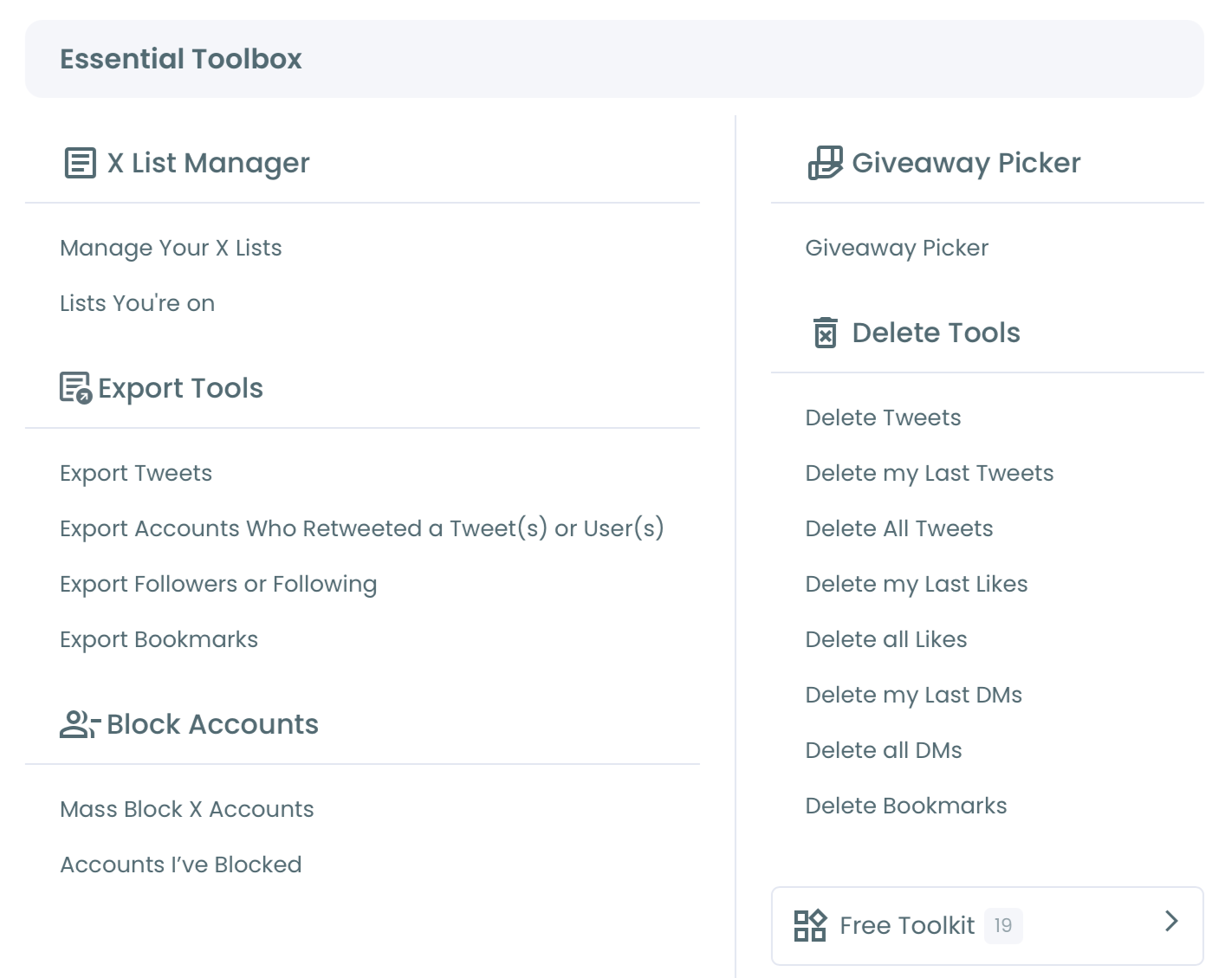
- Select X List Manager and click into the list you want to fill. The grid shows every list you own with member counts and a lock icon on private ones; create a new list here if the right one doesn't exist yet.
Load the accounts and run the batch
- Choose the account source. Click "Add or import new accounts" inside the list view for a username batch, or start from any follower segment or search result and tick the rows you want; the master checkbox selects the whole visible page.
- Apply the Add to List action to the selection and confirm the destination, either the existing list you opened or a new one named on the spot.
- Confirm the batch and leave the session open until it finishes. Circleboom processes the additions sequentially, so a large run should be left alone rather than interrupted midway.
That order is what makes the operation hold: the login establishes approved API access before anything moves, the destination is locked before accounts load, and a single confirmation stands in for hundreds of individual profile actions on X.
At a glance: log in, open Essential Toolbox, pick the list, load the source, apply Add to List, confirm.
Does your source set live specifically in your own follower base? The companion guide on how to add people to Twitter lists in bulk walks the segment-first path in more detail, filters included.
What Happens When a Bulk Add Hits X's List Limits?
Two ceilings apply no matter which tool submits the request, because X enforces them at the platform level: an account can own up to 1,000 lists, and a single list holds up to 5,000 members. X outlines how Lists behave on its About X Lists help page, and the caps are the part that catches bulk builders off guard.
The case worth understanding is a batch that crosses the member cap midway. Push 600 accounts at a list already holding 4,700 and the run reaches 5,000 before it finishes.
Circleboom's documented behavior at that point: accounts already added stay on the list, and the unprocessed remainder is skipped, with no rollback. You keep the 300 that fit and re-route the other 300 to a second list.
Timing has a documented shape too. List membership data syncs within a 24-hour window, and the list overview shows when the last refresh ran.
An account added natively on X may not appear in Circleboom until the next cycle, so a mismatch right after a native edit is a sync gap, not a failed add.
Visibility decides what your members notice. X may notify accounts when they're added to a public list, while private lists stay invisible: they can't be followed, discovered, or seen by the people on them.
Settling are Twitter Lists public by default is worth doing before a competitive-research build, and private is the safer answer.
Keep the List Useful After the Batch Lands
Lists rot quietly. Accounts go inactive, pivot topics, or turn out to be spam, and a monitoring feed full of dead members stops earning its click. Circleboom's list view carries the same segmentation filters as its follower screens:
- Quality flags for fake, spam, inactive, and egghead accounts.
- Engagement tier, follower count, and follow ratio ranges.
- Join date, language, location, and bio keywords.
Join-date filtering earns its place faster than you'd expect. The same logic that lets you create a Twitter following list with accounts created before 2020 also isolates the newest arrivals inside any list.
New arrivals are where bot waves usually cluster after a viral post.
A maintained list also solves a quieter problem: it is the cleanest way to see someone's tweets without following them. The list feed shows their posts in one place while your following count and home timeline stay untouched.
Protect the members that must survive every cleanup by whitelisting them inside the list; quality filters skip whitelisted accounts, so a partner with an oddly low tweet count never gets swept out with the spam.
When categories shift, Move to List relocates members without a remove-and-re-add cycle, the way a prospects list feeds a customers list as deals close. And when a fresh candidate set shows up, add Twitter accounts to your list in bulk again rather than drip-feeding them one at a time.
One Batch Instead of a Hundred Profile Visits
X gives Lists real strategic weight and no tooling to match, since every native add is one profile, one menu, one list. Circleboom collapses that into select, assign, confirm, from any follower segment, search result, or username import, with documented behavior at the 5,000-member cap and a visible 24-hour sync window.
The payoff shows up the morning after: competitor feeds that are complete, press lists that are current, and community lists that reflect who belongs there now.
→ Start adding Twitter accounts to your lists in bulk
Common Questions About Twitter Lists
Can I undo a bulk add if the wrong accounts ended up on a list?
Yes. Open the list in X List Manager, select the mistaken rows in the Members view, and use Remove from List, which works as a bulk action too. Removal only edits that list's membership; it doesn't unfollow, block, or relabel anyone.
Can I bulk-add accounts to a list someone else owns?
No. Circleboom manages the lists owned by the connected X account, so you can fill and reorganize your own lists at any scale, but another user's list can only be followed.
If you need control over its membership, rebuild the concept as your own list and fill it in one batch.