
A Twitter outreach list starts with a keyword, not a follower count.
You search the phrase your ideal contact would write in a bio or a post, then narrow the accounts that come back until only reachable people remain.
How do you build a Twitter outreach list from keyword search?
Search the exact phrase your prospects use, then filter the result by follower range, activity level, and bio wording until the list is small enough to act on in one sitting. Circleboom finds live X accounts by keyword and returns them as a filterable table you can follow, add to a list, or export through official API access.
→ build a Twitter outreach list
What a Twitter outreach list is
A Twitter outreach list is a named set of X accounts you intend to contact, grouped because they share a signal rather than because they already follow you.
The signal is usually a keyword: a job title, a tool name, a niche phrase, a community label.
That definition matters because it separates outreach from growth. A growth list is anyone who might follow back. An outreach list is people you have a specific reason to talk to.
The keyword is the reason.
Why native X search does not hand you a list
Native X search is built around posts, not people.
You type a phrase, you get a scroll of tweets, and the accounts behind those tweets stay locked inside individual posts.
To build anything list-shaped from that, you open profiles one at a time and copy handles into a spreadsheet.
Thirty accounts in, you have lost track of which ones you already checked.
The bottleneck is not discovery. It is structure. You can see the people; you just cannot hold them.
That is the gap a proper Twitter outreach list closes, because the result arrives as a table instead of a feed.
Circleboom returns each matching X account with its follower count, following count, tweet count, join date, follow ratio, and location in one row, so evaluation happens at a glance instead of one profile at a time.
The same structural problem shows up whenever people try to automate Twitter outreach before they have a list worth automating against.
How to build a Twitter outreach list from keyword search
To build a Twitter outreach list from keyword search, run a live keyword search against X bios and recent posts, filter the raw result down by quality and activity signals, then save the survivors as a list or a CSV.
The three phases below follow that order, and each one shrinks the pool the next phase has to work with.
Watch the keyword search run before you try it: this walkthrough shows an X account search built from a single keyword, start to finish.
https://www.youtube.com/watch?v=OAbQZmQ1z2Q
Set up the search and get a raw result
- Log in to Circleboom Twitter and connect the X account you plan to run outreach from.

- Open the Advanced X Search menu, where account discovery, community search, and tweet search all live.
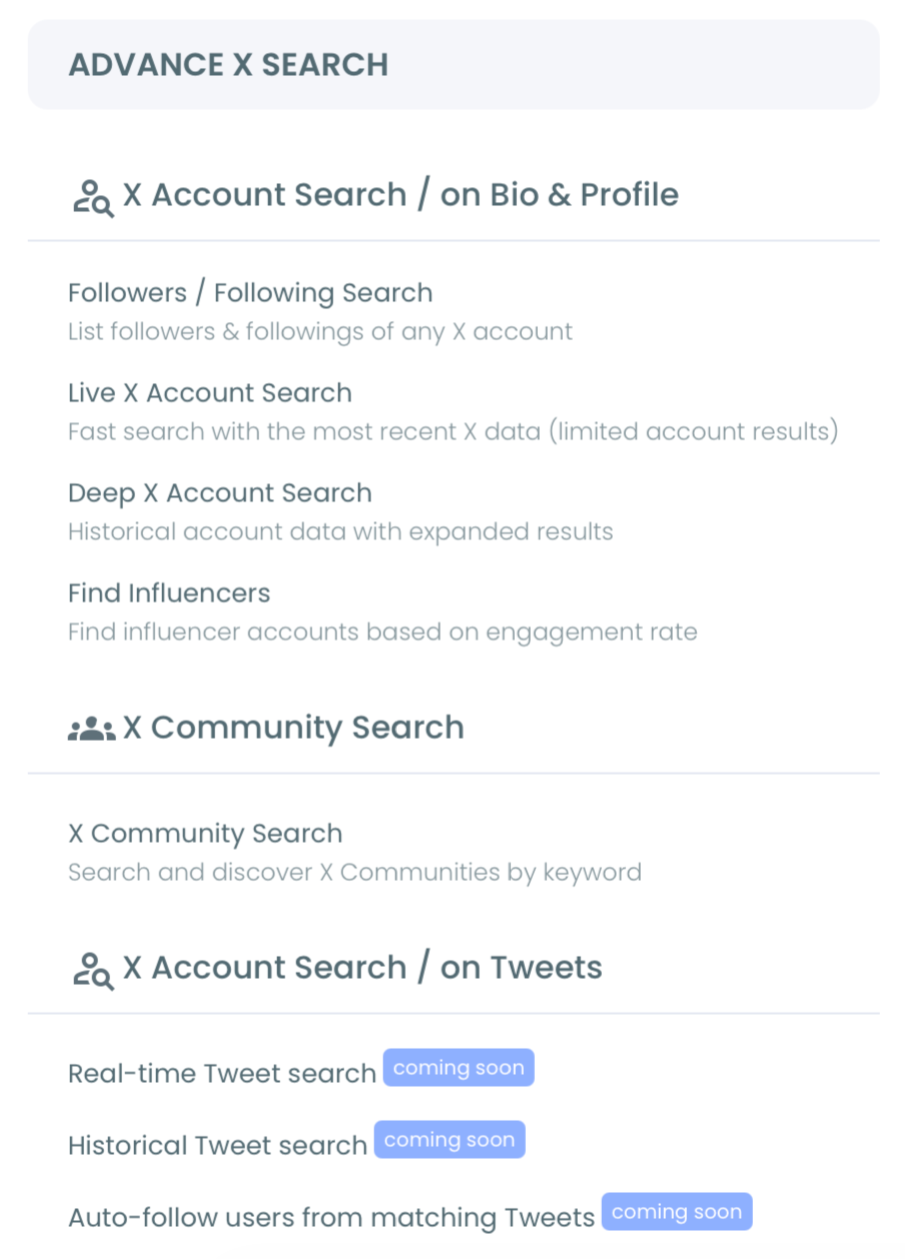
- Enter one precise keyword in Live X Account Search. Circleboom matches it against public bios and recent posts, and the results page opens with a header reading "Listing N profiles who are interested in [keyword]." Choose the phrase your prospects would write about themselves, not the phrase you would use to describe them.
Narrow the raw result into a shortlist
- Click Filter Options and apply the quality filters first. The side drawer lets you exclude eggheads, protected accounts, fake or spam-like profiles, inactive accounts, and overactive ones. Every filter combines with AND logic, so each toggle genuinely shrinks the set.
- Set follower, following, and follow-ratio ranges to match who you can realistically reach. An account with a 40:1 follow ratio rarely answers a cold reply. Circleboom exposes minimum and maximum inputs for follower count, following count, tweet count, and follow ratio, plus a join-date range and a free-text location field.
- Use Find in Bio and Name to test a second wording of the same idea. If the first keyword was "growth marketer," this is where you check "demand gen" against the same result set. An Active Filters bar shows each applied filter as a removable tag, and Clear All Filters resets the whole panel when a combination cuts too deep.
Turn the shortlist into something you can work
- Select the accounts worth contacting and use Add to List, or Export the result as CSV. Add to List opens a dropdown with Twitter List, Add to Mass Block List, Whitelist, and Blacklist. Export downloads the filtered table and consumes search tokens, with the remaining balance shown next to the button.
That order holds up because each phase removes noise the next phase would otherwise have to carry.
The keyword defines relevance, the quality filters remove accounts that cannot receive outreach, and the numeric ranges decide who is actually reachable, so the export at the end is a list of people rather than a dump of search results.
At a glance: one keyword, quality filters, numeric ranges, then list or CSV.
How to pick the keyword that builds the list
The keyword decides the list, so it deserves more thought than the filters do.
A good outreach keyword is a phrase your prospect would use about themselves, in public, without being asked.
Three kinds of phrase reliably produce workable lists:
- Role words people put in bios, like "fractional CMO" or "solo founder."
- Tool and platform names, because people announce what they build with.
- Community labels a niche uses about itself, like "buildinpublic" or "indie hacker."
Broad category words fail on the same test. Nobody writes "small business owner interested in social media tools" in a bio, so a search for it returns whoever happened to string those words together.
Precision in the keyword saves you a filtering pass later.
A phrase only your target audience uses gives you a smaller raw result and a much higher hit rate inside it. Circleboom's own guidance for Live X Account Search says the same thing: tie keywords to roles, topics, tools, or communities rather than broad themes.
There is a second reason to obsess over wording.
The difference between "founder," "SaaS founder," and "B2B SaaS founder" is not a matter of degree; each returns a different population, and only one of them is yours.
So write the three variants before you run anything. Search each, note the result count in the header, and keep the version whose first screen of accounts you would want to talk to.
That comparison decides the quality of everything downstream.
Which filters change an outreach list the most
Follower quality filters do the heaviest lifting, because they remove accounts that will never reply regardless of how well the keyword matched.
An egghead account with no profile photo and eleven posts matched your phrase by accident.
Activity classification does the second most.
Circleboom labels each account Active with high engagement, Moderate Active with medium engagement, or Inactive with low engagement, computed from public activity signals. Sorting an X outreach list from keyword search by that column puts the reachable people at the top.
Then bio wording. The Find in Bio and Name field searches display names and bios together, which is how you separate a founder who mentions SaaS from a fan account that quotes SaaS jokes.
The habit worth keeping is simple. Run two or three wordings of the same idea and compare what each returns. That is the discipline behind the best way to search Twitter bios and profiles.
How big should a Twitter outreach list be?
Small enough that you can write a specific first message to every account on it.
That number is usually somewhere between twenty and eighty accounts, not eight hundred.
Live X Account Search returns a smaller result set than deep historical search by design, because it anchors to recent public activity instead of scanning a full historical index.
For outreach that is the right trade. An account that posted about your topic this month is a live conversation, while an account that mentioned it in 2021 is an archive entry.
Result volume also swings with keyword breadth. Broad terms return more accounts and more noise; narrow technical terms return fewer accounts and better ones.
Circleboom is an official X Enterprise Developer, so every account in that result comes from sanctioned data access rather than scraping. Only public accounts and public posts are ever returned.
What happens after the list exists
An outreach list is an input, not an outcome.
Three things usually happen to it next.
- Selective following, so your first reply arrives from an account the person recognizes.
- A saved X List, which turns a one-time search into a feed you can monitor.
- A CSV export, which is what you hand to a campaign or a partnership effort.
Following in bulk is where accounts get into trouble, so pace it.
Follow and unfollow actions from search results run against X's platform rate limits, roughly 50 to 400 per day depending on your account standing. Rapid unpaced bulk following can trip spam detection.
Circleboom processes bulk actions gradually for that reason. X's own X Rules are worth reading before any campaign that touches hundreds of accounts.
Saving the list is the step most people skip.
A keyword result is a snapshot of who was active this week, and next week's snapshot is different. That is why adding people to Twitter lists in bulk beats rebuilding the same search from scratch.
Where keyword search stops being enough
Keyword search finds people who describe themselves in words. It misses people who describe themselves in behavior.
A founder who never writes "founder" in a bio but replies to every hiring thread in your niche will not appear in a keyword result. Neither will an account whose relevance lives entirely in who they follow.
For those, discovery has to start from a different signal, which is where more targeted Twitter account search and follower-graph approaches take over from keyword matching.
Keyword search is the fastest first pass. It is not the only one.
What to do next
The build is four moves: one precise keyword, quality filters, numeric ranges, then a saved list or an export. Everything else is refinement on top of that sequence.
The reason it works is that a keyword carries intent in a way a follower count never does. Someone who wrote your phrase in their bio told you what they care about, and an account that posted about it last week told you they still care.
Circleboom turns that signal into a structured, filterable table of X accounts through official API access. A filtered outreach list beats a scraped follower dump on every axis that matters: relevance, deliverability, and account safety.
That is also why an outreach list feeds naturally into generating Twitter leads rather than sitting in a spreadsheet.
If you have a keyword in mind, the search takes minutes.
→ Run your Twitter outreach list search
Common questions about Twitter outreach lists
Can I export a Twitter outreach list to CSV?
Yes. The Export button downloads the filtered result as a CSV, and it consumes search tokens from your balance, with the remaining count shown next to the button. Export the filtered view rather than the raw result, or you will pay tokens for rows you already decided against.
Will building an outreach list get my X account restricted?
Building the list will not. Acting on it carelessly can. Searching and filtering are read operations, but follow and unfollow actions run against X's platform rate limits of roughly 50 to 400 per day depending on account standing, so space bulk follows out instead of firing them in one burst.
Do private accounts show up in keyword search results?
No. Only public accounts and public posts are returned, which is a property of official API access rather than a Circleboom setting. A protected account can still surface as a filter category so you can exclude accounts whose posts you cannot read.
How often should I rebuild the list?
Rebuild whenever the conversation moves. Live keyword results reflect who is active in the current period, so a list built around an event or a launch goes stale within weeks, while a list built around a stable job title holds much longer. Saving results to an X List with the Twitter List Manager makes the rebuild a comparison instead of a restart.
Can I search by location as well as keyword?
Yes. Filter by Location is a free-text field in the same filter drawer, so you can combine a keyword with a city or region and keep both conditions active. It pairs with the dedicated search Twitter by location page when geography is the primary signal rather than a secondary filter.