
A drop in impressions is the easiest thing on X to misread. The account still posts. Replies still send. The profile still loads for anyone who types the handle in.
So the obvious conclusion is that the content got worse, and the obvious response is to rewrite hooks and shuffle posting times.
I spent longer than I want to admit on that response before I asked whether the account was allowed to be seen at all. Checking your X account status answers a different question than analytics does, and it answers it first.
How do you check your X account status?
Run a visibility check on the handle instead of inferring one from your analytics. Circleboom's Shadowban Test evaluates an X account against five named restriction types and returns a pass or issue result for each one, with an explanation of what that restriction limits.
→ check your X account status
How I check my X account status, step by step
Circleboom runs the whole X account status check from a single input field, and reading the result takes longer than running it.
Video walkthrough: what a sudden impression collapse looks like before you know whether a visibility limit is behind it.
https://www.youtube.com/watch?v=g4VD-Lc2sYM
Here is how I run it end to end.
Get the account connected before you read anything
- Log in to Circleboom Twitter and connect the X account you want to work from.
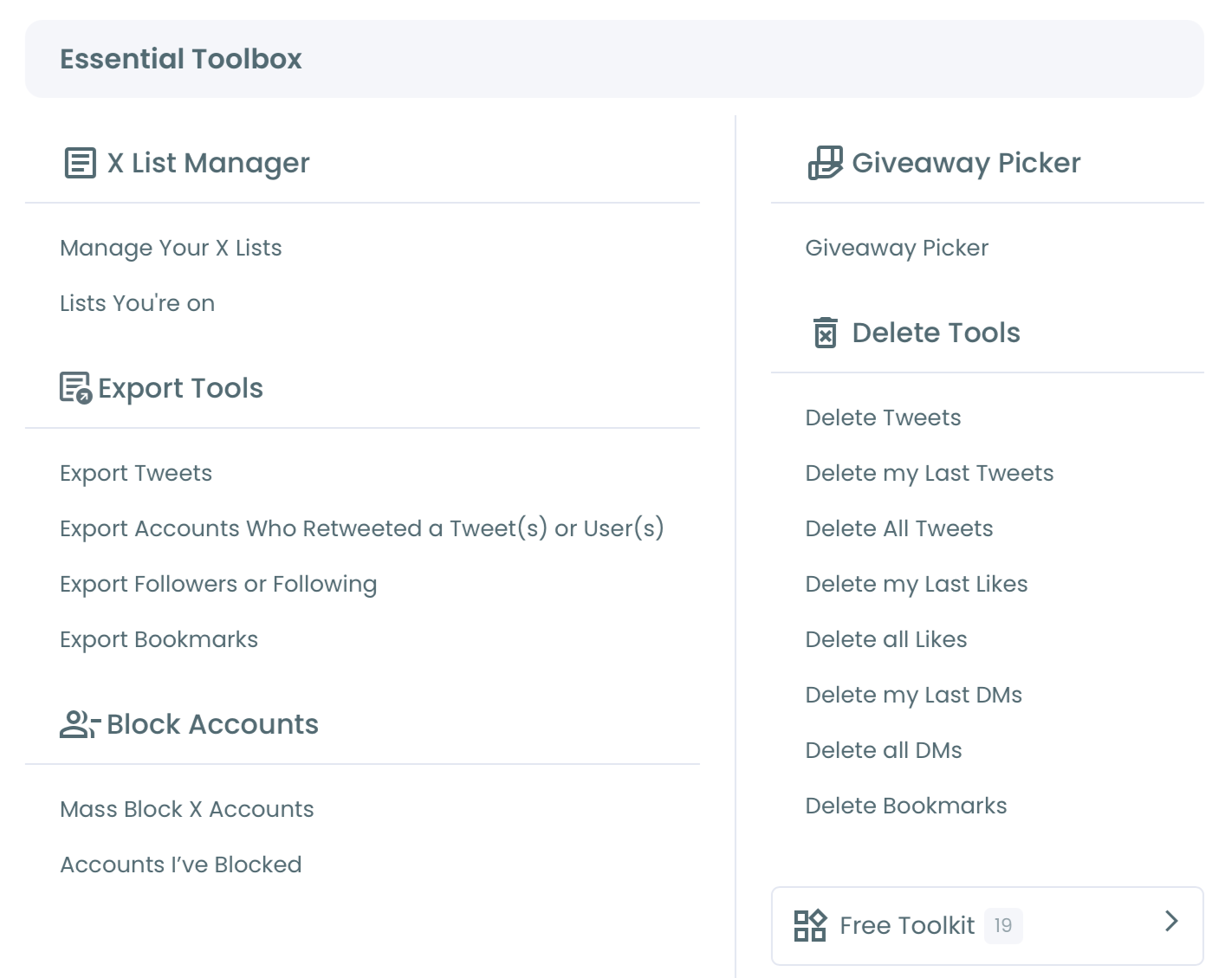
- Open the Essential Toolbox menu, where the visibility and account-health utilities sit alongside the export and list tools.
Run the check on the handle that actually matters
- Type the username into the input field. Letters, numbers, and underscore only, and the
@prefix is already supplied for you. Any public handle works here, not only your own. - Click Search and let Circleboom evaluate that X account against all five restriction types in one pass.
Nothing you do in that flow writes to the account. It is a read, which is why I run it on other people's handles as freely as my own.
Read all five results, not only the banner
- Read the summary verdict at the top first. A clean account returns a single banner saying it has no shadow bans in any country. When issues are present, the banner names which types were found.
- Expand each of the five checks underneath it. Every check carries its own status indicator, its own result label, and a full explanation of what that restriction does to visibility.
That order matters because the banner is a roll-up, not a diagnosis. The five results underneath are what tell you which part of your visibility is limited, and each one calls for a different response.
Quick recap:
- Connect the account.
- Open Essential Toolbox.
- Search the handle.
- Read the banner, then all five checks.
What "account status" actually means on X
X does not publish one status field you can read. Two very different things get called account status, and mixing them up costs people weeks.
The first is explicit enforcement. X tells you about it: a notice, a label on a post, a locked or limited account screen with an action to complete.
The platform's own explainer on account notices and what they mean covers that layer, and it is the layer you can appeal.
The second layer is quieter. Reach gets limited without any announcement, and the only signal is the shape of your numbers.
Nothing on X tells you when the second layer is active.
That is the gap a Twitter shadowban test fills. It is also why I open the X account status check before I touch the content calendar.
The practical difference is what you do next. Explicit enforcement has an action attached to it: verify an email, add a phone number, remove a post, appeal.
Quiet visibility limits have no button. They tend to lift once the behavior that triggered them stops, and the only way to watch that happen is to check again.
What I tried before I ran the check
I did the three things everyone does, in the order everyone does them.
First I blamed the writing. I rewrote openers, cut thread lengths, and tested a shorter format for two weeks. Impressions stayed where they were.
Then I blamed timing. I moved posts across four different windows to catch a supposedly better slot. That moved nothing either, because the posts were not competing badly for attention.
They were not being distributed to compete in the first place.
Then I blamed the algorithm in general, which is the most comfortable and least actionable answer available.
Every one of those tests assumed the account was visible. None of them checked.
That assumption is the expensive part, because each experiment costs a week and returns a result you cannot interpret.
A visibility check costs a minute and tells you whether the experiment was even measurable.
Why a clean X account status can still mean flat reach
The result that changed how I read these checks was a clean one.
Every restriction came back with no issues found, and the reach was still flat. The explanation was sitting inside the fifth check the whole time.
The seed group is the part nobody checks
Circleboom's Early Engagement Seed check looks at what happens in the first minutes after you post.
X shows a new post to a small seed group drawn from your followers. If that group engages, distribution widens. If the seed group is packed with dormant accounts, seed strength stays low, and the post never earns the wider push.
Your account can be entirely clean on policy and still throttled by its own follower list.
That reframes the fix completely. When the four policy-shaped checks pass and the seed check is the weak one, rewriting posts will not move anything, because the problem is who is receiving them.
A credibility signal like your Tweepcred calculator score tells you more at that point than another impressions screenshot. It is also where the honest answer to why did my Twitter impressions suddenly drop turns out to be about follower quality rather than about content.
Circleboom is an official X Enterprise Developer company. The account data behind that read arrives through sanctioned access, not through a scraper guessing at your profile from the outside.
When you are about to commit a month of strategy to a visibility result, that distinction is the value of the result.
Ready to see which of the five is yours? Pull your X account status report before you plan the next month of content.
What each of the five results is limiting
Each check maps to a different part of how people find you, which is why the summary banner alone is not enough to act on.
The five Circleboom checks cover:
- Search Suggestion Shadow. You stay reachable to existing connections but stop appearing in search suggestions and People results for everyone else.
- Total Search Blackout. Your posts and hashtags drop out of search results entirely, regardless of the searcher's filter settings.
- Reply Lock. Your replies look posted from your side and stay hidden from everyone else in the conversation.
- Reply Visibility Filter. Your replies get pushed behind a "Show more" barrier, out of the main conversation view.
- Early Engagement Seed. Your initial seed group is too inactive to trigger wider distribution.
The first two are discovery problems. The next two are conversation problems.
The last is a distribution problem that lives in your audience rather than in your behavior. Anyone working out how to get unshadowbanned on Twitter needs to know which of those three categories they are in before they change a single habit.
Two of the five call for opposite fixes
The categories matter because they contradict each other.
A Reply Lock says your posting cadence looked automated, so the response is to slow down and post less. An Early Engagement Seed problem says too few of your followers are alive, so the response is to prune the dead weight and post to a tighter, more responsive base.
Slowing down while your seed group is the real issue makes the numbers worse, not better.
That is the trap in a one-word verdict. "Shadowbanned" or "not shadowbanned" gives you no way to pick between two opposite responses.
What usually puts a status check on my calendar
Certain patterns make a visibility limit likely enough that I check without waiting for a metric to fall.
Fast growth is the first one. An account that gains followers in a sudden burst looks different to the platform than one that grows steadily, and the two checks that answer to that pattern are Reply Lock and Early Engagement Seed.
High-volume posting is the second. A day where you post far more than your own baseline reads as a spike whether or not the content is good.
Automation is the third, and the widest. Scheduled bursts, bulk follows, and reply loops all produce the shape the platform watches for.
The fourth is not about your behavior at all. If followers tell you they cannot find your posts in search, or that your replies vanish from a thread they were reading, that is a report from outside the account.
Outside reports are worth more than your own dashboard.
Is it worth checking your X account status regularly?
Yes, because a single check gives you a verdict while a repeated check gives you a baseline.
The first time I ran this, I had nothing to compare it against. A clean result told me almost nothing, because I could not say whether it had been clean the week before.
The second and third runs are what made the tool useful.
A steady cadence turns account status into a time series. You see the exact week a check flipped, and you can line that week up against what you changed:
- A burst of posting.
- A new automation.
- A campaign that pulled in a wave of low-quality follows.
That is also the cheapest way to learn how to prevent a Twitter shadowban instead of reacting to one.
Pair the run with your impression analytics and the two readings explain each other.
The status check says whether you are allowed to be seen. The impression trend says how much of that permission you are actually using.
For a brand account, that pairing is what turns a bad month into a defensible answer. "Reach fell 40 percent and here is the week the reply filter turned on" is a report. "Reach fell and we think the algorithm changed" is a shrug.
The line I keep coming back to
The account status check is not a verdict on your content. It is a permission slip, and you should read it before you rewrite anything.
When one of the five comes back flagged, the reading tells you which fix is even relevant. The guidance on how to get rid of a shadowban on Twitter then applies to the specific restriction rather than to a vague sense that something is off.
→ Start here: check X account status on any handle
Still wondering?
Can I check someone else's X account status?
Yes. The check runs on any public handle you type into the field, so you can compare a competitor's visibility against yours or confirm that a collaborator's replies really are being filtered before you plan a joint thread.
Does running the check affect my account in any way?
No. It reads the account's visibility state and reports what it finds. Nothing is posted, followed, deleted, or changed on the account you search.
What should I do first if one of the five checks flags an issue?
Stop the behavior most likely to have triggered it before you do anything else, which usually means pausing automation, high-volume posting, or an aggressive follow cycle. Then re-run the check a few days later so you can tell whether the restriction is lifting on its own or holding.