
Most tools sold as keyword research for X were built for search engines and ported over. The question worth asking is not which one reports the biggest number, but which one hands you something you can act on.
What a keyword tool has to give you on X.The public tweets that match your phrase, with their real engagement counts.The deduplicated accounts that wrote those tweets, not just a total.A filter layer that narrows the set before you spend anything collecting it.
Circleboom collects matching public posts on X through the official X Enterprise API and turns them into an account list you can filter, follow, list, or export. Start with the Twitter keyword research tool.
What a Twitter keyword research tool actually has to do
A keyword on X is a behavior rather than a search-volume slot: performed by a named account, at a timestamp, with public engagement numbers attached.
Any tool that discards three of those four fields has thrown away most of what the platform gave it.
That is why volume-style outputs feel hollow here. An estimate of how often a phrase appears cannot be filtered, cannot be exported, and cannot be followed up.
The unit of value on X is the account, and the keyword is only the query that finds it.
X's own advanced search proves the point from the other direction. It is genuinely capable at narrowing a query, and it still leaves the reader scrolling a feed instead of holding a dataset.
The narrowing works. The retention does not.
The practical fix is to track keywords on X inside something that stores the result. Circleboom keeps every keyword search on X as a stored result set, with the matching posts on one tab and the accounts behind them on another. The same query then becomes a repeatable input instead of a one-off reading session.
If you want the wider framing of X as a searchable corpus rather than a feed, Twitter search engine covers how the platform behaves when you treat it as an index.
Five criteria that separate a keyword tool from a keyword report on X
Judge any option on X against five things, in this order:
- Does it return accounts, or only counts? Counts are a report. Accounts are a workflow.
- Can you scope time precisely? A phrase from last week and the same phrase from last year are different research questions.
- Do filters run before collection? Filtering after the fact means you already paid for the noise.
- Does the output leave the tool? CSV export, list building, and follow actions decide whether research reaches anyone.
- Is the data access sanctioned? Scraped pipelines break, miss posts, and put the connected account at risk.
Ranked that way, most keyword research products fail criterion one immediately, which makes the other four moot. A tool that never names an account cannot be scoped, filtered, exported, or trusted, because there is nothing there to scope.
Circleboom answers criterion one by returning both halves of one query on X: the posts that matched, and the deduplicated accounts that wrote them.
The post side carries the public engagement numbers and the moment each post went up. The account side carries the profile-level fields that decide fit, including how heavily an account posts, how lopsided its follow ratio is, when it was created, and whether it is still active.
Criterion four is where research quietly dies, and it is the cheapest of the five to test. Ask whether a selected batch can be acted on without a copy-and-paste step in the middle.
In Circleboom every account row stays live: follow, unfollow, whitelist, blacklist, open the profile, or take a selection straight into an X List, a CSV file, or a paced follow queue.
The fifth criterion is the one people weigh last and regret first.
Data that arrives through an unauthorized pipeline is incomplete by construction, since anything the scraper could not reach simply is not in your result, and you have no way to know what is missing.
Sanctioned access is therefore a feature rather than a footnote. Circleboom is a verified Enterprise partner of X. The collection is licensed rather than scraped, which is what keeps the same workflow safe to run on a client account you do not own.
Hashtags are a special case of the same test. A Twitter hashtag counter is useful precisely because it counts something concrete rather than estimating something abstract.
Historical or real time: which question are you asking?
Pick historical when the signal you want has already been expressed, and real time when it is being expressed now. The two modes answer different questions and the wrong pick wastes the whole search.
Historical search queries a past window. It is the right mode for finding accounts that complained about a competitor eight months ago, asked for recommendations last quarter, or participated in an event you want to recreate. Their profile will never say any of that. Their posts already did.
Real-time search anchors to a start date and accumulates forward as new posts appear. It fits launches, incidents, conferences, and any moment where the value of finding someone decays within days.
A quick test that resolves most cases: if acting a week late would still be useful, the question is historical. If a week late is worthless, the question is real time.
One practical difference decides the budget rather than the answer. A historical window is closed, so the size of the haystack is knowable before you spend anything on it. A live collection accumulates from its start date, so the same phrase keeps drawing against the count you set until that ceiling is reached.
Pick the ceiling deliberately on the live side.
For the past-window version of this in practice, search Twitter history walks through what deep archive access changes about research.
Why the same phrase returns two different X account lists
Run one keyword historically and again in real time and the account lists will barely overlap. That is not a bug in either mode. It is the clearest evidence that the two searches are answering different questions.
The historical list skews toward accounts whose relevant post is settled. Engagement counts on those posts have stopped moving, the conversation around them has resolved, and the author has had months to change what they do.
Some of those accounts are now private, suspended, or dormant, and the profile view is where you catch that before acting.
The live list skews the other way. Engagement numbers on a fresh post are still climbing at the moment you read them, so a minimum-engagement filter set too high will exclude posts that would qualify an hour later.
A live result is a moving picture; a historical result is a photograph.
That difference should change how you filter. On a historical search, lean on engagement minimums to find the posts that mattered. On a live search, lean on exclude terms and language filters instead, and let engagement sort itself out after collection.
Edited posts add one more wrinkle worth knowing. A post may appear in its original or edited form depending on when it was indexed, which occasionally explains why a result does not match what you see when you open it on X.
Short demo: how one keyword query resolves into a filtered, exportable list of X accounts.
https://www.youtube.com/watch?v=ZRslhxkc43Y
Both modes run from one screen, one filter set, and one output shape, so a single sequence covers them.
How to use a Twitter keyword research tool step by step
Set up the query before it costs anything
- Open Circleboom Twitter Management and connect the X account you are researching from.
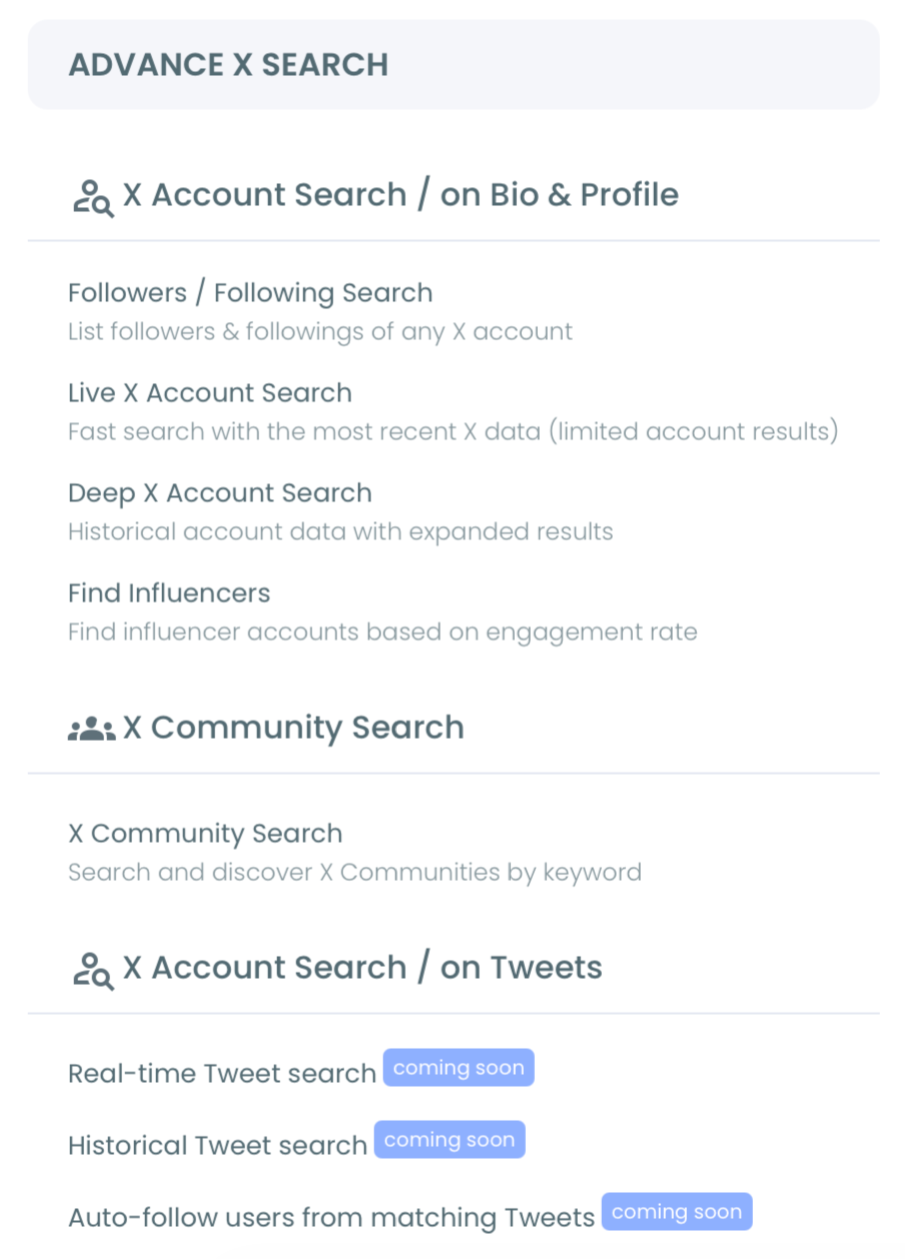
- Go to Advanced X Search and select the mode the decision test above pointed you to.
- Describe the search in plain language, then review the refined query variations offered and confirm the one that matches your intent.
Collect, then move to the accounts
- Apply filters and set the window: exclude terms, language, replies, links, hashtags, cashtags, verified-only, media type, minimum engagement, and either a date range or a start date.
- Choose the tweet count, run the collection, then open Display Profiles of this search to work the extracted account list.
The sequence holds in both modes because only two inputs actually change between them. Historical work leans on the date range and an engagement floor. Live work leans on the start date and the exclude list. Everything else is identical, which is what makes the two modes worth learning as one habit instead of two.
A Twitter keyword research tool used this way also composes with the rest of a research stack, because the phrases you feed it have to come from somewhere. Twitter interest targeting reads the vocabulary of your own audience and is the natural upstream source of candidate terms.
Downstream, profile attributes are the second pass once the keyword has finished its job. For where that pass belongs in the sequence, see the best way to search Twitter bios and profiles.
At a glance: describe, filter, scope, collect, pivot to profiles.
The start-date trap that quietly turns live research into old research
A real-time search with a start date set too far back stops being real-time research. It becomes a historical search wearing a live label, and the result set will skew toward posts whose moment has already passed.
The trap is easy to fall into because a wider window feels safer. More posts collected, more accounts extracted, better list.
What actually happens is that the accounts at the front of your list are the ones furthest from the moment you cared about.
Set the start date to the moment the signal began, not to whenever feels generous.
There is a diagnostic for it. Sort the collected posts oldest first and read the top ten.
If those posts belong to a different news cycle than the one you are chasing, the start date is wrong and no amount of filtering downstream will fix it, because the budget was already spent on the wrong days.
Live results carry a second caveat worth building into your process. Posts can be deleted, edited, or made private within minutes, so a tweet visible at collection time may be gone before you act on it.
Export strong findings quickly rather than treating a live collection as a stable dataset.
Which search to run next on X
If you need accounts that already expressed something, run a historical search with a tight date range and a minimum engagement filter, then export the profile view.
If you need accounts expressing it right now, set the start date at the moment the event began and track tweets in real time. Check the collection while the shared context still holds.
If you are not sure which phrase to research at all, start from your own audience's vocabulary and validate the candidates with a small historical search before committing tokens to a large one.
If the phrase belongs to one account rather than the whole platform, narrow the scope instead of the window. Search specific words a Twitter account said is the single-account version of the same query.
Questions creators ask
How many accounts will one keyword search return?
There is no fixed ratio to plan around. The number you request is a post count, and the profile list is whatever remains once repeat authors collapse into one row each, so identical requests can produce wildly different list sizes. Run a small collection first and read the profile count, because that is the only reliable way to size the real output of a specific phrase.
Does a keyword search cost the same every time I open it?
No. The charge lands once, at collection. A search you already ran stays in the search log and reopens without drawing on your balance again, so revisiting an old result costs nothing. Exporting is a separate action with its own draw, which is worth planning for before you pull a large set.
Can I search a phrase from several years ago?
You can set a custom historical window, though how complete that window is depends on the archive sitting behind it. Treat a thin result from a distant window as an incomplete picture rather than proof the conversation never happened, and sanity-check the phrase against a recent window first.
Are quoted phrases matched exactly?
Match type is a filter you set. Exact phrase, contains, and partial matching are all available, and pairing an exact phrase with a short exclude list is usually what separates a clean result from a noisy one.
Is it safe to follow accounts straight from the results?
Yes, provided the batch is paced and reviewed. Follow actions run inside X's platform limits and bulk operations process gradually, but a keyword match alone does not confirm intent, so review the profile view before running follow actions across a large selection.