
Your Likes tab is a public record of everything you have ever endorsed on X, going back to the day you opened the account. Deleting the last few likes barely touches it, because the X API only exposes your most recent 3,200 likes and hides the years underneath. To clear your entire Twitter likes history you need archive-based deletion, and that is exactly the gap this guide closes.
Manual: scroll the Likes tab, unlike one post at a time, and still never reach the likes older than your recent 3,200. Circleboom: upload your X archive's like.js file and remove your complete like history in one safe, official pass.
→ clear your entire Twitter likes history
The archive is what unlocks the likes X's API pretends do not exist.
Why the Likes Tab Is the Part of Your Account You Forget to Clean
Most people clean their tweets and forget their likes. That is the mistake, because likes are public by default and they accumulate silently.
Every post you ever tapped a heart on sits in your Likes tab, browsable by anyone who visits your profile. A journalist, a hiring manager, a potential client, a new follower deciding whether to trust you, any of them can open that tab and read years of your interests, humor, politics, and associations in one scroll.
The problem is not one bad like. It is accumulated signal. A five-year-old account has liked thousands of posts across many phases of work, and that full record can characterize your current positions in ways you never intended.
When the whole history is misaligned with who you are now, cleaning it one like at a time is not realistic. This is the moment to clear your entire Twitter likes history in a single operation instead.
Deleting recent likes only covers the visible surface. The likes that resurface in a screenshot months later are almost always the old ones, the ones the API cannot even show you.
The 3,200 Limit Is Why Recent Cleanup Is Not Enough
The X API caps like access at your most recent 3,200 likes. Anything older is invisible to API-based tools, but still fully public on your profile.
This is the technical wall that traps most cleanup attempts. A tool that only talks to the live API can unlike what it can see, and it simply cannot reach the deeper history. For an account that has been active for years, that deeper history is the majority of the record.
Circleboom solves this by working from your X data archive instead of the live API window. The archive contains your complete like history in a file named like.js, and Circleboom processes that file to remove likes that reach back to the day you joined.
Circleboom is an official X Enterprise Developer company, so the actual unliking runs through sanctioned channels. Your account stays compliant while the archive supplies the reach the live API alone denies you.
One detail worth understanding before you start: the archive is a one-sided record. It captures every like your account ever made, but it is a snapshot from the moment you requested it, not a live feed. That means you export once, work from that file, and treat it as the permanent copy of what you are about to remove. There is no time limit on how far back it reaches, so an account opened a decade ago is covered end to end.
How to Clear Your Entire Twitter Likes History with Circleboom
Circleboom uses a simple upload-and-filter flow built on your X archive. Here is the process, in order.
Log in and open your Delete Likes workspace
Log in to Circleboom Twitter and connect your X account with official OAuth. This is the account whose like history you are about to reset, and it must match the account tied to your Circleboom subscription.

Open the Essential Toolbox and its Delete tools
Open the Essential Toolbox menu, where the Delete Likes tools live alongside the rest of Circleboom's cleanup utilities.
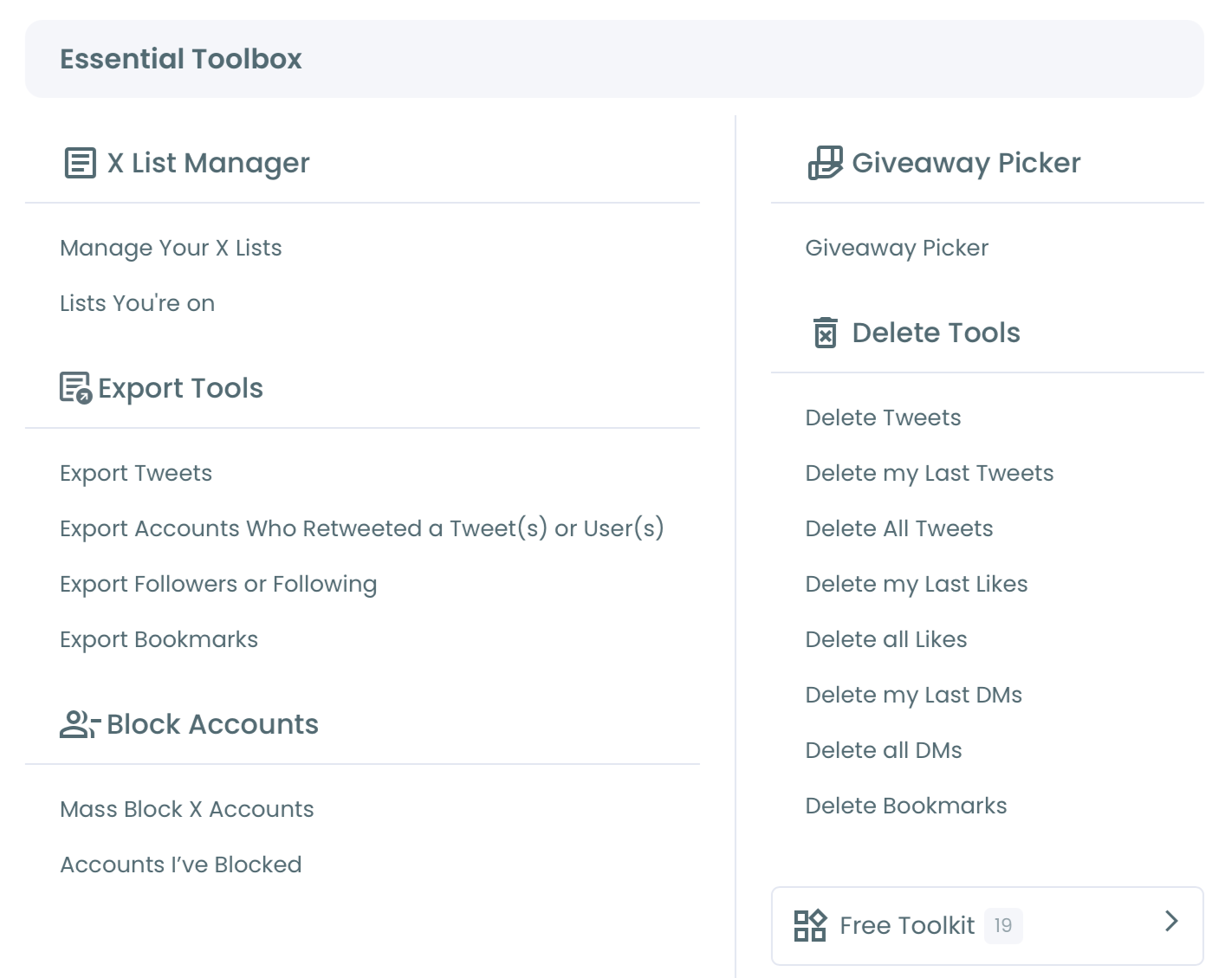
Request your X archive first if you have not already, from your X settings under Account and Your Archive. The archive can take 24 to 48 hours to generate, so start it before you plan to run the deletion.
Upload your like.js file
Upload the like.js file from inside your downloaded archive folder, not the full archive ZIP. Circleboom reads the file and displays the total number of liked tweets it found, including everything past the 3,200 API line.
Filter or clear everything, then approve
Leave every like selected for a complete wipe, or apply filters to narrow the set by date range, keyword, hashtag, media type, or like count. Add any liked post you want to keep to the Protect List so it survives the reset. Review the Approve and Delete count, then confirm to start the permanent removal.
Filtering is what turns a blunt wipe into a precise one. If only a specific year or campaign is the problem, a date filter clears that slice and leaves the rest of your history intact, which is smarter than deleting everything by reflex.
Video walkthrough: how Circleboom reads the archive and removes every like at once, including the ones older than your 3,200 API window.
What Changes After You Reset Your Like History
Your Likes tab becomes a clean slate. Every processed like is unliked at the X platform level, so anyone visiting your profile sees only what you deliberately protected, not years of accumulated endorsements.
The archive you downloaded stays as your private record. Nothing is truly lost, because the like.js file preserves the complete history locally even after the public tab is cleared. That separation matters: the public signal disappears, the reference you might want later does not.
For a brand or a professional account, this is a reputation reset rather than a chore. A clean engagement record removes the risk that an old like gets pulled out of context during a career move, a partnership review, or a moment of heightened public attention.
If your goal is broader, pair it with a full sweep of your posts through Circleboom's Delete All Tweets tools so both halves of your public record match.
Unlike manually hunting through a Likes tab that will not even load your oldest entries, Circleboom clears the complete history in one reviewed pass and keeps your account inside X's rules the entire time.
Delete All Likes vs Delete My Last Likes
The two tools solve different scopes of the same problem. Delete All Likes works from your uploaded archive and reaches your complete history, including everything past the 3,200 API line. Delete My Last Likes works from the live API and covers only your most recent 3,200 likes, with no archive upload required.
Pick Delete My Last Likes when the problem is recent activity. It is faster, needs no archive download, and clears the most visible slice of your Likes tab in a few clicks. If you liked something last week that you want gone today, this is the direct route.
Pick Delete All Likes when the problem is the depth of the history. A multi-year account carries thousands of likes the recent tool cannot even see, and those buried entries are usually the ones that surface in a screenshot later. When you need a true engagement reset rather than a quick tidy, archive-based deletion is the only method that reaches the full record.
You can also use both in sequence. Clear the recent window first with Delete My Last Likes, then run the archive pass to sweep the older history, so no era of your Likes tab is left behind.
Why People Clear Their Entire Like History
The reason is rarely one bad like. It is that the whole record has drifted out of sync with who the account is now, and a public Likes tab keeps that drift visible to anyone who scrolls.
The most common driver is a brand or professional reset. A creator, a founder, or a job seeker cleans years of endorsements before a period of heightened attention, so old associations cannot be pulled out of context during a review. Others do it purely for privacy, removing a browsable diary of interests, politics, and humor they never chose to publish.
A third group faces a practical wall. When problematic likes are scattered across so many dates and topics that reviewing them one by one is impossible, a full reset is simply the more realistic option. The archive route turns an impossible manual audit into a single reviewed pass.
What to Know Before You Clear Your Likes
Can I really delete likes older than the 3,200 limit?
Yes, and that is the entire point of archive-based deletion. Uploading your X archive's like.js file gives Circleboom access to your full like history, so it removes likes far beyond the recent 3,200 that the API alone can reach.
Is clearing my entire like history reversible?
No, like removal is permanent, so review before you confirm. Your downloaded X archive becomes the only remaining record of the cleared likes, which is why you should keep that file safe and check the Approve and Delete count before starting.
Do I have to delete every like, or can I keep some?
You can keep specific likes using the Protect List. Add any liked post you want to survive the reset, then run the deletion, and Circleboom clears everything else while leaving your protected entries in place. This is how a full history reset still keeps partner endorsements, customer posts, or milestone likes.
How long does the archive take to arrive?
X can take 24 to 48 hours to generate your archive after you request it from your settings. Request it before you plan to run the deletion, since the like.js file inside that archive is what unlocks your full history past the 3,200 limit.
Your Next Move
Choose your path based on scope. If only your recent activity is the concern, a quick recent-likes cleanup covers the visible window without an archive upload. If your oldest likes are the ones you actually worry about, the archive route is the only one that reaches them, so that is the one to run.
Most people who came looking to clean their Likes tab want the second path, because the likes that embarrass you later are almost always the forgotten ones. When you are ready to close that exposure for good, you can remove your full Twitter like history in one archive-based pass.
Circleboom handles the neighboring jobs too. When you are cleaning up in bulk, run a full delete your retweets sweep, or a targeted delete Twitter likes on iPhone pass when you are away from your desk.
For deeper reading, see the fastest way to unlike every tweet you have ever liked and a plain-English walk through how to delete Twitter likes. It also helps to know how to download Twitter likes before you clear them, plus a rundown of the best app to delete Twitter likes at once.