
You can delete all tweets on Android from the phone already in your hand. What stops people is never the deleting itself. It is one file that X packs inside a ZIP and only releases a day or two after you ask for it.
I spent far too long treating the phone as the compromise version of this job. It is not. The tool is the same tool, the filters are the same filters, and exactly one step in the sequence behaves differently because of the device.
Once you know which step that is, a cleanup you have postponed for two years becomes an afternoon of light attention.
Can you really delete all your tweets from an Android phone?
Yes. Circleboom is a browser tool rather than an app you install, so Android Chrome loads the same Delete Tools menu and the same filter panel a desktop gets. Circleboom removes posts, reposts, and replies on X in bulk, working either from your live timeline or from an archive file you upload.
→ delete all tweets on Android
How I delete all tweets on Android, step by step
The whole run happens inside one browser tab, and the order of the steps matters more than the hardware you run them on.
On screen: the delete run executing against a connected X account, with filters applied and the count confirmed before a single post is removed.
https://www.youtube.com/watch?v=L8_zgq5b6nk
The sequence I use now, in order.
Get the account connected before you touch a single filter
- Log in to Circleboom Twitter on your phone and approve the profile you intend to clear from the official permission screen.

- Open the Essential Toolbox menu. Circleboom groups every delete tool for X underneath it.
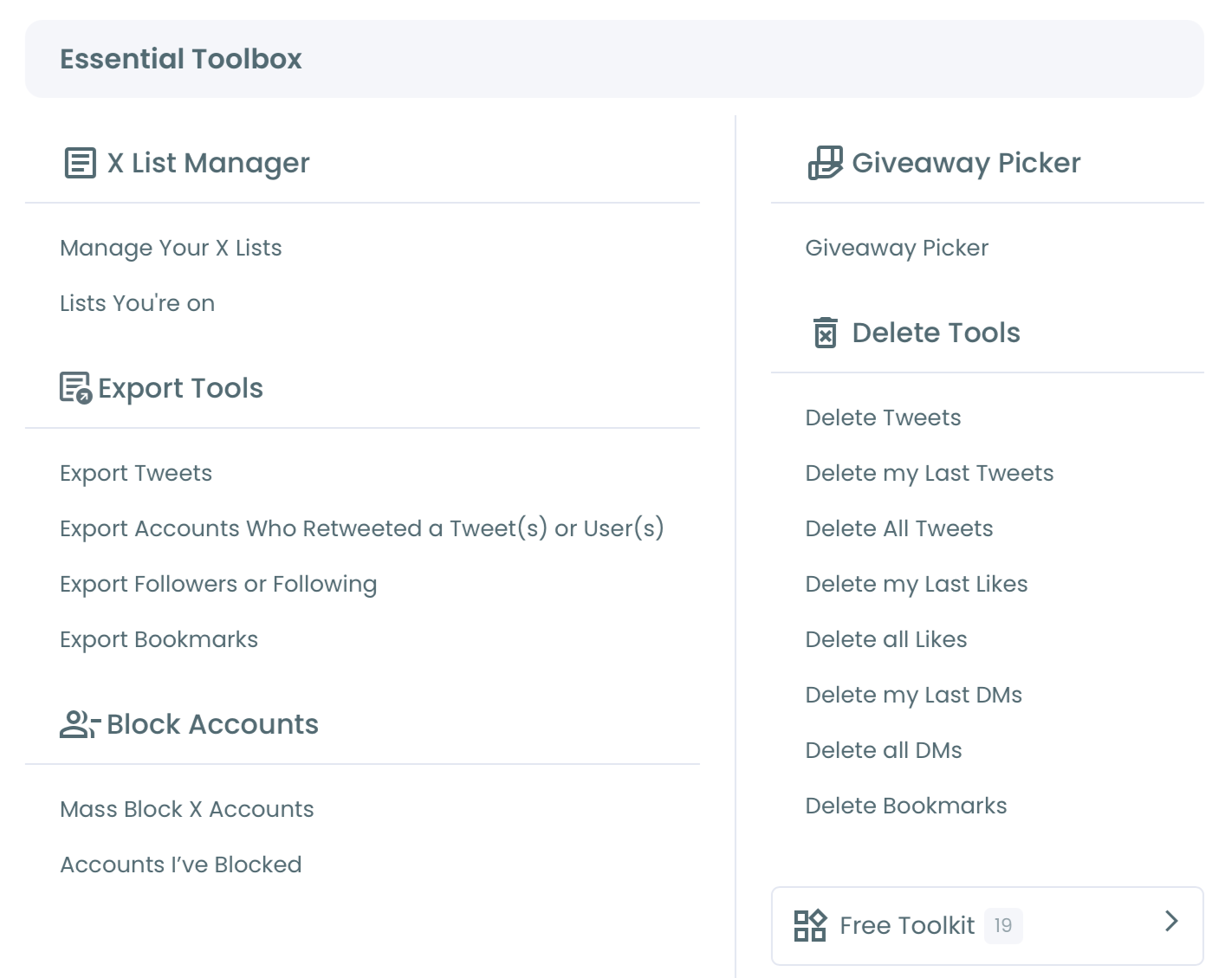
- Pick your route inside the Delete Tools group. Delete My Last Tweets works straight from the API and asks for no file at all. Delete All Tweets asks for your archive and reaches everything older.
Narrow the run before you let it touch anything
- Tap Filter Options and set the scope. This panel is where the job stops being all-or-nothing and starts being a decision.
- Export the list as CSV before you delete a thing. The Export button on the same page shows how many export tokens you have left, and that file becomes the only record of what you removed.
Confirm the number, then let the tab finish the job
- Read the count on the delete button before you press it. Delete Selected carries the exact figure in its own label, while Delete All clears every post currently loaded into the table.
- Keep the tab in front of you until the run reports finished. X paces bulk deletion through its own rate limits, so a large job takes real time, and closing the tab stops it mid-queue.
That order is what keeps the run honest. Connecting first earns official API access, filtering second shrinks what you are about to lose, and exporting third leaves you the only copy of it you will ever hold.
Quick recap: connect, open Delete Tools, filter, export, read the count, then leave the tab alone.
What actually changes when the screen is a phone
One thing changes, and it is not the tool.
Circleboom runs in the browser, so there is no Android package to install, no Play Store listing to hunt for, and no reduced mobile feature set to learn around. The menus load in Chrome on a phone the way they load on a desktop.
That is a deliberate choice, and the team has been making Circleboom more mobile friendly around it for years.
The difference is file handling.
A desktop has a downloads folder you can see, a ZIP you can double-click, and a file picker that shows you everything. Android has all three, but each one takes an extra tap and lives somewhere less obvious.
That is the entire device gap.
If you never need the archive file, the gap closes completely, and you can clear your entire tweet history without leaving the phone. If you do need it, budget one extra step rather than one extra device.
The same split shows up for anyone trying to delete all tweets on iPhone. The constraint belongs to the archive format, not to the operating system.
Why your post count picks the route, not your device
X's API returns at most 3,200 recent posts and nothing behind them, and that ceiling decides everything about how your cleanup will feel.
Delete My Last Tweets loads that window directly.
No archive, no upload, no file manager. You get a table of your posts where creation date sits beside every metric X reports, from impressions down to bookmarks, and you can filter and manage your X posts right there.
Delete All Tweets is the archive route, and it exists because the 3,200 ceiling leaves long-running accounts mostly untouched.
Work the number out for your own account before you pick a route.
Someone posting twice a day for six years sits near 4,380 posts.
The API route reaches the most recent 3,200 of those and leaves roughly 1,180 of the oldest ones standing.
For most people that leftover slice is exactly the period they wanted gone, which is why the count matters more than any feeling about how much you have written.
The same logic drives every decision about how to mass delete tweets based on popularity, where ranking beats raw volume.
The filters that keep a phone run precise
Filtering is what turns a frightening button into a controlled operation, and every filter is available on a phone screen.
The archive-side panel gives you these controls:
- Post type checkboxes for tweets, reposts, and replies, all checked by default.
- A Protect List that holds named posts back from an otherwise complete wipe.
- Date range, where both the start and end dates are included in the run.
- Like count and repost count ranges, with the highest value in your file shown for reference.
- Keyword, language, and media filters, matching post text, mentions, hashtags, and attachments.
The Protect List is the control most people discover too late.
It lets a full reset keep the handful of posts that still earn their place, which is the difference between clearing a timeline and losing a testimonial.
Anyone who has worked through deleting low-engagement tweets on mobile already knows how much of a cleanup is really a selection problem.
Requesting the X archive from the Android app
The archive request is fully native on Android, which surprises people who expect a desktop-only flow.
X documents the mobile path in its own help center. Tap your profile icon, open Settings and privacy, choose Your account, then select Download an archive of your data and confirm your password.
The request goes in from the phone. The wait is the same 24 to 48 hours it takes anywhere else.
Here is the detail worth reading twice.
X's own help page says the delivered file lets you view your data in a desktop web browser. The archive is built as a desktop artifact, which is exactly why the phone version of this job has one awkward step and not five.
When the notification arrives, the download is a ZIP. Android opens it without extra software, and Google documents the flow for unzipping files on Android: find the ZIP, tap it, then tap Extract.
Inside the extracted folder, one file matters. Upload tweet.js and nothing else. The Twitter archive eraser reads that single file rather than the whole bundle, and it has to belong to the account linked to your subscription.
Start there when you want to delete all tweets on Android with nothing left behind the API ceiling. If you are still weighing approaches, the rundown of best methods to delete tweets covers the trade-offs each route carries.
Is it safe to delete all your tweets on Android?
Yes, provided you understand what safe means here. The account is not at risk. The posts are.
Every deletion runs through official platform access rather than a scraper or a browser script. Circleboom is an official X Enterprise Developer company, working inside the same rules X publishes for everyone.
Your credentials never leave the authorization screen, and nothing about the operation puts your account standing in question.
What is genuinely irreversible is the content. There is no undo. The CSV you pulled beforehand becomes your sole account of what disappeared, which is why the export step sits ahead of the delete step rather than after it.
One thing survives no matter which route you take.
Reposts, quotes, and replies made by other accounts referencing your deleted posts remain on their timelines, because that content belongs to them. The same asymmetry catches people deleting replies on Twitter from a phone, where the conversation half you did not write stays exactly where it was.
What the timeline looks like once the run finishes
The profile stays. The posts do not.
Your account keeps its handle, its follower relationships, its join date, and its verification state, because none of that lives in the posts you removed. What changes is the timeline itself, which renders either empty or reduced to whatever you held back with the Protect List.
Every removed post takes its own metrics with it. The text, the attached media, the like and repost counts, and the impression history all stop being reachable from your profile, because they were attributes of a post that no longer exists.
Three shapes of result are common, and they map to how tightly you filtered:
- A complete reset, where the profile is live but the timeline shows nothing.
- A date-bounded clear, where everything before a chosen year is gone and recent posts remain.
- A type-bounded clear, where reposts and replies disappear while your original writing stays.
Decide which of the three you want before you press anything, because that decision is the filter panel's entire job and it cannot be revisited afterward.
What this changes
The pushback I get most often says a cleanup this permanent deserves a proper desktop session, so it gets scheduled for a weekend that never comes.
That instinct is understandable and it is also why so many timelines still carry a decade of posts nobody wants. The phone is not the risky version of this job.
The risky version is the one that keeps getting deferred while the content stays indexed and searchable.
You control the risk with filters and the export, not with the size of your screen. Set the scope, pull the CSV, read the count, then let it run.
Every control that makes this decision safe on a desktop is on the phone screen too, including the Protect List, the date bounds, and the confirmation count.
The one thing a laptop genuinely gives you is a faster path from a ZIP to a file picker, and that step only exists at all if your history reaches past the API window.
Check your post count first. It will usually tell you that the weekend session you have been waiting for was never required.
The questions that follow
Do I need to install anything on my Android phone?
No. Circleboom runs entirely in the browser, so Chrome on Android is enough for the connection, the filters, and the deletion itself. The only app you might open is a file manager, and only if you take the archive route.
What happens if my phone locks in the middle of a run?
Posts already removed stay removed, because each deletion is committed at the platform as it happens. The remaining queue stops rather than continuing in the background, so keep the tab in the foreground and the screen awake for a large job, then reload and start a fresh pass if it stalls.
Can I do this without the X app installed at all?
Yes. Circleboom needs only a browser, and X's help center documents the archive request on the web as well as in the mobile app, so x.com in Chrome covers the one step people assume the app is required for. The extraction still happens in whatever file manager your phone already has.