
X's API reaches only your 3,200 most recent tweets, and everything older sits beyond an ordinary cleanup tool's reach. That single number decides how you delete tweets older than a specific date, so find out where your cutoff falls before you touch anything.
Three answers before you delete anything.A 30-second rule that tells you which Circleboom delete tool matches your cutoff date.Exact steps for the API route (no archive needed) and the archive route (tweet.js upload).The safeguards that keep a dated purge controlled: export first, the Protect List, and the Approve & Delete count.
Circleboom deletes tweets older than any cutoff you set on X, working through X's official API from start to finish. Set your first cutoff from the delete tweets older than a specific date page.
Why Delete by Date Instead of Deleting Everything
The tweets that age worst are rarely the recent ones. Old jokes drift out of context, abandoned opinions get screenshotted, and posts from a previous version of you get dug up at the worst possible moment.
A full account wipe overshoots the problem. It throws away threads that still earn clicks, proof of past work, and the engagement history that makes an account credible.
The risk lives in the old content; the value lives in the recent content.
A cutoff date separates the two cleanly.
Circleboom draws that line for you on X: pick the date, and the filter catches every post published before it while leaving everything after it untouched. If that is the timeline you want, you can remove tweets published before a chosen date in one filtered run.
No scrolling, no deleting post by post.
Choosing the date is strategy, not admin. Anchor it to a boundary you can name: the day you changed roles, the month a rebrand went live, the point where your current voice took over the account.
A cutoff tied to a real event beats an arbitrary round number.
Settle one more thing before committing: permanence. Deletion at the platform level is final no matter which tool performs it.
The recurring questions around that finality are answered in can you permanently delete tweets.
Which Delete Tool Handles Your Cutoff Date?
The rule takes 30 seconds: if your cutoff date falls inside your most recent 3,200 tweets, use Delete My Last Tweets; if it falls anywhere earlier, use Delete All Tweets with your X archive. Nothing else about the process matters until that question is answered.
The 3,200 figure is X's boundary, not Circleboom's. The platform's X API timelines documentation caps live retrieval at the most recent 3,200 posts per account.
Older content still exists; the live connection cannot see it.
The math is quick. At five posts a day, 3,200 tweets cover roughly 21 months. At ten a day, closer to 10 months.
A practical check removes the estimating. Open Delete My Last Tweets and set its Date filter to end at your cutoff: if posts from before that date appear in the list, the API window reaches your target.
If the filtered list comes back empty while older posts remain visible on your profile, the cutoff sits beyond the window, and the archive becomes the only complete path. The deep-history case gets a fuller treatment in delete tweets from years ago.
Both routes live inside Circleboom's delete all tweets toolset, and both end at the same place: a timeline that begins on the date you chose.
One Dashboard, Both Routes
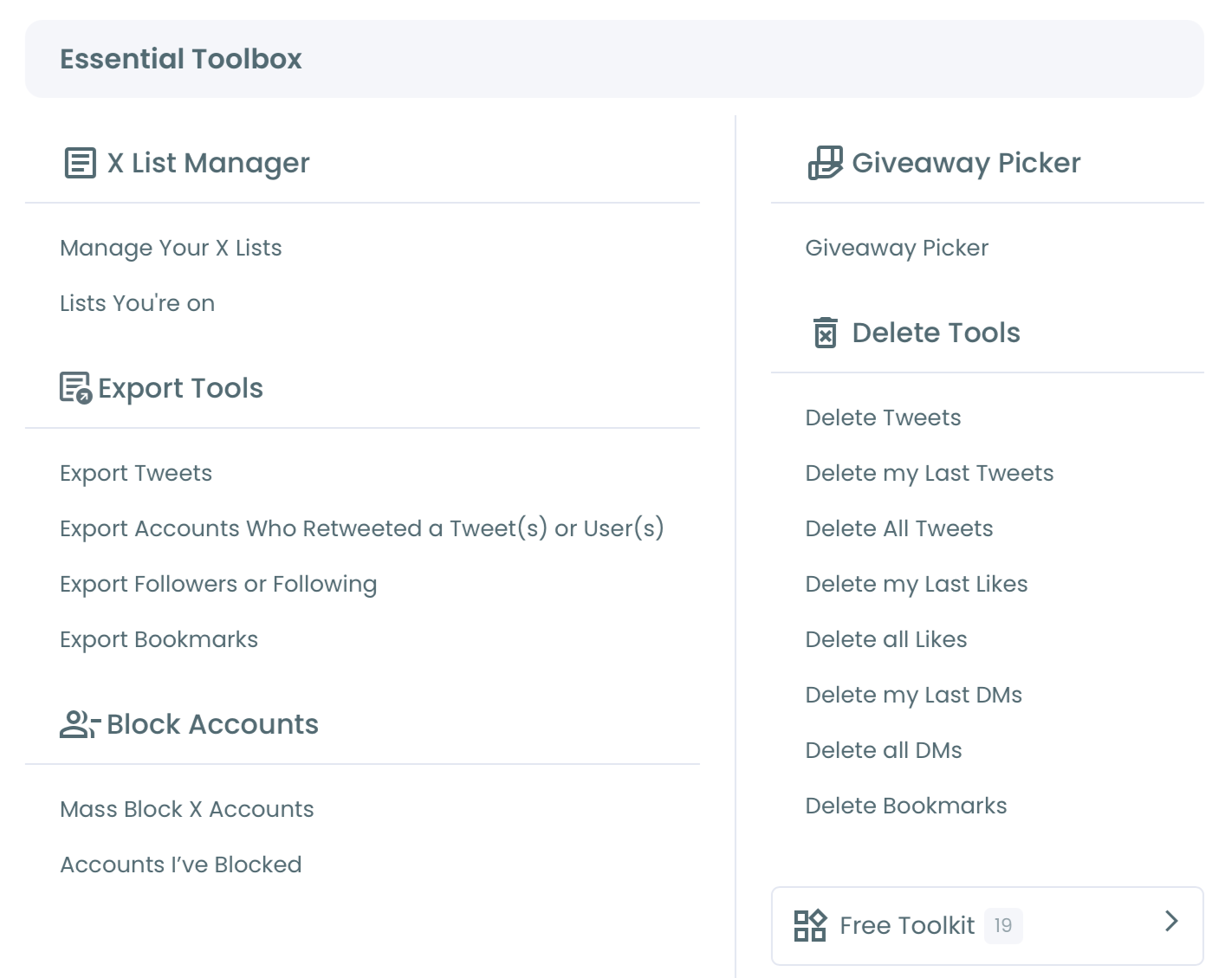
Delete My Last Tweets and Delete All Tweets sit side by side under Essential Toolbox in the Circleboom Twitter dashboard, sharing the filter design that makes a date cutoff practical instead of theoretical.
Circleboom holds official X Enterprise API access, so every deletion travels through X's sanctioned pipeline rather than scraping or session tricks. For an operation this destructive, that distinction is the safety story: your account stays inside platform rules while the bulk work runs.
Date is the headline filter, but the supporting filters decide how smart the cleanup gets. Four more stack on top of the date window:
- Keyword, username, or hashtag matching.
- Language.
- Media type.
- Engagement ranges (likes and retweets in both tools; replies and impressions on the API route only).
Cap the like count before selecting, and your proven posts survive the purge while the forgettable ones go. I treat that one setting as the difference between a cleanup you celebrate and one you regret.
Open either tool from the delete tweets by date page and you can be filtering in minutes.
For a compressed version of the same workflow, how to delete tweets by date makes a good companion read.
Watch the date filter do the work: a cutoff set in Circleboom, and every tweet older than it cleared in a single run.
https://www.youtube.com/watch?v=sRl1DYsR_tg
How to Delete Tweets Older Than a Specific Date, Step by Step
To delete tweets older than a specific date, log in to Circleboom, open the delete tool that matches your cutoff, set the date filter, and confirm after reviewing the final count. The first phase below handles cutoffs inside your last 3,200 tweets; the second continues into archive territory for anything older.
Run only the phase your date calls for.
Clear the recent window with the API date filter
- Log in to Circleboom Twitter and authorize the X account you want to clean.

- Open the Essential Toolbox menu and choose Delete My Last Tweets under Delete Tools.
- Click Filter Options and set the Date filter to run from your earliest loaded tweet through your cutoff date. Every loaded post arrives pre-selected, so the filter is what narrows the scope.
- Review the filtered table, deselect anything worth keeping, and run Export if you want a CSV record. The export is your only recovery reference once posts are gone.
- Click Delete Selected and let the batch finish. Deletion is permanent from the moment each post processes.
Go through the archive when the cutoff sits deeper
- Request your data archive from X settings; the platform's how to download your X archive guide covers the request. Expect a 24 to 48 hour wait while the file generates.
- Locate the tweet.js file inside the archive folder and upload only that file to the Delete All Tweets wizard. It must come from the same X account linked to your Circleboom subscription.
- Set the Delete by date filter: Start and End default to the first and last tweet dates in your file, so keep Start in place and move End Date back to your cutoff. Both dates are inclusive, and boundary-day posts are caught too.
- Add any posts you want to keep to the Protect List, then read the Approve & Delete panel. It shows the exact count of tweets, retweets, and replies about to go; if that number surprises you, recheck the dates.
- Click Delete my Tweets to confirm. Keep the browser tab open while large batches run, because the X API paces bulk deletions.
That ordering carries the safety: the date filter defines scope before anything is committed, the export and Protect List preserve what matters, and the Approve & Delete count gives you one last honest number before the run turns permanent.
At a glance: cutoff inside 3,200 means the API date filter; anything older means tweet.js upload, an inclusive date range, protected keepers, and a reviewed count.
If precision matters less than speed, the one-click approach in Twitter archive eraser trades the date filter's control for a faster wipe.
What a Dated Cleanup Changes
The visible payoff is a timeline that starts where you decided it should. Anyone who scrolls your profile (a hiring manager, a journalist, a prospective client) reaches your chosen date and finds nothing older to quote.
The account keeps its followers, its age, and its handle; only the record before the line is gone.
The archive route also leaves you a repeatable setup. Circleboom removes already-deleted posts from the file before applying new filters, so the same tweet.js can be uploaded again for a different pass: a date window today, a keyword sweep next month, with no double processing.
Reach is the other common question. Deleting changes what is on the record, not automatically what the record earns, and does deleting tweets affect the algorithm separates what deletion fixes from what it does not.
And when the goal is age-based pruning rather than a single hard line, the delete old tweets page works the same archive year by year.
The Date Decides the Tool
A tweet history you would not stand behind today is a liability with a timestamp. Clearing it takes one decision rather than a hundred: pick the date, check which side of 3,200 it falls on, and run the matching tool.
→ Clear every tweet older than your cutoff date
Frequently Asked Questions
How long does it take to delete tweets older than a specific date?
The deletion itself runs from minutes to a few hours depending on volume; the real wait is the archive. The API route starts immediately, while the archive route adds the 24 to 48 hours X takes to generate your file, plus processing time paced by API limits on large batches.
Do I need a fresh archive for every cleanup run?
No. You can re-upload the same tweet.js file for as many filter runs as you like, and Circleboom automatically excludes posts it already deleted. You only need a new archive to cover tweets published after the old file was generated.
What happens to other people's replies and retweets of my deleted posts?
They can remain on X. Replies and retweets from other accounts are third-party content, so deleting your original does not remove what others posted around it, and no tool can delete content that belongs to someone else's account.
Can I recover a tweet after the cutoff run deletes it?
No. Deletion through the X API is permanent, and Circleboom has no undo. Your export CSV or the archive file on your computer is the only record left, and reposting manually from that file is the only way to bring content back.