
You can delete tweets posted in a specific month by setting a date-range filter to that month's first and last day, then bulk-deleting everything inside the window. Circleboom handles this in a few clicks through the official X API, so one bad month, one campaign month, or one stretch you would rather scrub comes off your timeline without touching anything outside it.
The hard part on X itself is that the platform gives you no month switch. You either scroll forever or you reset the whole account. A date filter solves the middle ground that X skips.
How do you delete only one month of tweets without deleting the rest?
You point a date-range filter at that month's start and end dates, preview the matches, and bulk-delete. Circleboom is an official X Enterprise Developer company that loads your tweets through the official API and lets you delete tweets posted in a specific month without resetting your archive.
→ Delete tweets from a single month
Why a Single Month Is the Hardest Thing to Delete on X
X is built around two extremes: delete one tweet, or delete your account. There is nothing between them. When the content you regret is concentrated in one stretch of time, neither extreme fits.
A specific month carries weight that a random scroll-back cannot. Maybe it was the month a campaign went sideways. Maybe it was a stretch where the tone drifted off-brand. Maybe a job interview is coming and one calendar month of old posts no longer matches who you are now. The boundary you care about is a date boundary, and X gives you no way to draw it.
Manual deletion fails here for a specific reason. You cannot tell at a glance whether a tweet falls inside or outside your target month, so you end up checking timestamps one tweet at a time. On an active account that is hundreds of clicks, and a single misread date means you either miss a post you wanted gone or remove one you wanted to keep.
The cleaner approach treats the month as a filter, not a scroll. That is the difference between an afternoon of manual work and a 60-second operation. If you want the broadest version of this, you can also filter and delete tweets by date across any custom range, not just a calendar month.
It also helps to compare your options before you commit. There are several routes to clearing posts, and the trade-offs between speed, scope, and recovery matter once a deletion is permanent. A rundown of the best methods to delete tweets lays out which approach fits which cleanup, so you pick the right one for a month-sized job rather than a full reset.
How Circleboom Targets One Calendar Month
Circleboom loads your tweets into a filterable table and lets you set a date range down to the exact day. To isolate June, you set the start date to June 1 and the end date to June 30, apply the filter, and the table shows only that month's posts. Everything before and after stays untouched.
The feature retrieves up to your most recent 3,200 tweets directly through the API, which covers recent months without any archive upload. As an official X Enterprise developer, Circleboom pulls this data through sanctioned access rather than scraping, so your account stays compliant the entire time.
Here is the part most month-deletion guides skip. The date filter stacks with engagement filters. If your target month had a couple of posts that actually performed well, you can set a minimum like or retweet threshold so those survive while the rest of the month clears. You delete the weak month without losing the one post from it that still earns impressions. That is precision X cannot offer at all.
You can launch the bulk tweet deleter for a specific month and have the window narrowed before you commit to anything.
What the Filtered Table Actually Shows
When the month loads, you do not just see a count. You see a table with one row per tweet and a column for each metric that decides whether a post is worth keeping.
Each row carries the tweet text, plus Impressions, Likes, Retweets, Quotes, Bookmarks, and Replies, with a Created At stamp that shows the date, the time, and the relative age. That last column is how you confirm a post sits inside your target month at a glance rather than guessing from a timestamp.
The filter panel that drives all of this is wider than a single date box. Beyond the date range, you can narrow by post type, by minimum and maximum counts on every engagement metric, by language, by keyword or hashtag, and by whether the tweet contains media. For a month cleanup the useful stack is usually two filters: the date range to draw the window, then one engagement floor to spare your best post.
One detail trips people up. The page loads with every tweet pre-selected by default. If you set the date range but forget to apply it, Delete All would clear the whole loaded window, not just your month. Apply the filter first, watch the count drop to the month, then act. The bulk delete tweets workflow follows the same filter-before-select discipline at any scale.
How to Delete Tweets From a Specific Month with Circleboom
The flow below isolates one calendar month and clears it through the official API, with an export safety net before anything is permanent.

Log in and load your recent tweets
- Log in to Circleboom Twitter and connect your X account through official OAuth.
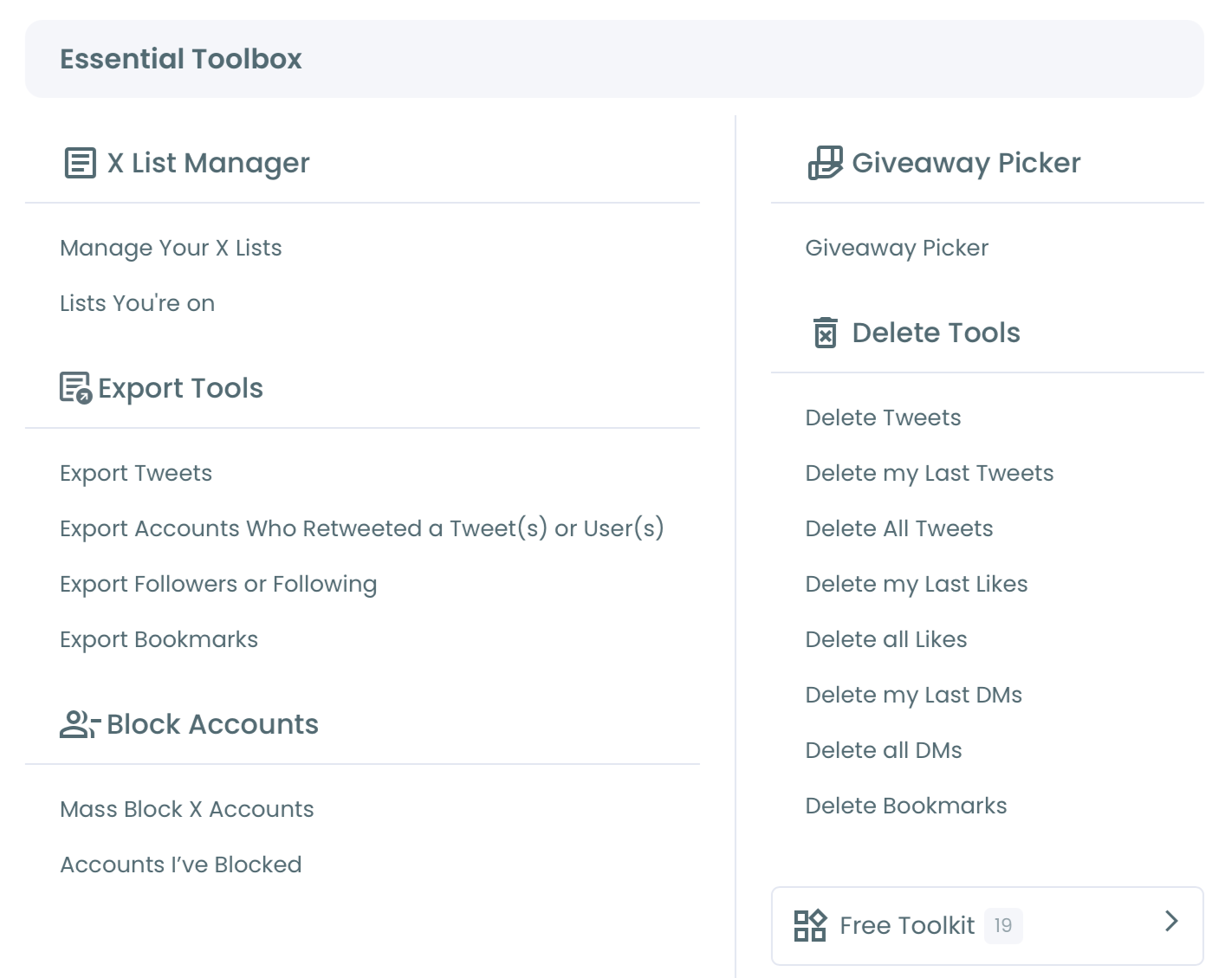
- Open the Delete Tools inside the Essential Toolbox menu and let Circleboom load up to your last 3,200 tweets.
Filter to the month and protect what matters
- Set the date range to the first and last day of your target month, then apply the filter so only that month's posts remain.
- Add an engagement filter if any post in that month performed well, setting a minimum like or retweet count so high-value tweets stay.
- Export the filtered list as CSV first, so you keep a record of exactly what is about to be removed.
Review and delete
- Review the previewed tweets, confirm they all fall inside your chosen month, and run Delete Selected.
That order matters because each step protects the next. The login earns official-API access, the date filter draws the month boundary X refuses to draw, the engagement filter saves your best posts, and the export gives you the only recovery path that exists after deletion. Skip the export and a deletion that runs broader than intended has no undo.
At a glance: connect, load, set the month, protect high performers, export, delete.
Short demo: setting the exact start and end dates that fence off a single month before deletion.
What Changes After the Month Is Gone
The visible result is a timeline that reads continuously, with the problem stretch removed and the rest of your history intact. A visitor scrolling your profile never sees the gap because the surrounding months still tell your story.
The deeper change is control over how your account presents in time. Recent tweets are the first thing a partner, recruiter, or new follower sees, so removing one off-brand month directly shapes that first impression. Cleaning a low-performing month can also help here, since deleting old tweets can lift your reach by concentrating your profile around content that still resonates.
Speed is the other payoff. A month that would take an afternoon of manual scrolling clears in under a minute once the filter is set. The same workflow that lets you delete tweets within seconds applies whether the month holds 20 posts or 200, and the boundary stays exact regardless of volume.
If the month you cleared predates your most recent 3,200 tweets, you will need the archive route instead. The API window only reaches so far back. For those deeper cleanups you can delete old tweets by year using your X archive file, then apply the same date discipline to any month inside it.
The engagement angle scales too. Say the month you want gone was mostly weak content. The same workflow that helps you delete low-engagement tweets fast and safely applies inside a month window, just with a tighter date boundary around it.
One operational note matters once the volume climbs. A large month deletion is paced by the X API, so the batch can take time and the browser tab needs to stay open until it finishes. That is normal, not a stall. If you want the CSV record before you run anything, the export button shows a remaining-token count, so the safest sequence is to export your tweets as a backup first, then delete.
Summary
Deleting tweets from a specific month is a date-filter problem, not a scroll problem. You fence the month with a start and end date, protect any high performers inside it with an engagement filter, export a backup, and clear the rest in one pass. Circleboom does all of this through official X API access, so the cleanup is precise and your account stays safe.
The result is a timeline you actually want people to read, with one regretted month gone and everything else exactly where it was.
→ Clear a single month of tweets now
Questions Readers Ask
Can I delete tweets from just one month without affecting older posts?
Yes. The date-range filter targets only the start and end dates you set, so a June 1 to June 30 window removes that month alone and leaves every other month untouched.
What if my target month is older than my last 3,200 tweets?
The API loads your most recent 3,200 tweets, which covers recent months directly. For a month further back, upload your X archive and apply the same date filter to reach the full history.
Can I keep the good tweets from a month I am deleting?
Yes. Stack an engagement filter on top of the date filter and set a minimum like or retweet count, so strong posts from that month survive while the rest clears.
Is deleting a month of tweets reversible?
No. Deletion through the X API is permanent, which is why exporting the filtered list as a CSV before you delete is the recommended safety step.
Can I filter the month by something other than dates and engagement?
Yes. The same panel lets you narrow by post type, language, keyword or hashtag, and whether a tweet has media. You can stack any of these on the date window, so a single month can be cleared by topic or post type rather than wholesale.