

You want to delete replies to a specific Twitter account, but every deletion tool you open treats your replies as one giant bucket. That is the root of the frustration: the standard "delete all replies" switch clears every conversation you have ever joined, when the only thread you actually want gone is the back-and-forth with one handle.
The fix is not a bigger delete button. It is a narrower filter. You isolate the replies aimed at one account first, confirm the list, then remove only those.
Can you delete only the replies you sent to one specific account on X?
Yes. Circleboom stacks two filters, Post Type set to Reply and Keyword set to that account's @username, so only your replies to that one handle load into a preview list before anything is removed, all through official X Enterprise APIs. Nothing else on your timeline is touched.
→ delete replies to a specific Twitter account
Most tools that surfaced when you searched this problem stop at a single "Only Replies" toggle. That toggle is the wrong resolution for your need.
It answers "delete all my replies," not "delete my replies to @thatoneaccount," and the gap between those two intents is exactly where accounts get over-cleaned.
Why "Delete All Replies" Is the Wrong Tool Here
A reply on X always contains the @mention of the account you replied to. That single fact is what makes precise targeting possible, and it is what the blunt tools ignore.
When you reply to an account, X writes that account's handle into the reply text as the first token. Reply to `@brandsupport` fifty times over a rocky support week, and all fifty of your replies carry the string `@brandsupport` inside them.
So the account you want to clean is already tagged, permanently, in every reply you sent it.
The blunt approach throws that signal away. It groups your 50 replies to `@brandsupport` with your 900 replies to friends, clients, and threads you actually want to keep, then deletes the whole pile.
You lose your entire conversational history to solve a problem that involved one handle.
The precise approach keeps the signal and filters on it. You tell the tool: show me only replies, and only the ones that contain `@brandsupport`. What loads is the exact subset, nothing more.
This matters beyond tidiness. Your reply history is a record of who you talk to and how you show up in public.
Nuking all of it to erase one conversation is the social-media equivalent of burning the filing cabinet to shred one folder. Circleboom lets you clear your replies to a single Twitter account precisely because it treats the @mention as a filter, not noise.
The Solution and How the Two-Filter Stack Works
Circleboom retrieves your recent posts through the official X API and lays them out as a filterable table, then hands you the two controls that isolate one account: Post Type and Keyword. Circleboom is an official X Enterprise Developer company, so the whole operation reads and removes your posts through sanctioned access, not a scraper working around the platform.
The mechanism is simple once you see the two filters together:
- Post Type = Reply strips out your original tweets, retweets, and quotes, leaving only replies in view.
- Keyword = @username narrows those replies to the ones that contain the target account's handle.
Run both and the table collapses to your replies to that one account. You preview the exact list, then delete. Because deletions on X are permanent, that preview step is the safeguard: you confirm the scope on screen before a single reply is removed.
Compared with scrolling your own profile, hunting for the reply arrows, and deleting each one by hand until you lose your place, the two-filter stack surfaces the entire set in one view and removes it in a paced batch. You never guess whether you missed a few.
The delete replies to a specific Twitter account workflow is the fast, controlled path.
Keyword walkthrough: watch the Post Type and Keyword filters narrow a full reply list down to one account before deletion.
The two-filter stack is the whole method, in order.
Load your replies and open the filters
- Log in to Circleboom Twitter and connect your X account with official OAuth.

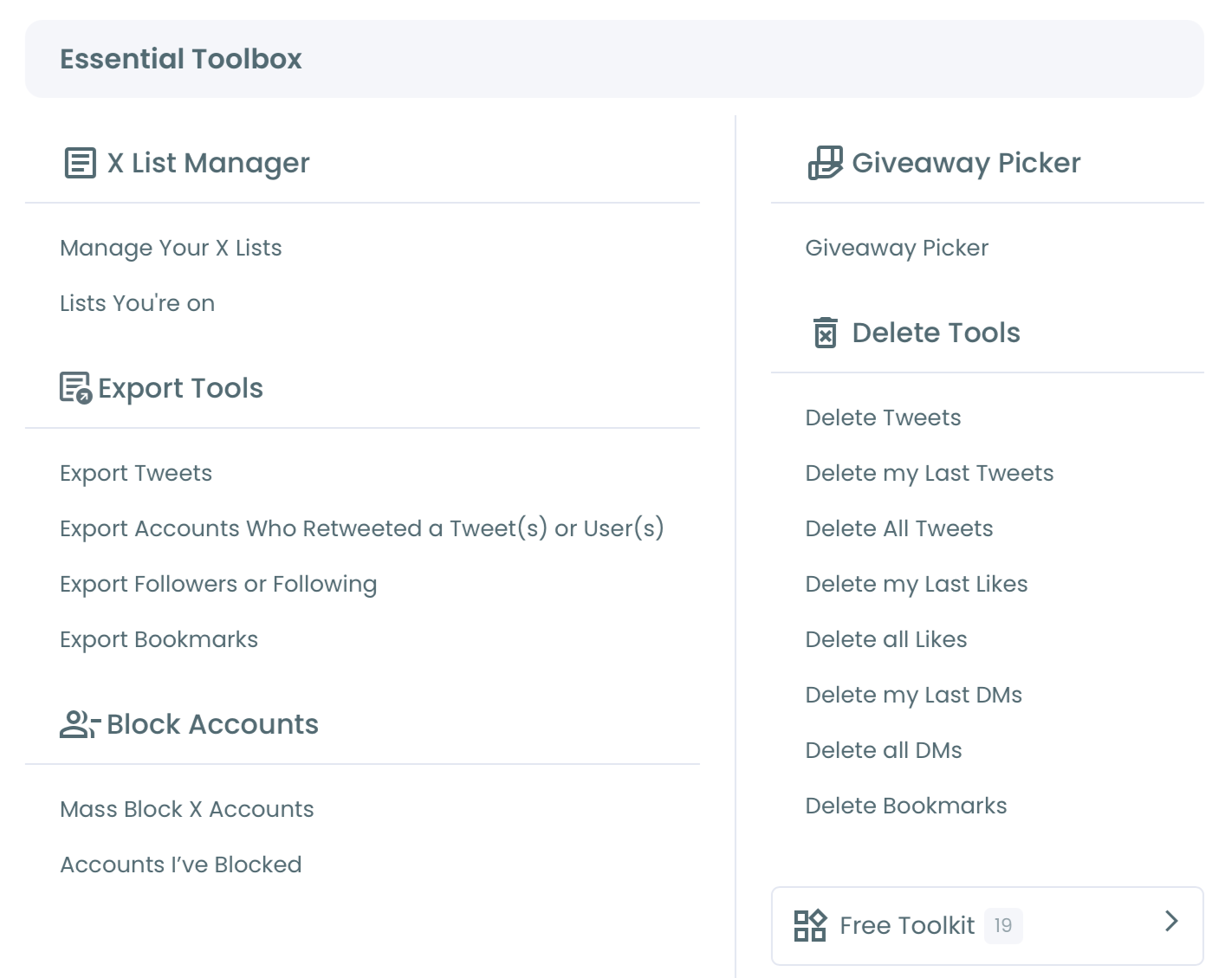
- Open the Essential Toolbox menu and launch the Delete tools, which load up to your last 3,200 posts from the live API.
- Click Filter Options to open the panel where both filters live.
Stack the two filters and confirm before deleting
- Set Post Type to Reply so original tweets, retweets, and quotes drop out of the list.
- Set the Keyword filter to the target @username (type the handle exactly, including the @) so only replies containing that account load.
- Apply the filters, review the previewed list, then delete the isolated replies once the scope on screen matches what you intended to remove.
That order is what keeps the operation safe. The login earns official-API access, Post Type removes the bulk of your posts, the @username keyword narrows to one account, and the on-screen preview is your last check before a permanent action.
Skip the preview and you risk removing a reply you meant to keep.
At a glance: connect, load replies, set Post Type to Reply, add the @username keyword, preview, delete. High-engagement replies stay protected if you add an engagement floor before selecting.
What You Get After Cleaning One Account's Threads
Your public reply record loses one conversation and keeps everything else intact. A visitor scanning your profile no longer trips over the thread you wanted gone, while your replies to clients, collaborators, and communities remain exactly where they were.
This is the outcome the blunt tools cannot give you. They force a choice between keeping the bad thread or losing all your replies.
The two-filter stack removes that trade-off entirely, which is the real information gain here: precision replaces the all-or-nothing switch.
There is a strategic read too. Marketers and creators often need to prune a soured brand interaction or a heated exchange before a partnership review, a job search, or a public moment, without erasing the goodwill they built in hundreds of other replies.
Surgical removal protects reputation without erasing history. If a few of those replies to the target account still carry real engagement and you would rather keep them, an engagement filter set before selecting will exclude them from the batch.
Once the reply cleanup is done, the same filtered approach carries over to related cleanups. You can remove tweets that mention a specific handle when you want to clear posts that tag the account rather than reply to it, or delete tweets that contain a specific keyword when the thread revolved around a phrase instead of a handle.
Where This Fits in a Wider Cleanup
Replies are one slice of your public footprint, and the same @username logic scales to the rest of it. A reader who cleans replies to one account is usually eyeing a broader tidy-up.
If the conversation you want gone lives in the easy way to delete replies on Twitter, that walkthrough covers the reply-specific mechanics in more depth. When tags rather than replies are the problem, the guide on how to delete Twitter mentions shows the mention-side of the same filter.
For the wider picture, the rundown of the best methods to delete tweets compares approaches across post types. And if you are wondering whether the cleanup helps beyond one thread, the piece on how deleting old tweets increases reach explains why a leaner timeline can lift your account overall.
Each of those is a different filter on the same underlying idea: the data you need to target precisely is already inside your posts. You just need a tool that reads it through sanctioned access and lets you act on it.
The Objection Worth Answering Before You Start
The hesitation most people feel is "will this catch replies I want to keep?" It will not, if you set the scope correctly, and the preview step exists to prove it before anything is permanent.
Set Post Type to Reply, set Keyword to the exact @username, apply, and read the list. Every row on screen is a reply to that one account. Nothing outside that filter loads, so nothing outside it can be deleted.
Because Circleboom is listed on X's Enterprise customer directory and works through sanctioned access, the operation stays inside X's rules the whole way through, and your account faces no suspension risk from the cleanup itself. When the scope looks right, clear your replies to that specific account with the delete action and the batch runs at a paced, safe rhythm.
Questions Readers Ask About Targeting One Account
Will the keyword filter also catch replies where I only mentioned the account, not replied to it?
The Keyword filter matches the @handle wherever it appears in your post text, so a reply that begins with the account's @mention will match. If you also tagged that handle inside an original tweet, use Post Type set to Reply alongside the keyword to keep the result limited to true replies and exclude those standalone mentions.
Does deleting my reply remove the whole conversation on X?
No. Deleting your reply removes only your side of the exchange.
The original post from the other account and any replies from other people stay visible on X, because you can only delete content your own account created.
Your reply disappears from your timeline and from your public profile.
The Bottom Line
Deleting replies to a specific Twitter account is not a job for the "delete everything" switch. It is a filtering job, and the filter you need already lives inside every reply you sent, sitting there as the account's @mention.
Stack Post Type set to Reply with Keyword set to that handle, preview the isolated list, and remove only what belongs to that one conversation. Everything else on your timeline stays untouched, and the whole run happens through official X access.






%20in%20bulk)
)