
You open your likes tab, scroll for two minutes, and the list quietly stops loading.
That is not your browser giving up. X serves the likes timeline through an endpoint that returns a fixed window of your most recent activity, and every method that reads that timeline inherits the same ceiling. The number is 3,200.
Knowing where that ceiling sits changes which of the two available paths you should be on.
What this walkthrough gets you.A CSV of your recent Twitter likes, filtered before it is written.The exact point where the API window ends and the X archive takes over.A safe order for clearing the likes tab once the record is saved.
Circleboom loads your liked posts from X over official API access, then lets you filter, save and remove them in bulk. Start by opening unlike and delete all Twitter likes.
How to export Twitter likes and clear them in Circleboom
The whole run takes four screens, in this order.
Connect the account that owns the likes
- Log in to Circleboom Twitter. On the authorization screen, pick the X account whose likes you want to work on.

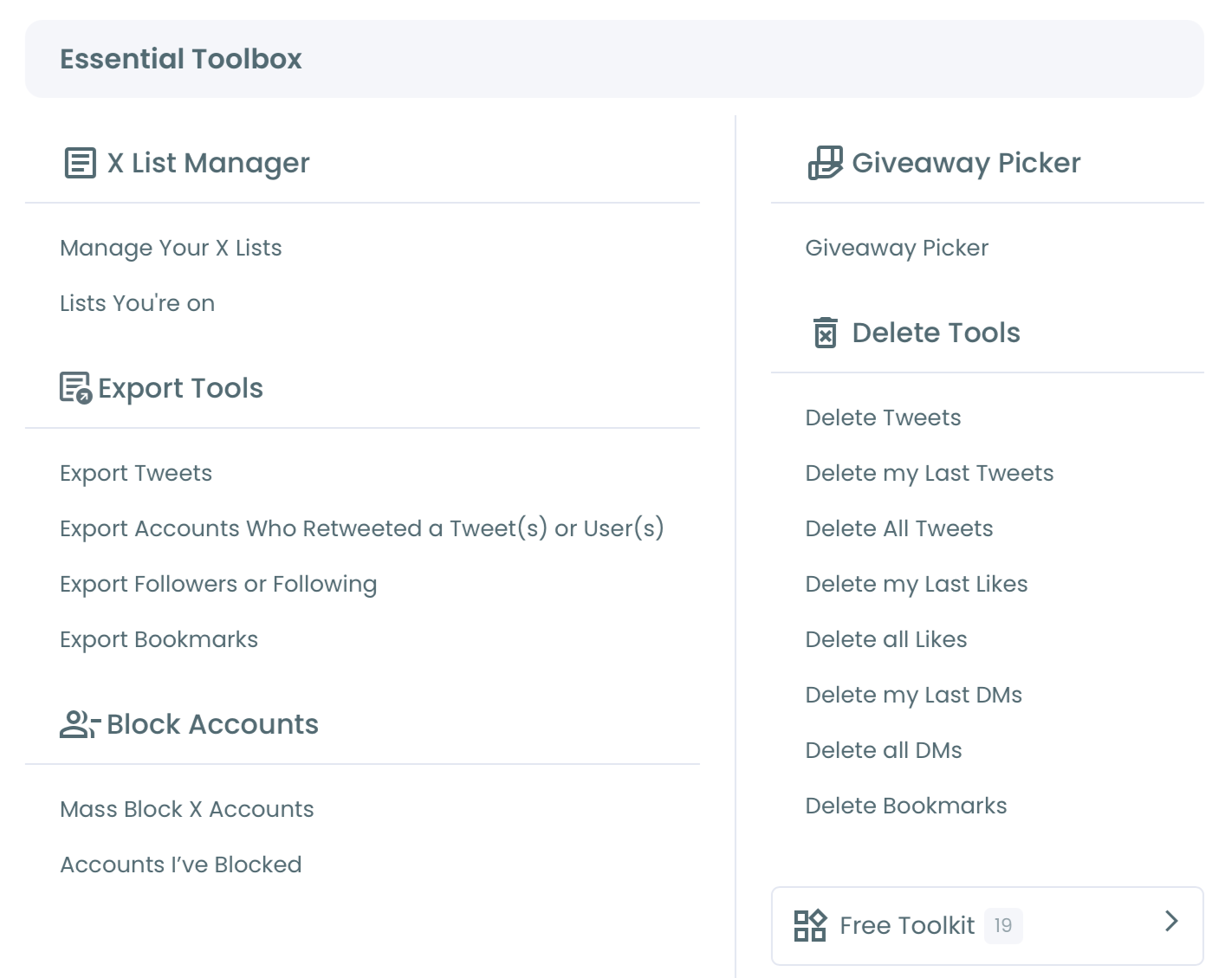
- Open the Essential Toolbox menu, then go to the Delete Likes tools inside it.
- Choose Delete My Last Likes to work from live API data, or Delete All Likes when you need to upload an archive file instead.
Narrow the list before anything gets written to disk
- Open Filter Options and set the range that matters. Scope by date, by keyword, by @username, by hashtag, by language, or by a floor under any of the six engagement columns.
- Read the row count the screen reports once the filter runs, and compare it against what you expected.
- Click Export to write the filtered rows to CSV. The button carries your remaining export balance next to the label, so you can see what a run costs you before you commit to it.
- Open the file and confirm it holds the right window before you go anywhere near Delete All or Delete Selected.
That sequence is what keeps the operation recoverable. Filtering first means the CSV holds the segment you actually care about instead of a raw dump, and exporting before deleting means the file exists while the likes still do.
Unliking through the X API is permanent, and Circleboom carries no undo for it.
Quick recap:
- Connect the X account that owns the likes.
- Open the Delete Likes tools inside Essential Toolbox.
- Filter down to the window or topic you want.
- Export the filtered rows, then open the file.
- Delete only after the CSV checks out.
Why does the export stop at 3,200 likes on X?
The 3,200 cap belongs to X, not to Circleboom.
Delete My Last Likes reaches your latest 3,200 liked posts over the official API and lays them out in a paginated table. Every row carries replies, quotes, bookmarks, retweets, likes and impressions, plus a created-at timestamp and a small external link icon.
That icon pops the original open so you can judge a borderline row before deciding.
The same ceiling shows up on the tweet side of the product, where it is documented as a platform-level constraint that applies no matter how long the account has been running. No plan changes it. No workaround extends it.
That distinction matters for who you hand an X login to.
Circleboom is an official X Enterprise Developer company. The likes it loads arrive over X's sanctioned data path, not through a script reading your logged-in session in a browser tab.
The ceiling is the same either way. The way the data leaves your account is not.
If you want to see how many rows your own account actually surfaces, check it on your Twitter likes history screen. Our walkthrough on how to download Twitter likes covers the same screen from the saving side.
Where your full likes history actually lives
X keeps the complete record and hands it over on request.
Open Settings and privacy, go to Your account, choose download an archive of your data, confirm your password, and select Request archive.
X sends an email and an in-app notification when the file is ready. Its own help page warns that preparing the archive may take a few days.
Budget for that. Request it before you need it, not on the afternoon you decided to clean house.
The download arrives as a .zip of HTML and JSON files. Inside the unzipped folder sits like.js, the likes equivalent of tweet.js, holding the posts you liked years before the API window begins.
That single file is what Circleboom's archive path consumes. Delete All Likes runs a three-step wizard, START then UPLOAD then FILTER, and it wants like.js specifically rather than the whole ZIP.
The file also has to come from the account tied to your Circleboom subscription.
Once it processes, the screen shows the total count of liked posts pulled from the file, and every one of them is pre-selected by default.
That default is the part people get burned by, which is exactly why how to delete all liked tweets walks the filter step before the delete step rather than after.
What the archive path filters on, and what it does not
The two paths do not offer the same controls, and the difference runs opposite to what most people assume.
The archive path reaches back further, but it filters on less.
Uploading like.js gives you a set of controls that covers most of what a cleanup needs:
- Post type, split across posts, reposts and replies.
- A Protect List for individual posts you want spared from the run.
- Like-count and retweet-count ranges, each with a minimum and a maximum.
- A date range where both endpoints and every day between them are included.
- Keyword search across post text, @mentions and #hashtags, plus language and media filters.
Two filter defaults that change the whole run
Two of those controls deserve a second look before you trust them.
The language dropdown carries a UND value. It stands for undefined, and it catches posts with no text at all, the ones a keyword search can never reach.
The date range is the other one. It defaults to your first and last like dates, so leaving it untouched means the run covers your entire history rather than nothing.
The live API path filters on all of that plus four more engagement signals:
- Reply count, as a minimum and maximum range.
- Quote count, same range shape.
- Bookmark count, same range shape.
- Impression count, same range shape.
So the archive gives you reach and the API gives you resolution.
Chasing a specific noisy week from three years ago? The archive is the only thing that can see it.
Trying to isolate the likes that landed on posts with real reach? The live table is the sharper instrument.
Re-uploading the same archive file is safe
You can upload the same like.js more than once across separate sessions.
Circleboom strips out anything already removed before the filters run, so a second pass with different criteria is additive rather than destructive. That makes a staged cleanup possible: one run for a bad month, a second for a hashtag, a third for everything above a like threshold.
Staging beats a single all-or-nothing sweep, which is the approach delete Twitter likes argues for as well.
Screen recording: the filter, sort and unlike sequence running on a live likes table.
How long a big unlike run takes on X
Removal is paced, not instant, and that is deliberate.
X applies rate limits to unlike calls the same way it does to follows and unfollows, so Circleboom works through the queue at a speed the platform accepts instead of firing everything at once.
A few hundred rows clear quickly. A multi-thousand-row history is a background task you start and leave running.
Two practical consequences follow from that.
The browser tab has to stay open until the operation reports finished, because closing it mid-run stops the queue. And expect the likes tab on X to catch up gradually rather than emptying in one refresh.
The pre-selection default is the other thing to hold in mind. Every row on the screen arrives already checked, on both the live path and the archive path, so Delete All means all of them unless a filter or a Protect List entry says otherwise.
Read the count on the Approve and Delete panel before you confirm. That number is the last honest checkpoint you get.
What Circleboom's other CSV exports cover
Circleboom's export section does not carry a standalone likes entry.
It carries four: tweets, followers or following, the accounts that retweeted something, and bookmarks. The likes export is not one of them, because it lives on the likes screen itself, beside the delete controls, rather than in the export section.
That is worth knowing before you go hunting for it in the wrong menu.
It also explains a difference in what you get back. A tweet export writes fifteen named columns: PostId, Name, Username, ProfileId, CreatedAt, Lang, CountBookmark, CountImpression, CountLike, CountReply, CountRetweet, CountQuote, TweetType, HasMedia and Text.
You can export X tweets to CSV for any public account, not only your own. The finished file lands in your inbox and is also stored on your Circleboom account page, so email trouble does not cost you the run.
Bookmarks are the export people usually meant
Bookmarks are the other list people confuse with likes.
X ships no native way to get bookmarks out at all. The ability to export Twitter bookmarks into a spreadsheet is filling a hole the platform never filled.
If what you actually wanted was your saved-reading list rather than your public endorsements, that is the file to pull.
Once the record is safe, open the Twitter likes cleanup screen and do the removal in one pass.
Clicking through hundreds of posts by hand is not just slow. It is the version where you lose count halfway and cannot tell what you already handled.
That failure is exactly what the best app to delete Twitter likes at once exists to remove.
How to use this
Skip the export and your X archive becomes the only copy of your like history that will exist after the unlike runs, and if you never requested one, there is no copy at all.
Do it in order and the picture inverts.
The CSV sits on your disk with the filtered window intact. The likes tab reflects what you meant it to reflect. A mistake in the filter costs you a re-read of a spreadsheet instead of a permanently lost record.
Your likes tab is public.
Anyone who visits your profile can browse it, which is why a stale like history reads as a current endorsement to whoever is forming an opinion about you.
A post you liked in a different job, a different year and a different mood still sits there presented as your position today.
That is what makes this urgent rather than housekeeping you get to someday.
The same math runs through delete or unlike all tweets or multiple tweets in seconds, where the cost of leaving old activity up is the whole argument.
Kick off the run here:
Questions about what unliking cannot undo
Can I undo an unlike if I clear too many?
No. Unliking through the X API is permanent and Circleboom has no restore path for it, which is why the CSV you exported first is the only record left of what the tab held. The original posts are unaffected either way, though their like counts drop by one as each removal goes through.
Do I need the archive if I only want my recent likes?
No. The live path loads up to your 3,200 most recent liked posts with no upload at all, and for most accounts that covers everything anyone is realistically going to scroll to. Request the archive only when you need to reach content older than that window.
Can I export the likes of an account that is not mine?
No. The likes screen works on the X account you authorized, because likes are read against your own authenticated session. Account-level exports behave differently: follower lists, following lists, retweeter lists and tweet exports all work on any public account, not only the one you logged in with.