
Why does every account search you open let you filter by location but never by language? The answer is not a missing feature. It is a fact about how X stores data, and once you know it, the route to find Twitter accounts tweeting in a language becomes obvious.
What this walkthrough gives you.The one screen in Circleboom that carries a language filter, and why it is not the account screen.The pivot that turns a filtered list of posts into a list of accounts you can act on.The checks that stop a machine-detected language label from sending you after the wrong people.
Circleboom reads live public posts on X through Enterprise-level API access and hands you the accounts behind them. Check the setup on the page for find Twitter accounts tweeting in a language.
How to find Twitter accounts tweeting in a language, step by step
Screen recording: the live keyword stream this walkthrough runs on, from search box to collected posts.
The sequence, top to bottom.
Open the search that reads post language
- Log in to Circleboom Twitter and authorize whichever profile the searches will run under.

- Go to Advanced X Search, the menu holding every discovery tool on the platform.
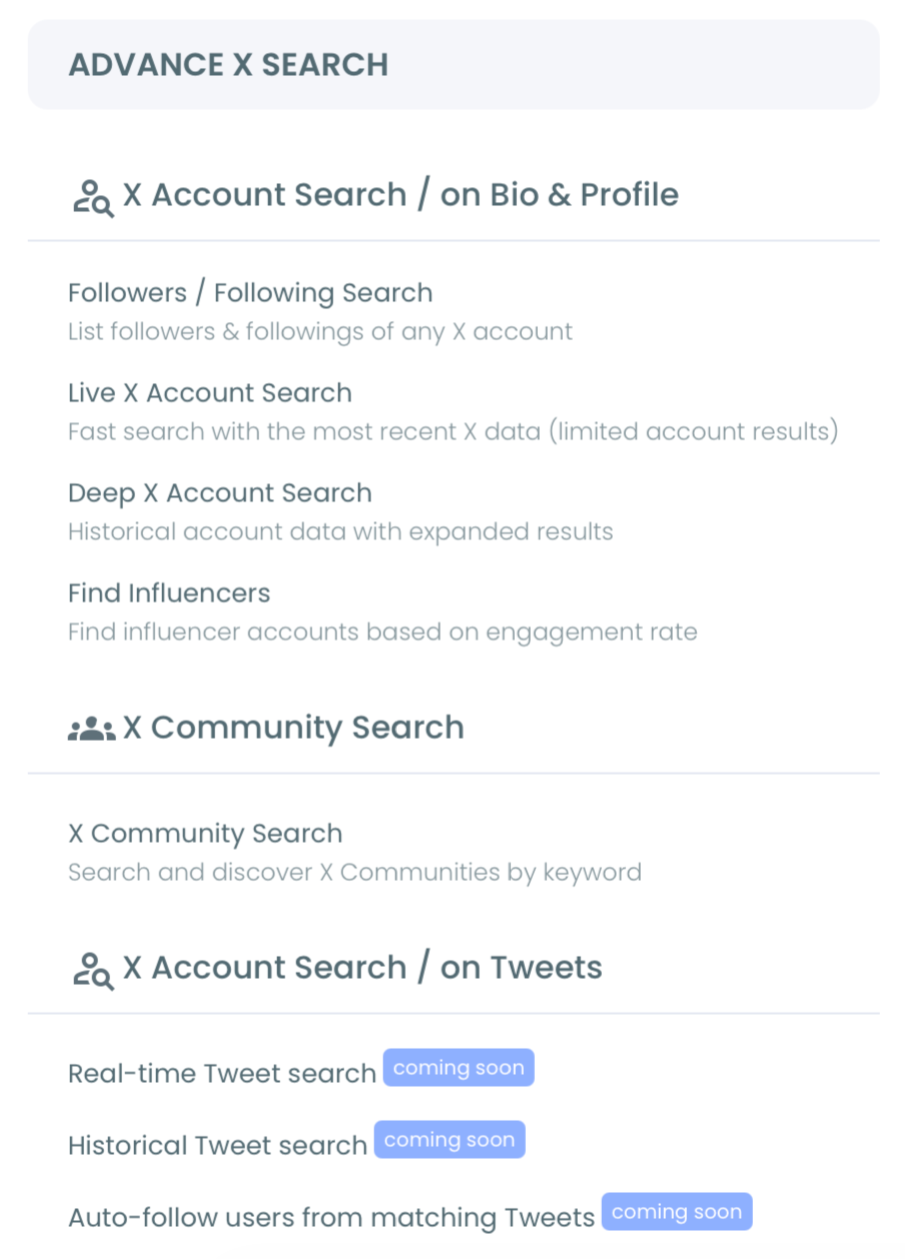
- Choose Real-time Tweet Search and describe what you are looking for in plain words. Circleboom suggests refined query variations from that description, so you do not have to write operator syntax by hand. Pick Historical Tweet Search instead when the conversation you care about already happened.
Narrow the stream, then read the accounts behind it
- Open Filters and set Language to your target. The same panel holds keyword match type, exclude terms, replies and links toggles, hashtags, cashtags, verified-only, media type, and minimum engagement counts. Every filter you add here shrinks the pool before a single account reaches your screen.
- Set a start date and a tweet count. The dropdown offers the last 24 hours, the last 7 days, the last 30 days, or a range you define yourself. Collection spends GetTweetTokens in step with the number of posts you gather, and the remaining balance sits on screen while you choose.
- Switch to the profile view. The button reads "Display Profiles of this search", and it swaps the tweet list for a deduplicated account list. From there you can follow, unfollow, add accounts to an X List, whitelist, blacklist, or export the set as CSV.
The order matters because each step removes noise the next step would otherwise inherit. The language filter runs against post text, so it belongs on the collection side, not on the review side.
By the time you reach the profile view, every account in it earned its place by writing something in your target language.
Quick recap:
- Log in and open the discovery menu.
- Start a Real-time or Historical Tweet Search.
- Set Language, keywords, and engagement minimums in Filters.
- Choose a start date and collection size.
- Pivot to the profile view and act on the accounts.
Why the account search panels have no language dropdown
X does not attach a language to a person. It attaches one to a post.
Open X's API data dictionary and the lang attribute appears on the Post object. It is described there as the language of the tweet "if detected by Twitter."
Scan the User object in the same reference and there is no language field anywhere among its two dozen entries. Bio, display name, location, follower counts, join date, verification type, all present. Language, absent.
That single design decision explains the whole product surface.
Live X Account Search and Deep X Account Search filter on account attributes. Their panels offer Follower Quality, Verification Status, Find in Bio and Name, follower and following and tweet counts, Follow Ratio, Join Date, and Filter by Location.
No language dropdown, because there is no account-level language to read.
Real-time and Historical Tweet Search filter on post attributes, so both carry Language. Posts are exactly where the label lives.
The route people expect does not exist. I lost a fair amount of time to that before the reason clicked.
The route that works starts one level down and climbs back up. If you have been trying to search Twitter accounts by language from a profile-based screen, this is why it kept failing.
Start where the data is with search Twitter accounts by language, then pivot.
What the language filter is actually matching
The lang: operator, in X's own search operators reference, matches posts classified as a specific language. Classified, by a machine, from the text of one post.
Nobody declares it. No setting on a profile controls it. A classifier reads the words in a single tweet and returns a code.
That has two consequences worth holding in your head while you work.
The first is that a language label describes one post, not a person. An account that writes in Portuguese four days a week and English on Fridays produces posts in both buckets. Filter for English and you will meet that account. Filter for Portuguese and you will meet them again.
The second is that classification needs text to work with. A post that is nothing but a link, a string of hashtags, or a single emoji gives the classifier almost nothing, and X's own wording carries the hedge in plain sight: language of the tweet, if detected.
Is a language match on X reliable enough to act on?
Yes, at the level of a shortlist, and no, at the level of a single account.
Treat one matching post as one observation.
The profile view gives you the columns that turn observations into a judgment: total tweet count, join date, follow ratio, follower and following counts, and an activity band reading Active, Moderate Active, or Inactive.
An account with 12,000 posts and an Active classification that matched your Spanish query is a far safer bet than an account with 30 posts that matched once.
Two habits close most of the gap:
- Run the same query on two start dates and keep the accounts that appear in both.
- Open a handful of profiles from the result and read their recent posts before any bulk action.
A keyword match is evidence, not a verdict. The feature documentation says so directly: accounts can match a term incidentally, ironically, or in a context unrelated to your goal, which is why review comes before bulk following or exporting.
Circleboom is an official X Enterprise Developer company. The post text the classifier read is the post text X published, not a scraped approximation of it.
The two searches that carry a language filter
Real-time Tweet Search and Historical Tweet Search both hold the Language control, and they answer different questions.
Real-time gathers posts going forward from whatever start date you set, accumulating them live as people write. Historical queries a past window that has already closed. The distinction is direction, not depth.
That matters more than it sounds when language is your filter.
A language community reacting to something today is visible only to the real-time collection, because the posts did not exist when a historical window was defined. A language community with years of accumulated writing on a subject is visible only to the historical query, because most of those accounts are quiet this week.
Most people need both, run in sequence. Historical first, to learn which terms the community actually uses. Real-time second, with those terms, to catch who is writing right now.
Open the screen where you find Twitter accounts tweeting in a language and you land on the entry point for both.
Filters that sharpen a language-scoped result
Language on its own is a wide net. Spanish is spoken across twenty countries and several continents, and a Spanish-language filter returns all of them at once.
Pair it with engagement minimums first. A minimum like count or reply count strips out the accounts that posted into a void and keeps the ones people answer. Then add exclude terms for the meanings of your keyword you did not want.
For a geographic cut on top of a linguistic one, run the language filter first. Then search Twitter by location as a separate pass. The two attributes live in different places and answer different questions.
Once the account list is clean, save it. An X List keeps the segment watchable without changing who you follow, and export writes the whole set to CSV with sixteen columns per account.
A language-scoped list now behaves like any other audience segment. The same follow-up thinking applies as when you find people who follow a certain account on Twitter.
If your goal is the posts themselves rather than the people, export tweets writes the tweet view out instead, with impressions, likes, retweets, and timestamps intact.
What happens after the list exists
A language-scoped account list is a starting position, not an outcome.
Following is rate-limited on purpose. Circleboom releases 50 follow actions per 15-minute window and stops at 400 for the day. Reach that ceiling and the queue pauses, then continues by itself the following morning.
That pacing is not a limitation to work around. It is what keeps a large follow campaign from reading as automated behavior to X.
Run 300 accounts through that queue and the operation spans about an hour and a half of processing rather than three hundred clicks. Meanwhile the list you built stays reusable, which is the part most people skip.
Keeping the segment rather than consuming it pays off a second way.
Language communities on X are small enough that the same accounts keep appearing across queries. A saved list makes that repetition visible.
Recognizing people by pattern rather than by handle is a skill worth building. It sits behind every way to find people on Twitter when you do not know their usernames.
One caution on the export. The CSV carries Location and Bio for every row, but it carries no language column, because there was never an account-level language to write into one. The language lived in the query you ran, not in the record you downloaded.
Note which language a file represents in its filename before you archive it, or a month from now you will be guessing.
Before you go
Choose the fork that matches your actual goal.
If you need people talking about a topic in a language right now, use Real-time Tweet Search with a start date inside the last week, then pivot to profiles and act while the conversation is live.
If you need coverage rather than currency, use Historical Tweet Search across a wider date range and accept that some accounts have moved on.
If you already have a seed account whose audience speaks your target language, skip keyword discovery entirely. Work from that account's follower list instead, the way a more targeted X account search does.
Whichever fork you take, the first move is the same. Open the tool that reads post language and let it hand you the people.
The mistake I still catch myself making is judging a language market by one thin result set. Widen the window before you conclude anything.
→ Kick off a Twitter account search by language
What people ask once they try it
Can I search for accounts in two languages at once?
Run one language per collection and combine the results afterward. The Language filter takes a single target per search, so two languages means two searches, and the profile views can be exported and merged in a spreadsheet.
Does a language search cost tokens even if I find nothing useful?
Collection spends GetTweetTokens against the number of posts gathered, not the number of good accounts found. Set a small tweet count for the first run of any new query, read the result, then re-run wider once the filters are tuned.
What happens to accounts whose posts X could not classify?
They fall outside your language filter entirely and never reach your result. That is worth remembering when a query returns fewer accounts than expected, because link-only and hashtag-only posters are systematically underrepresented in every language-scoped search on X.