
You know the post exists. You remember roughly what it said, roughly when it went out, and maybe who wrote it. What you cannot do is put it back on your screen, because scrolling a profile backwards and typing half-remembered words into the X search bar fail for the same reason: neither one searches the archive by content.
What this walkthrough gives you.A way to search old X posts by what they said, not by whose profile they sat on.A mapping from the fragments you still remember to the control that narrows on them.An honest list of the posts no search can return, so you stop hunting for them.
Circleboom's Historical Tweet Search queries public X posts by their wording across a date range you set, then returns both the matching posts and the accounts behind them. Start with find old tweets by what they said.
Why can't X search find your old tweet?
X search is tuned for what is happening now, not for exhaustive retrieval of everything ever posted.
The ranking favours recent and relevant results, so a three-year-old post with modest engagement sits far below the fold of anything you type, even when your wording is close to correct.
The profile scroll fails differently. A timeline is ordered by date, but it is not searchable.
There is no way to jump to a phrase inside it, so you are reduced to loading page after page and reading with your eyes.
X's own how to use advanced search on X page documents keyword, account, and date filters that help. The catch is that those filters still run against the search index you are already fighting, and they assume you can name the account.
I have spent more time than I want to admit reconstructing a post from a screenshot someone sent me, which is how I ended up building searches that start from the words instead.
That is the shift worth making. If your only tool is the profile scroll, every failed guess about who posted it costs you another evening.
Searching the right words against the wrong account
There is a third failure mode people rarely name: searching correctly against the wrong assumption.
A tidy query aimed at the wrong account returns a clean, confident, empty page, and an empty page reads like proof. Several of the 4 mistakes to avoid while performing Twitter search come back to that one habit.
Circleboom approaches the problem from the opposite direction, searching public X posts by content across a historical window and reporting the authors as a second view of the same result set.
That inversion is what lets you find an old tweet you can't locate when your memory of the author is the wrong part.
What you remember maps to a specific control
Every lost post leaves residue in your memory, and each kind of residue has a control that uses it. Most write-ups on this topic stop at "use advanced search." The useful step is translating what you actually still remember into a setting.
| What you still remember | The control that uses it |
|---|---|
| A phrase, but not the exact words | Keyword Match Type set to contains or partial |
| Roughly when it was posted | A custom date range, widened on purpose |
| It got a lot of attention | Engagement minimums on likes, retweets, or impressions |
| It had a photo or a video attached | Media Type set to images or videos |
| One word that keeps polluting results | The Exclude field |
Read that table as a checklist before you search rather than after.
A search built from two or three of those rows lands far closer than a single keyword typed hopefully into an empty box.
The row people skip is the last one.
Exclusions do more work than extra keywords, because the noise in a historical result set is usually one recurring term, not a general vagueness.
How to find an old tweet you can't locate on X
The flow runs in three moves: describe the post, narrow the window, then read the results.
Filter-by-filter run-through: how a half-remembered phrase narrows down to one original post.
https://www.youtube.com/watch?v=ZRslhxkc43Y
Describe the post in the words you still have
- Log in to Circleboom Twitter and connect your X account with official OAuth.

- Open the Advanced X Search menu and choose the historical tweet search flow.
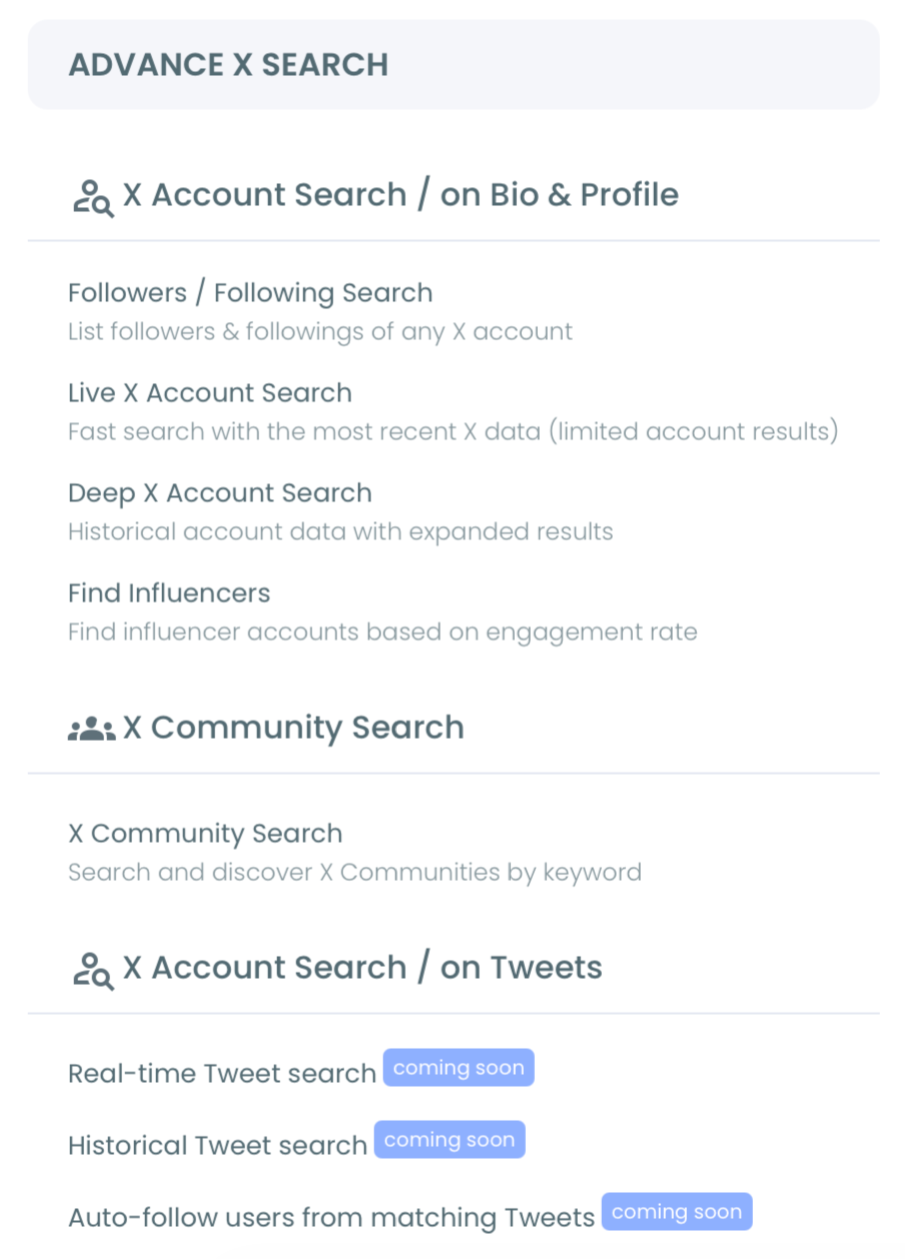
- Write the search in plain language, the way you would describe the post to a colleague. The interface accepts a natural-language request and can suggest refined variations, so you do not need to guess at operator syntax.
Narrow the window before you collect anything
- Set the date range to the window you believe the post falls in. Preset ranges cover the last 30, 60, and 90 days and the last year, and a custom range handles anything older or more specific.
- Open the filter panel and add the constraints from the table above. Every filter stacks, and the four doing most of the work are match type, exclusions, media type, and engagement minimums. An active filters bar shows what is currently applied.
Read the results and open the original
- Scan the results table and click through to the post on X. Each row carries the text preview, impression, like, retweet, quote, bookmark, and reply counts, and the creation timestamp with a relative age, plus a link icon that opens the original post.
Each move shrinks the one after it. Describing the post in plain words gives the search something to match. The date range and filters cut the collection down before any tokens are spent.
The results table then carries enough metadata for you to recognise the right post without opening ten wrong ones.
Is the search safe to run on your account?
Yes, because nothing about it touches your posting behaviour. The search reads public X data server-side rather than driving your logged-in session, so there is no automated browsing pattern for X to flag.
Circleboom uses official X (Twitter) Enterprise APIs to do it. The concrete consequence for this job is coverage. A custom window you set actually gets queried across its full span, instead of quietly returning the most recent slice of matches and calling that the answer.
Retrieval depth is exactly what that access buys. It is the difference between a search that says "not here" and a search that only checked the last few weeks.
So the honest way to search the X archive by tweet content runs against the archive itself, not against whatever a browser session can reach.
The posts no search can return
Two limits deserve to be stated plainly rather than buried.
Only publicly available posts come back, so anything from a protected account and anything already deleted is out of reach.
Historical coverage also depends on what has been indexed for the range you asked for, which means very old content and rapidly deleted posts can leave gaps.
A gap is not the same as a guarantee that nothing existed.
If a post has genuinely been removed, the follow-up question of whether you can find deleted tweets is a different one with a different answer. Knowing which of the two situations you are in saves the most time of anything in this article, because it tells you when to stop looking.
What you get back beyond the one post
Finding the post is usually not the end of the job.
The result set that produced it is often more useful than the single row you were chasing.
Because the search collects everything matching your criteria in that window, you end up with the surrounding conversation: who else said the same thing, when the topic peaked, and which of those posts drew real engagement. Anyone who has tried to search Twitter history manually knows that context is the part that never survives a profile scroll.
The results are stored under a search log and can be revisited without re-consuming tokens, which matters more than it sounds.
You can come back to the same collection a week later and read it again for free.
From the post to the account behind it
From there the profile view is one click away. The "Display Profiles of this search" control converts the matched posts into a deduplicated list of the accounts behind them, with follower counts, join dates, follow ratios, and per-row actions. If the reason you wanted the post was to reach the person who wrote it, that is where the workflow continues.
Exports are available for both views, tweets and profiles, as CSV. Export consumes tokens separately from the search itself, so check the remaining balance before pulling a large set. Teams that regularly export tweets for reporting tend to run the search once and export once rather than iterating live.
One more thing worth knowing before you interpret what comes back.
Engagement numbers reflect counts at the time of retrieval, and edited posts may return in their original or edited form depending on when they were indexed.
If the wording in the result does not match your memory exactly, an edit is a likely explanation rather than a sign you found the wrong post.
Turn what you remember into a search
Run the search before you spend another evening scrolling. The checklist below is the whole job.
- Write down the fragment you are certain about, and the one you are guessing at.
- Pick the widest date range you can tolerate rather than the narrowest you can defend.
- Add one exclusion for the term you know is polluting your results.
- Set an engagement minimum only if you remember the post doing numbers.
- Read the timestamps in the results table before opening anything.
The mistake I see most often is over-constraining on the first attempt: three keywords, a two-week window, and a verified-only toggle.
That combination returns nothing, and an empty page gets read as "the post is gone."
Start loose, then tighten.
A search that returns two hundred rows you can sort is more useful than a search that returns zero rows you can trust.
Once the workflow is familiar, the same search shape carries into competitor research and campaign retrospectives. That is where Twitter advanced search filters earn their keep well beyond a one-off rescue.
Questions that come up mid-search
How far back can the search actually go?
You choose the window. Four presets sit at 30, 60, and 90 days and one year, with a custom range for anything beyond them. How much comes back from a very old window depends on what has been indexed for that period, so treat deep history as best-effort rather than guaranteed.
Does the search cost anything if it finds nothing?
Yes. Searches consume tokens in proportion to the number of posts collected, so a broad query that collects a lot of irrelevant posts still spends balance. Narrowing with exclusions and engagement minimums before you run is the cheapest habit to build.
Can I find a post if I have no idea who wrote it?
Yes, and that is the main reason to use content search rather than a profile scroll. The search matches on what was said, then the profile view shows every unique account that said it, which is often how people rediscover posts they had attributed to the wrong person. The same approach helps when you want to find your most popular tweet without remembering the date.
What happens if my tokens run out halfway through?
The collection stops at the point the balance was exhausted, and the partial results up to that moment are still saved and accessible. You do not lose what was already collected, and you can revisit that partial set from the search log. If you are recovering your own material rather than someone else's, the separate question of how to retrieve my archived tweets covers the download path instead.