
Junk followers are the accounts that pad your follower count and give nothing back: weak follow ratios, thin posting history, no replies, no reposts. You find them by ranking your audience on ratio, then narrowing that ranked list with a second and a third signal before anything gets removed.
How do you find and remove junk followers on Twitter?
Circleboom reads your Twitter follower list through official X data and groups the weakest accounts into a Low Quality view you can narrow by follow ratio, tweet count, and engagement tier. You select what comes off, and removals run gradually with your browser open.
→ remove low quality Twitter followers
What counts as a junk follower on X?
A junk follower is a real-ish account that adds nothing to your audience. Not a bot. Not a coordinated spam ring. Just an account that follows thousands, is followed by a few dozen, posts once a month, and has never touched anything you published.
That is a wider and softer category than "bot," and the difference matters for what you do next.
A bot fails an authenticity test. A junk follower fails a usefulness test, and usefulness is a judgment you make, not a verdict a scanner hands you.
The weak signals that stack up into "junk" are ordinary ones:
- A follow ratio far below 1, meaning they follow far more accounts than follow them.
- A tweet count in the single or low double digits after years on the platform.
- An engagement classification of inactive or low engagement.
- A profile with no photo, no bio, or a location field left blank.
Any one of those on its own describes a lot of perfectly real people.
Two or three of them together is where the account starts to look like padding.
The arithmetic side of this is worth a look too. A good like-to-followers ratio on X is the same math running in the other direction, pointed at your own account instead of theirs.
Notice what the definition does not include. It says nothing about intent, nothing about whether the account is automated, and nothing about whether the person behind it exists.
Junk is a description of value returned, and value returned is measured from your side of the relationship.
That is why two people auditing the same follower list will draw the line in different places and both be right.
The junk follower list ranks strangers by how they use X, not by how they treat you
Here is the part almost nobody writing about this says out loud.
The Low Quality classification is computed from the follower's own numbers: their followers, their followings, the ratio between the two.
None of those numbers describe their relationship with you.
An account that reads every post you publish and never likes one will score exactly the same as an account that has never loaded your profile. The ratio cannot tell them apart, because the ratio was never about you.
That is why the same row can read "low quality" in one column and "Active / High Engagement" in another. The classification comes from the follow ratio signal alone; the engagement column comes from behavior.
They disagree constantly, and the disagreement is information, not a bug.
So the list is a ranking of strangers by posture, not a list of people who wronged you. The relationship-side signal has to be added by you, with a filter, before removal makes sense.
Circleboom gives you both columns in the same table on X so you can read them together instead of trusting one.
The practical consequence is that the size of the list means less than people assume. If the Low Quality view returns 40% of your audience, that is a statement about how the people who follow you use the platform.
It is not a work order for 40% of your followers.
The mirror image of this exercise is worth running first, actually. High quality followers and friends on Twitter applies the same scoring in reverse and shows who is carrying your reach, which tells you how much of your audience you can afford to touch at all.
How to find and remove junk followers on Twitter, step by step
Straight from the dashboard: the low quality follower list loading, and a selected batch going into the removal queue.
https://www.youtube.com/watch?v=3WZYewoHaW0
The flow below runs in two passes: protect what you already recognize, then narrow until the weak signals agree.
Open the low quality list and protect what you already know
- Log in to Circleboom Twitter and connect the X account you want to clean.

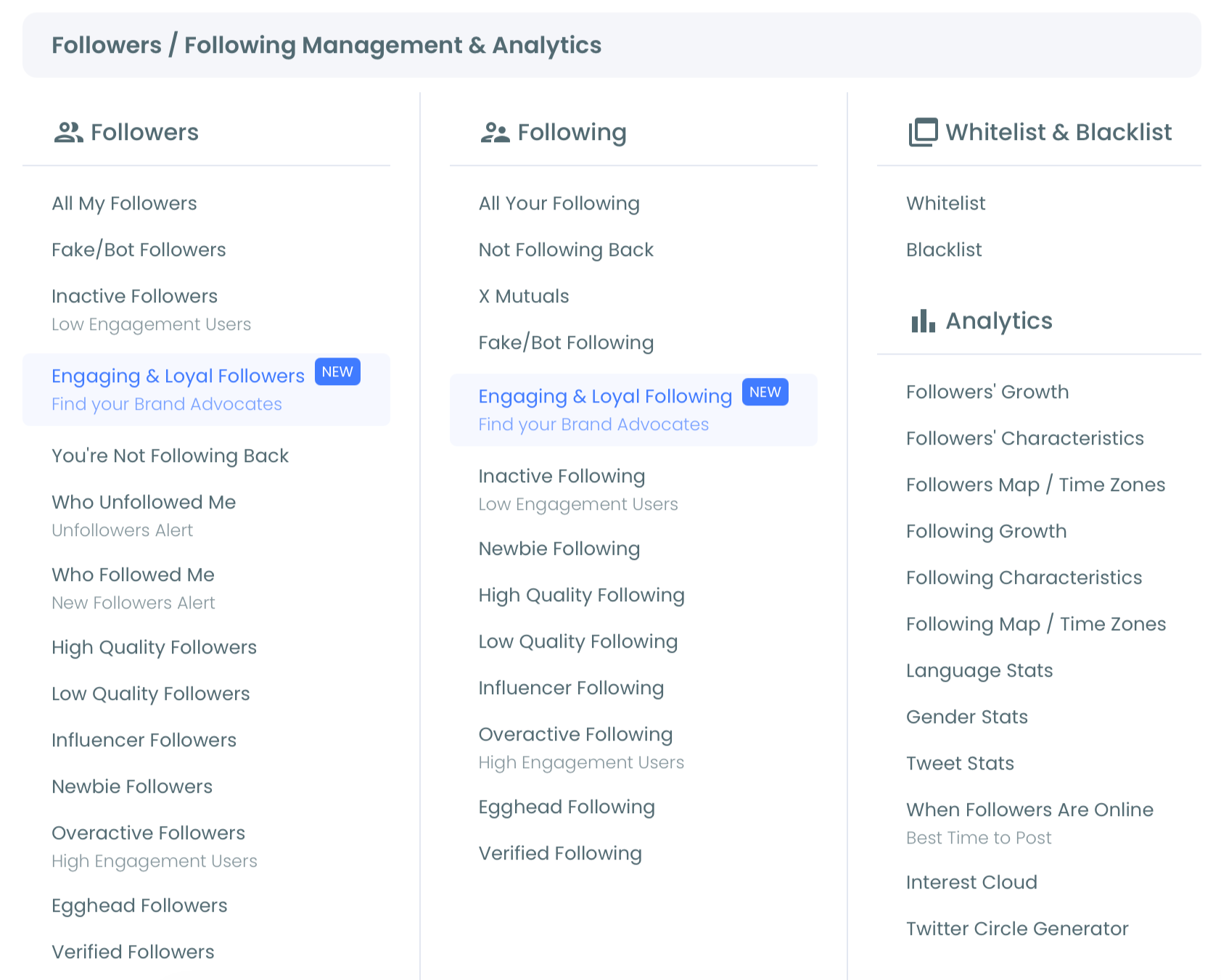
- Open the Follower & Following menu and pick the Low Quality Followers view inside it.
- Whitelist every account you recognize before touching a filter. Customers, partners, people from your niche, anyone whose name you know. Whitelist status is permanent until you remove it and it excludes that account from bulk actions everywhere in the platform, not just this view. Doing it now is cheap; doing it after a removal is impossible.
Narrow the list until three weak signals agree
- Open Filter Options and set Follow Ratio to a maximum of 0.2. The side drawer opens with every filter group in it, and the active filter bar at the top of the table shows exactly which conditions are live.
- Set Engagement to the inactive or low engagement tier, then set Tweet Count to a maximum of 20. Three conditions now apply together as AND rules: weak ratio, no engagement, almost no posting. What is left is the segment where the signals actually agree.
- Select the filtered rows and choose Remove Follower. Circleboom stages them for the Circleboom Remove Twitter/X Followers Chrome extension, which does the removal with your browser open. When the X rate limit is reached, it pauses and tells you the process will continue in N minutes; those pauses run between 1 and 20 minutes and then resume on their own.
That order is deliberate.
Whitelisting comes first because it is the only protection that has to exist before the selection does. The three filters come next because a single weak signal catches real readers. The removal comes last because it is the one action Circleboom cannot reverse for you.
Run those three in any other order and you are removing people you meant to keep.
One thing the interface will not do for you: column sorting is single-column. Clicking Follow Ratio sorts by ratio and nothing else, so you cannot sort by ratio and tweet count together. That is what the filter panel is for, and it is why the flow above filters rather than sorts.
If your goal is engagement quality rather than list hygiene, the narrower version of this filter set is described in remove Twitter followers who don't engage. Same table, tighter thresholds.
What a wrong removal actually costs you
The cost of a mistake here is not symmetric, and that should change how aggressive you get.
Remove a bot and you lose nothing. Remove a quiet real reader and you lose a reader.
Circleboom cannot restore the follow relationship afterward. X's own help page on following and followers covers the rest: a removed account is free to follow you again whenever it likes. Most never will, because nobody checks their own following list.
So the practical question is not "how many junk followers can I find." It is "how many wrong removals am I willing to eat."
A 5% error rate on 2,000 removals is 100 real people gone. On 200 removals it is 10.
The filter depth you pick is a bet on that number, whether or not you think of it that way.
Two habits keep the bet cheap.
Export the filtered segment to CSV before you stage anything. The export carries usernames, bios, join dates, and the fake, inactive, and overactive flags, so you have a record if you ever want to re-follow someone manually.
Then treat junk followers on Twitter as a segment you revisit quarterly rather than a one-time purge. A shallow pass repeated four times catches more real junk than one deep pass that also catches your customers.
Whitelisting is the other half of that discipline, and it compounds. Whitelist my Twitter followers covers how the label carries across every cleanup view once it is applied, which means the second audit is faster and safer than the first.
Where the numbers come from
Circleboom pulls follower counts, following counts, join dates, and tweet totals as an official X Enterprise Developer company. That is why the ratio you sort on reflects the account as X reports it, not a cached copy scraped weeks ago.
On a judgment call this fine, stale numbers are worse than no numbers.
An account that looked dormant in a three-week-old snapshot may have posted forty times since, and you would have removed it on the strength of a number that expired.
The same table carries the fields you would otherwise open forty profiles to read: name, tweets, join date, following count, follower count, follow ratio, and the active or inactive classification, all in one row.
A sort by ratio ascending puts the weakest accounts first before you touch a single filter, which makes it a fast way to judge whether cleanup is even worth a session.
If you would rather see all of it condensed into one number, Twitter Follower Quality runs the same signals and reports a grade for the audience as a whole.
That grade is the thing worth tracking across quarters, because it moves when your audience composition genuinely changes and stays flat when you have only shaved the edges.
When you are ready to work the segment rather than read it, list your weakest followers on X and let the filters do the narrowing.
What a careful junk-follower pass looks like
Junk followers are weak, not fake, and that is the whole reason this takes filters instead of a scan.
Rank the audience by follow ratio, protect the accounts you recognize, then add engagement tier and tweet count until three signals agree before anything comes off.
Done that way, the removal is small, reversible in spirit if not in fact, and repeatable every quarter.
Done as a one-click purge on the raw ratio list, it costs you readers you will never notice leaving.
The starting point is the same either way: list your low quality friends and followers first, decide second.
→ clear the junk followers out of your Twitter audience
Junk follower questions worth answering before you remove anyone
Does removing a junk follower stop them from following me again?
No. Removing a follower on X breaks the current relationship only. The account can follow you again at any time, and Circleboom's Mass Block is the stronger action when you need the relationship prevented rather than reset.
Can I get my followers back if I remove the wrong ones?
Not through Circleboom. Once the extension processes the queue, the removal is permanent on Circleboom's side, and the account has to choose to follow you again on its own. Export the segment to CSV first if you want a record of who was in it.
Why does an account show up as low quality and active at the same time?
Because the two columns measure different things. Low Quality comes from the follow ratio signal, while the active or inactive column reflects posting and engagement behavior. An account with a lopsided ratio can still be a genuinely busy user, which is exactly the case the ratio alone cannot catch.
Do I need a browser extension to remove followers on X?
Yes, for removals. Remove Follower and Mass Block run through Circleboom Chrome extensions because X's API does not support these operations directly, and the browser has to stay open while the queue processes.
How many junk followers should I remove in one sitting?
Fewer than the filter returns. Removals are paced against X's rate limits and pause automatically for 1 to 20 minutes when a limit is hit, so throughput is not the constraint. Your error tolerance is.